




10 Best Practices in Contract Lifecycle Management

When contract lifecycle management is overlooked in business operations, it leads to unnecessary financial losses and can reduce operational efficiencies. For Sales, Legal, and Finance teams, adhering to contract management best practices is essential.
From contract drafting and storage to speedy approval times, here are 10 key contract management standards and best practices that should be applied to any CLM process.
1. Standardized and Streamlined Contract Drafting
Standardizing a contract development process will lead to a streamlined contract drafting experience. Ensure that all contracts follow a standard format and include as much pre-approved contractual language as you can.
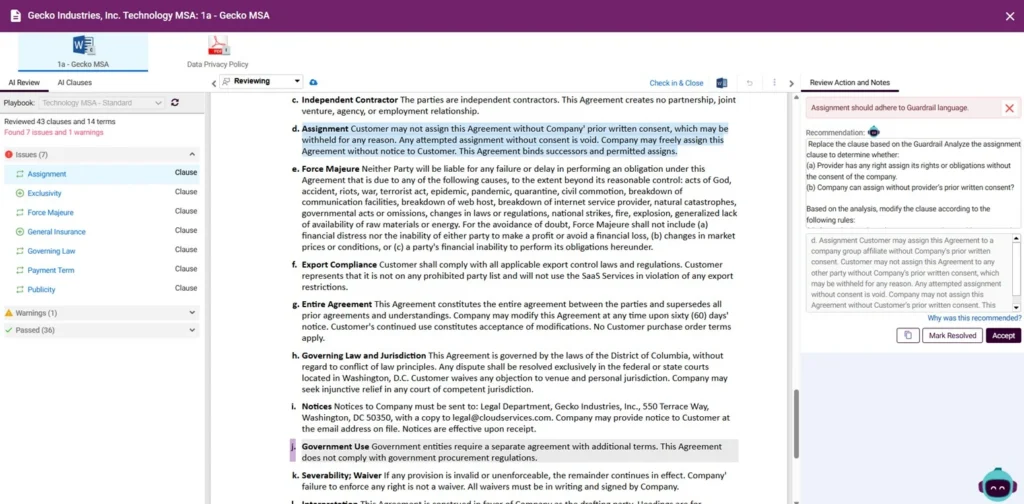
Creating a playbook of legal terms and legal language in order to “recycle” what works is a helpful idea. A standard format with consistent language reduces the time it takes to review the entire contract, focusing instead on the unique aspects of the contract with a vendor or counter-party.
2. Contract Search
A CLM solution that contains a contract search feature allows creators, users, and signing parties the ability to search for a specific term or keyword within the document. This can save precious time when looking to make updates, confirm certain clauses, or check on contract specifications. And when that search function is as easy to use as any consumer-grade search engine, your users will thank you.
3. Document Storage Security
An effective contract management process includes securing all sensitive storage documents while still keeping them accessible in a contract repository. This can be done through verification checks of user identity and by locking unauthorized users out from confidential files. A centralized document storage system with varying levels of access makes it possible for the right people to access the right information.
4. Track and Streamline Contract Approval Time
Streamlining and tracking contract approval should be a prioritized aspect of every CLM solution. The contract approval process can seemingly take forever with all of the revisions and reviews planned for each contract. The time lost during this crucial phase is amplified when time is spent locating the individuals or parties who need to sign off on each document. There is also the chance of contracts slipping through the cracks when using email or other less efficient channels to communicate.
With a contract management system guiding the process, businesses don’t get stuck waiting on approvals or miss renewal deadlines. An automated system sends out notifications of key deliverables and upcoming dates to the appropriate contract parties to avoid missed deadlines or unexpected delays.
5. Scale Contract Review Process with AI
Bring your contract management to life with artificial intelligence. From contract and clause classification to similar documents classification, you can identify similar contracts and clauses with ease to re-use pre-approved language in new contracts.
Using pattern recognition algorithms, AI can also help teams identify areas for improvement in their CLM process. Based on previous contract drafting, an AI-based CLM solution can predict when a clause may be named incorrectly. Here are some other benefits to AI-powered contract management:
- Eliminate errors by automating the contract review process
- Process third-party contracts faster while reducing the risk of error and improving contract quality
- Consistency in negotiations, often resulting in the best possible terms for the contract developer
- Simplifies the contract compliance process
- Draft better contracts faster by identifying the relationships between similar contracts
- Make better decisions by identifying the relationships between common entities hidden in contract data
6. Automate Contract Communications
Having to send emails back and forth to get contracts reviewed or approved wastes time and resources. With a cloud-based system and storage of your contracts, multiple individuals can access a document in real-time to makes changes or collaborate on inclusions or omissions. Automated reminders can also keep parties on a timeline for reviewing the documents and mitigates accidental bypassing of important approvers.
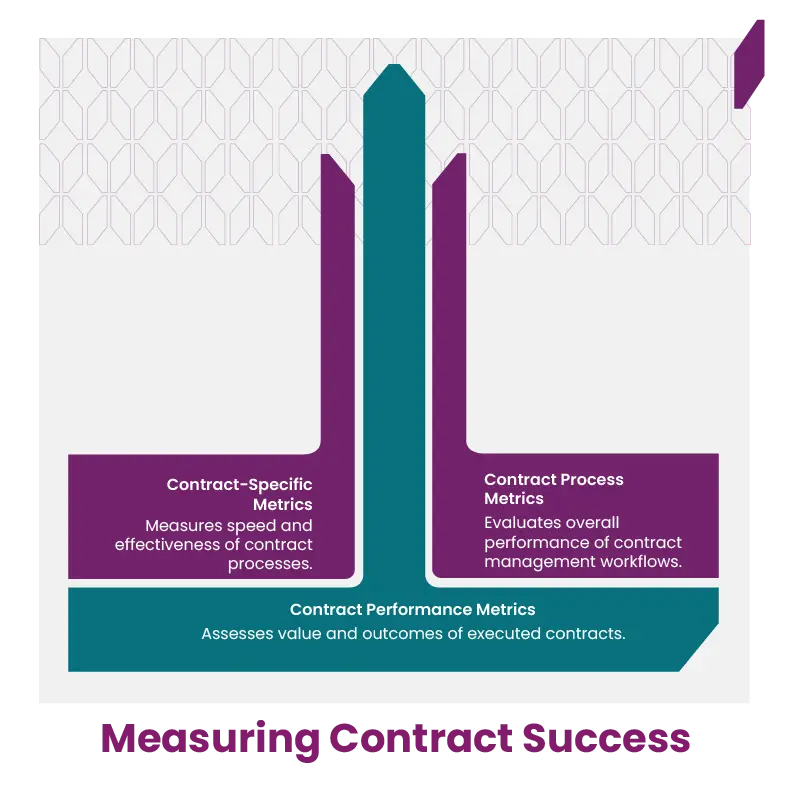
7. Set Contract Management KPIs
An effective CLM solution allows the goals of an organization to be more transparent by measuring key performance indicators (KPIs). Clear expectations give department heads something to aim for when developing their contract processes. KPIs allow teams to recognize when teams aren’t meeting these goals or expectations.
With KPIs, it is also easier to see how your contracts are performing. You should always keep track of the pricing for your most popular documents, as well as keep aware of any changes in production or sourcing that tech or the global market may bring. You are able to negotiate for a more competitive contract when you have the data behind your position.
You can read more on recommended contract management KPIs in our dedicated article here.
8. Execute Regular Compliance Reviews
What is contract compliance? It is a practice to guarantee that all signing parties follow through with their legal obligations. This contract management strategy focuses on following the regulations of an agreement and completing the obligations within the contract.
It is crucial to continuously review contract documents for compliance. For every contract, ensure the terms and conditions are compliant. Also guarantee that both parties are in compliance with any federal, state, industry, or other external regulations on a contract-by-contract basis. Failure to comply can result in serious penalties and steep fines.
In a white paper by Dr. Sara Cullen, she recounts a government department that discovered a five-year contract was only 40% compliant four years into the agreement. Work obligations of around $200,000 per year had not been executed and KPIs were not being provided or reported on as promised. Upon further investigation, the reason for this non-compliance was the client not following up on missing work or missing reports.
“The provider was grossly non-compliant with the contract but the client was grossly negligent in its governance responsibilities.” — Dr. Sara Cullen
After the government department executed their compliance audit, they decided to build out a seven-person contract management team to prevent these issues in the future. Imagine the cost savings and reputation protection that could have been captured with a more proactive approach to contract compliance.
9. Legal Protection
Contracts are legal documents, and when written with clearly spelled expectations for both parties, legal recourse is a way to ensure each party is living up to its obligations. Reaching out to the contract manager for the offending party might be helpful in warding off litigation, but consulting an attorney can help you remove yourself from the contract and receive compensation for any losses the offending party may have caused.
10. Resolve Disputes Promptly
For feedback to be effective it needs to be acted upon quickly. It should also directly address the issue or problem that has arisen. You will save time and money by taking care of problems when they are first noticed rather than waiting until a more opportune time to address them comes.

Stay On Top of Your Contracts
The contract experts at Malbek provide a CLM solution that meets contract management best practices and standards while doing so much more. Contact us or request a demo today to learn more about our contract management solutions.
FAQ – Contract Lifecycle Management Best Practices
What is contract lifecycle management (CLM) in contract management?
Contract lifecycle management (CLM) refers to managing contracts from creation and negotiation through execution, compliance monitoring, and renewal or termination, as an integrated contract management lifecycle rather than a set of isolated tasks. In mature enterprise contract management, CLM operationalizes contract creation through standard templates and pre-approved language, structured approvals, and controlled collaboration so that drafting quality and cycle time improve without weakening governance.
What are the stages of contract lifecycle management?
While terminology varies by organization, CLM commonly includes:
- Request and intake,
- authoring and drafting,
- negotiation and redlining,
- review and approval,
- execution and electronic signature,
- storage and retrieval,
- Obligation, compliance, and performance management, and
- Renewal and termination.
Importantly, these are not discrete “handoffs” but interdependent controls; weaknesses in contract creation propagate into avoidable post-signature risk.
What are contract lifecycle management best practices for standardized contract drafting?
A foundational contract lifecycle management best practice is standardized drafting: a repeatable contract development process with consistent formatting and pre-approved language.
Effective contract creation standardization typically includes:
- A uniform structure for each contract type (e.g., MSA, SOW, NDA)
- Reusable, pre-approved contractual language for common provisions
- A legal playbook to “recycle” proven terms and fallback positions
- Controlled variance rules (what may be edited, by whom, and when)
- Version control to prevent “multiple truths” during drafting
What are CLM tools?
CLM tools (contract lifecycle management tools) are the applications and system capabilities used to run CLM processes—especially standardized authoring, collaborative review, approvals, repository/search, and lifecycle reporting. In high-scale environments, CLM tools function as an enterprise contract management system by ensuring a single authoritative record and preventing uncontrolled versions across email and shared drives.
How do contract lifecycle management tools use templates and clause libraries to improve contract creation?
Contract lifecycle management tools operationalize contract creation by translating institutional knowledge into templates and clause libraries, enabling consistent drafting at scale.
Well-governed use typically involves:
- Pre-approved templates aligned to legal and compliance standards
- Clause libraries that support rapid customization without re-litigation
- Auto-population of essential clauses to reduce omission risk
- Version control to preserve negotiation integrity
- Clear linkages between the contract document and the CLM record
How can CLM tools streamline the contract approval workflow?
Streamlining approvals in contract lifecycle management depends on shifting from informal escalation to a governed workflow: approval routing is predefined, notifications reduce time spent locating approvers, and authority thresholds prevent repetitive or unnecessary re-approvals. A system-guided process is also less prone to “slipping through the cracks,” which is a material control concern in enterprise contract management.
What should a contract playbook include to support a contract management strategy?
A contract playbook supports contract management strategy by defining defensible positions and escalation logic during contract creation and negotiation. Core components generally include:
- Preferred clauses and approved “recyclable” legal terms by topic area
- Fallback options with explicit boundaries for acceptable deviation
- Escalation thresholds tied to risk, value, and business criticality
- Decision rationale to preserve consistency across matters and reviewers
How can AI improve contract review and management without weakening governance?
AI supports contract lifecycle management best practices when it reduces manual effort in data-heavy steps—such as identifying similar clauses for reuse and detecting drafting inconsistencies—while governance remains anchored in defined approval authority and reviewer accountability. This division of labor improves speed and consistency in contract management without creating uncontrolled “auto-accept” pathways for legal risk.
Which contract lifecycle management metrics best assess contract creation performance?
Contract lifecycle management metrics should measure both throughput and quality in the contract management workflow process.
Commonly defensible metrics include:
- Contract cycle time (request-to-first-draft; draft-to-approval; approval-to-signature)
- Approval time by stakeholder group and threshold level
- Deviation rate from standard clauses (by contract type)
- Rework frequency (number of revision rounds)
- Compliance exceptions detected pre-signature and post-signature
How exactly can Malbek assist in implementing contract lifecycle management best practices?
Malbek assists with contract lifecycle management best practices by translating policy (templates, playbooks, approval authority, compliance controls) into enforceable workflows inside an enterprise contract management system—especially during contract creation, where standardization and governance are most cost-effective to implement.
How Malbek operationalizes best practices during contract creation:
- Structured initiation (intake): Contract requests can be initiated from upstream systems (e.g., CRM/procurement) and routed into CLM workflows, reducing ad hoc email-based starts.
- Standardized authoring: Malbek supports authoring with standard templates and clause libraries, so contract creation begins from approved language rather than precedent hunting.
- Clause governance: A clause library functions as a centralized repository of pre-approved, standardized clauses, explicitly positioned to reduce drafting and review effort and to improve consistency.
- Collaborative contract management: The platform explicitly supports collaboration/negotiation use cases (including third-party paper and redlining), which aligns with CLM best practices for reducing roundtrips.
- Automated approvals + auditability: Approval workflows can be routed based on contract value, type, and risk, while maintaining audit trails—core requirements for controlled contract management lifecycle processes.
- In-Word drafting to improve adoption and version integrity: Malbek’s Word integration keeps authoring in Microsoft Word while adding CLM controls such as AI playbook review, automated redlining assistance, and synchronization to reduce “version chaos.”
Concrete implementation sequence:
- Map the contract management workflow process first (intake forms, approval pathways, template rules). This is consistent with procurement-oriented CLM implementation guidance: the technology automates a defined process; it does not invent one.
- Build/normalize drafting assets: contract-type templates + clause library + playbook positions (preferred/fallback), then define what constitutes an exception.
- Configure workflows: route reviews and approvals by value/type/risk; assign roles and thresholds; ensure audit trail coverage.
- Deploy authoring and collaboration tooling (notably the Word integration if Word is your drafting surface).
- Integrate execution and upstream/downstream systems (eSignature and CRM/procurement triggers are explicitly part of the CLM model described).
- Migrate contracts + train users: Malbek’s implementation framing explicitly includes configuration, migration, integrations, and training as core CLM implementation workstreams.