




Contract Intelligence 2026: How BusinessIQ’s Commercial Intelligence Platform Puts It to Work

There’s money hiding in your contracts right now. Revenue you’re not collecting. Risk you haven’t seen yet. Opportunities with expiration dates nobody’s tracking.
Most contract teams know AI can help. Many have the software. And yet the day-to-day reality is still a lot of scrolling, searching, and second-guessing — while the signals your contracts are transmitting go completely unread.
That ends here.
In this article, we’ll focus on how to actually use contract intelligence, one of several intelligence types within Malbek’s Commercial Intelligence Platform, BusinessIQ, across the workflows where it delivers the biggest impact, including review, negotiation, clause creation, obligation tracking, and strategic reporting.
What Is Contract Intelligence in 2026?
It’s changed more in the last two years than in the previous decade. And if you’ve been following along, you already know Malbek has been building toward this moment — through our CLM foundation, our recognition as a Leader in the Gartner® Magic Quadrant™, and every iteration of AI got us closer to something the market had never seen: contract intelligence reliable enough for a board presentation. A platform that doesn’t just manage contracts, but mines them.
For anyone new to the concept: contract intelligence is the practice of using AI to extract, interpret, and act on the commercial data locked inside your agreements — data that’s been sitting there, untouched, often for years. We covered the foundations in our 2024 primer — NLP, machine learning, the shift from static document management to AI-driven analysis. That’s your starting point if you need it.
What’s changed since then? Quite a lot.
The most significant shift is the move toward ensemble LLM architectures. Instead of relying on a single large language model, contract intelligence platforms now use multiple LLMs working together, cross-referencing and reconciling outputs to eliminate hallucination and probabilistic guessing. At Malbek, this is powered by LIVEGraph℠ — the core extraction technology that processes contract documents paragraph by paragraph, table by table, and exhibit by exhibit, building a fluid taxonomy of thousands of data points rather than the 50–200 fields standard tools capture. Once LIVEGraph℠ has built that foundation, Context Threading℠ pulls threads of commercial meaning across the entire portfolio, surfacing patterns, relationships, and risk clusters invisible to traditional analysis. The result isn’t just more accurate extraction — it’s board-grade reliability, the kind of intelligence a CFO can present directly to the board without verification.
Retrieval-augmented generation (RAG) has also matured. When a contract intelligence platform answers a question about, say, a price escalation cap, it first retrieves the relevant clause context before generating a response, grounding the output in your actual contract language rather than general training data.
The result is that artificial intelligence in contract lifecycle management has moved past the “interesting but unreliable” phase. Teams can now trust these tools to handle complex analysis at scale, which brings us to the practical applications.
How to Use Contract Intelligence Software for Faster Contract Review
Let’s start with the workflow that eats more legal hours than almost anything else: contract review. According to a 2026 survey of 452 in-house legal professionals, 52% of in-house legal teams are already using or evaluating AI for contract review, with active usage nearly quadrupling since 2024. That adoption is accelerating for good reason.
A 100 page long master services agreement on a counterparty’s paper used to mean hours of manual, clause by clause reading. Even experienced reviewers miss details after the fortieth page. Artificial intelligence contract review changes this equation fundamentally, not by simply replacing the reviewer, but instead, by reorganizing the work so humans focus only on what requires human judgment.
When a third party document enters the system, the AI immediately parses it, extracting key terms, identifying clause types, and mapping them against your organization’s approved language.
Within seconds, the reviewer sees a structured summary: which clauses align with policy, which deviate, and which are missing entirely. Instead of reading every word, the reviewer skips directly to flagged exceptions.
The AI automatically categorizes clauses across the agreement, making them instantly searchable and visible in relationship graphs. For teams handling high volumes (procurement departments processing hundreds of supplier agreements per quarter, for instance), this alone can cut review times in half.
Rather than manually comparing a redlined version against the original, the AI generates a concise summary of all changes, highlighting which modifications affect risk exposure and which are immaterial. A reviewer can assess a heavily negotiated document in seconds rather than hours.
Platforms like Malbek also allow legal professionals to run AI powered reviews directly inside Microsoft Word, so teams can automate routine review tasks without leaving the tool they already use. This minimizes context switching and keeps the review workflow in a single environment, which is especially useful for legal teams that live in Word throughout the negotiation process.
This matters most for teams dealing with counterparty paper, where agreements are drafted on the other side’s terms using their preferred language. These documents carry the highest review burden because every clause needs to be checked against your standards. AI handles that comparison instantly, presenting a clear view of where the incoming language aligns and where it diverges, so the reviewer’s time is spent on decisions rather than discovery.
Automating Playbook Enforcement and Intelligent Contract Risk Detection
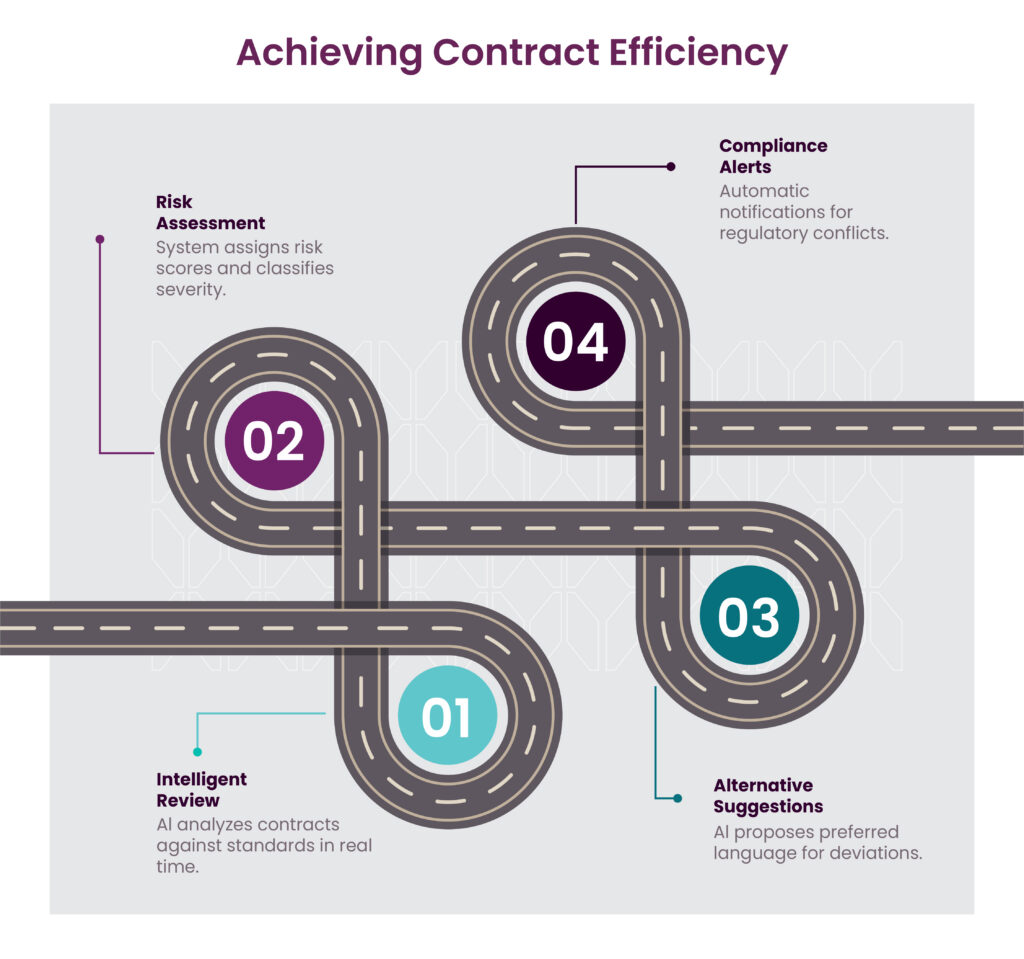
The real efficiency gains come when artificial intelligence contract review is paired with automated playbook enforcement.
- Intelligent contract solutions can autorun your organization’s playbook against every incoming agreement, comparing clause language against approved standards, fallback positions, and non-negotiable terms in real time.
- When the system detects a deviation, it doesn’t just flag it. It assigns a risk score, classifies the severity, and in many cases suggests your preferred alternative language.
- Compliance alerts fire automatically when clauses conflict with regulatory requirements or internal policies.
This is especially valuable for teams that handle third party paper frequently. Rather than relying on individual reviewers to remember every playbook rule, the AI applies the full set of guardrails consistently, across every contract, every time. Reviewers still make the final call, but they start from a position of full visibility rather than hunting for issues manually.
Artificial Intelligence Contract Analysis for Smarter Negotiations
Here’s a question every contract manager has asked at some point: Are the terms I’m agreeing to actually favorable, or am I just used to them?
Artificial intelligence contract analysis gives you a data driven answer. Instead of relying on gut instinct or institutional memory, teams can benchmark any clause against their entire agreement portfolio and against their organization’s defined policy standards.
When preparing for a supplier negotiation, AI can analyze your full contract database in seconds and surface patterns like:
- average payment terms across vendors
- which suppliers offer the most favorable indemnification language
- contracts approaching renewal that offer renegotiation opportunities
- historical pricing trends that inform your leverage
This transforms negotiation from a reactive process (where you respond to what the counterparty proposes) into a proactive strategy grounded in data. You walk into the room knowing exactly where you stand, what’s standard across your portfolio, and where you have room to push.
Portfolio analysis also reveals patterns that individual contract reviews cannot. You might discover that a particular vendor consistently negotiates away liability caps, or that your average payment terms have drifted from 30 to 45 days over the past two years without anyone making a deliberate decision to allow it.
Clause Assessments, Favorability Scoring, and Artificial Intelligence Contract Clauses
AI can evaluate whether specific artificial intelligence contract clauses favor your organization, the counterparty, or represent a balanced position. This favorability scoring works by comparing clause language against your playbook standards and flagging terms that fall outside acceptable ranges.
When the system identifies an unfavorable clause, it recommends specific revisions aligned with your organizational policy, pulling from your approved clause library to suggest alternative language. This gives negotiators concrete, preapproved options rather than leaving them to draft alternatives from scratch under time pressure.
Legal teams spend less time debating whether a clause is acceptable and more time making strategic decisions about which concessions to make and which to hold firm on. Negotiations move faster, and the outcomes are better documented and more consistent across the organization.
Intelligent Contracting: AI Assisted Clause Creation and Authoring
Drafting new contracts and clauses has traditionally been one of the most time intensive parts of the lifecycle. Even with template libraries in place, teams often spend significant effort customizing language, ensuring consistency, and translating complex legal concepts into terms that business stakeholders can understand.
Intelligent contracting tools address this from multiple angles. AI powered templates go beyond simple forms. They dynamically adjust clause language based on the contract type, counterparty profile, and applicable jurisdiction. An authoring assistant can regenerate alternative clause language on demand, transforming dense legalese into clearer, more accessible wording without changing the legal meaning.
For teams producing high volumes of similar agreements (sales contracts, NDAs, procurement terms), this is transformative, because the AI generates a solid first draft from the approved language library in seconds. The human reviewer then refines, adjusts, and approves rather than building from scratch every time.
Custom AI model training adds another layer: Organizations can train the system on their own documents and preferred language, so the AI learns which clause formulations the legal team favors, which terms are non-negotiable, and which areas allow flexibility. Over time, the authoring assistant becomes increasingly tuned to your organization’s specific standards, reducing revision cycles and maintaining consistency at scale.
The result is an intelligent contract drafting process where AI handles the repetitive groundwork and human expertise is reserved for judgment calls, exactly where it adds the most value.
Some platforms take this even further with conversational AI assistants. Malbek’s Bek, for example, acts as a legal copilot that guides contracting workflows through typed prompts or voice commands. Rather than clicking through menus to find the right template or clause, users simply tell the assistant what they need, and it handles the retrieval and drafting steps. This kind of accessibility makes contract authoring practical for non-legal stakeholders who need to initiate agreements without deep knowledge of clause libraries.
It’s also worth noting that this capability is particularly impactful for organizations scaling quickly. When contract volume doubles, you rarely get to double the legal team. Authoring assisted by AI absorbs the increased workload without proportional headcount growth, keeping quality consistent even as demand spikes.
Business Intelligence: Turning Contract Data Into Strategic Insight
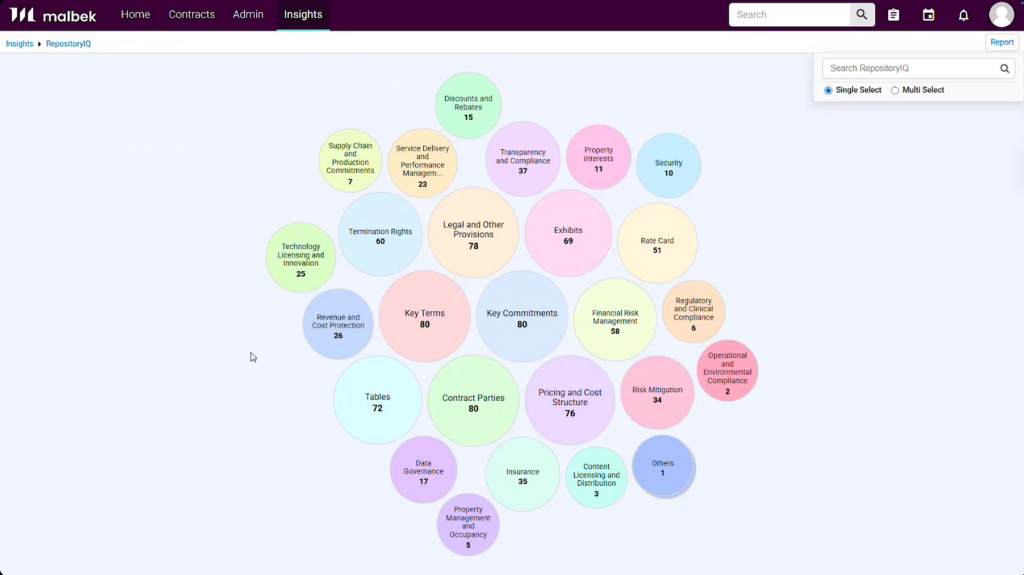
Most organizations sit on a goldmine of contract data and barely scratch the surface. This is the foundation of Business Intelligence — one of the core intelligence types BusinessIQ surfaces from your contract repository, feeding structured, reliable data directly into your existing BI tools and executive reporting. Thousands of agreements containing pricing terms, obligation schedules, performance benchmarks, and risk allocations, all locked in PDFs and filing systems where they do nothing.
Contract business intelligence changes this. Through smart tagging and metadata enrichment, AI powered systems automatically categorize and index every agreement in your contract repository. Each contract is tagged with key attributes (type, value, status, counterparty, jurisdiction, renewal date), making the entire portfolio searchable and analyzable at scale.
This structured data feeds into analytics that surface patterns invisible to manual review: which contract types carry the highest risk concentration, where your most favorable terms cluster, which vendors consistently push for non-standard language, and how cycle times vary across departments or agreement types.
For executive teams, this is the difference between anecdotal reporting (“we think our average cycle time is improving”) and data backed answers with specific numbers and trends.
When contract data is structured and accessible, it becomes a shared resource across departments.
- Sales can check contracted pricing before making commitments.
- Procurement can verify whether a supplier’s proposed rates align with existing agreements.
- Finance can tie revenue forecasts directly to contractual terms rather than estimates.
Taken together, these signals don’t just improve day-to-day operations — they feed into the commercial intelligence your CFO, CPO, and executive team need to answer the questions that matter most: Where is our revenue exposure concentrated? What’s our supplier risk? What opportunities are we leaving on the table? That’s the destination contract data has always been pointing toward. BusinessIQ is what gets you there.
Platforms that support master data storage, like Malbek, take this further by capturing supplier and counterparty details that plug directly into existing ERP or supplier management systems. This creates a single source of truth that ensures data accuracy and consistency between old and new contracts, saving significant time during contract requests.
Contract Intelligence Tools for Procurement and Finance Teams
Procurement and finance leaders often have the most to gain from contract intelligence tools for procurement, and the least time to dig through individual agreements to find what they need.
For procurement teams:
- AI driven analytics enable real time spend tracking against contracted rates
- Identification of maverick spending that deviates from negotiated terms
- Vendor performance monitoring tied to specific contractual SLAs
- Automatic alerts when supplier agreements approach renewal windows
Finance teams benefit from equally concrete applications:
- Revenue recognition becomes more reliable when AI extracts delivery schedules, acceptance criteria, and termination rights from agreements and feeds structured data directly into financial systems.
- Forecasting improves because obligation data (payment milestones, escalation triggers, penalty clauses) is captured automatically rather than tracked in disconnected spreadsheets.
How Do I Use Contract Intelligence Software for Obligation and Milestone Tracking?
Signing the contract is only the beginning. The real exposure (missed renewals, overlooked obligations, blown deadlines) lives in the post-signature phase. And this is precisely where most teams lose visibility.
How do you use contract intelligence software to solve this? The answer lies in automated tracking and proactive alerting. Once an agreement is executed, the AI extracts every date driven commitment: renewal windows, payment milestones, deliverable deadlines, compliance checkpoints, and termination notice periods. These are converted into structured tasks assigned to the appropriate stakeholders.
Rather than relying on calendar reminders or manual tracking spreadsheets, the system generates contextual “To Do” lists tied to specific clauses. Each task includes the relevant contract language, the deadline, and the responsible party, so there’s no ambiguity about what needs to happen or when.
This is also where configurable integrations prove their worth. When your contract intelligence software connects directly to ERP, CRM, and financial systems, obligation data doesn’t live in isolation. Payment milestones sync with accounts payable, delivery deadlines feed into project management tools, and renewal dates trigger procurement workflows, all without manual data entry or the risk of information falling between systems.
Solutions built with integration as a core design principle (Malbek, for instance, offers a configurable integration wizard rather than requiring custom code) make this connectivity practical even for teams without dedicated IT resources. In BusinessIQ’s intelligence framework, this is what’s known as Obligation & Risk Intelligence — converting post-signature commitments into trackable, owned milestones with direct ties to revenue impact and compliance exposure, and feeding that visibility into the broader commercial picture your leadership team depends on.
Approver Guidance and AI Driven Workflow Automation
Obligation tracking becomes even more effective when paired with intelligent approval workflows. AI provides contextual insights at each approval stage, pinpointing the specific clauses that need attention and presenting approvers with clear, prioritized action items.
This keeps approval timelines on track without constant manual followup. Stakeholders receive notifications tied directly to the clauses they need to review, not generic “please approve” requests, but specific guidance on what changed, what the risk implications are, and what action is recommended. The result is faster decisions, fewer bottlenecks, and better alignment across everyone involved in the contracting process.
Getting Started With Artificial Intelligence Driven Contract Management Software
If you’re considering artificial intelligence driven contract management software for the first time, or looking to get more from a platform you already have, the path forward doesn’t need to be complicated.
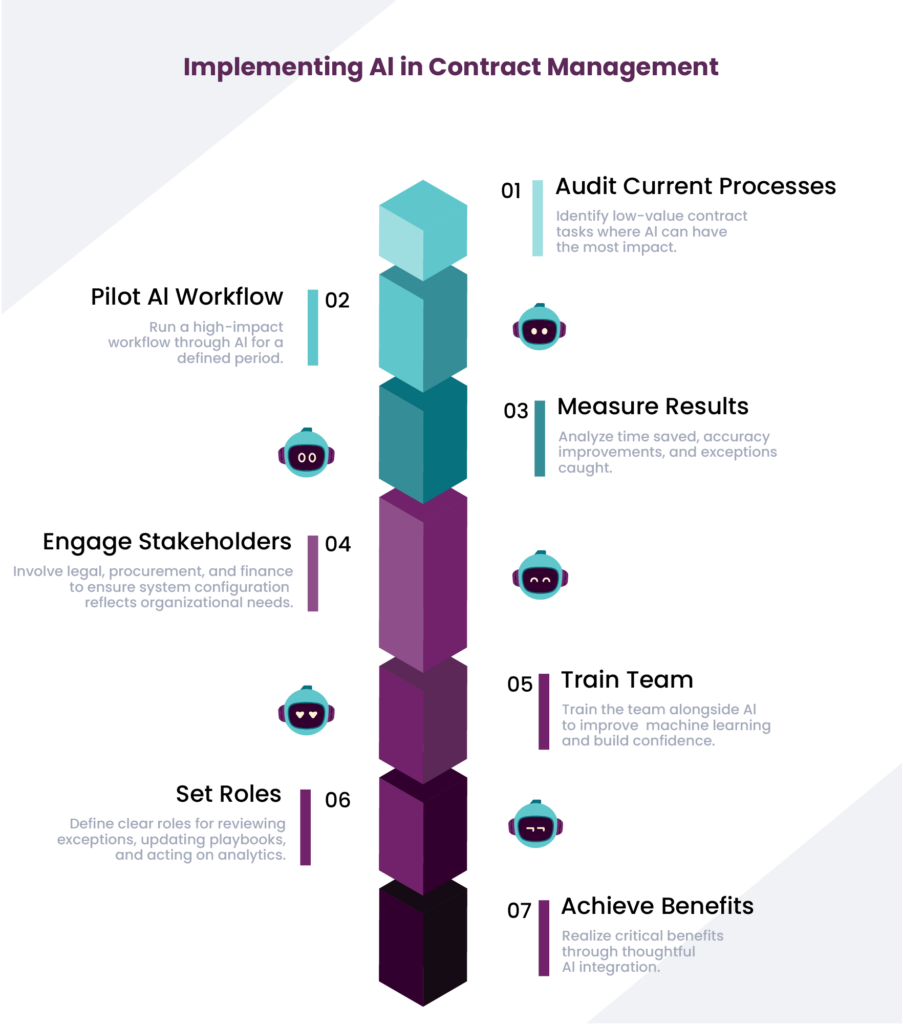
Start with an honest audit of where your team spends the most time on low value contract tasks. Is it an initial review? Clause drafting? Chasing approvals? Tracking renewals? The answers tell you where to pilot first.
Pick one high impact workflow and run it through the AI for a defined period. Measure the results (time saved, accuracy improvements, exceptions caught) and use those numbers to build the case for broader adoption. Engage stakeholders from legal, procurement, and finance early, so the system configuration reflects how your organization actually works, not just how one department operates.
Train your team alongside the AI. As people validate and correct the system’s outputs, the machine learning improves, and so does the team’s confidence in using it. Set clear roles for who reviews AI flagged exceptions, who updates playbooks based on new insights, and who acts on the analytics.
Intelligent contract management shouldn’t be a replacement for expertise. It’s much more of an amplifier! According to a Thomson Reuters and Georgetown Law report on the state of the legal market*, organizations with a formal AI strategy are 3.9 times more likely to realize critical benefits than those without one. The organizations getting the most from these contract intelligence solutions in 2026 are the ones treating AI as a working partner, not a magic button, but a tool that gets sharper the more thoughtfully you use it.
The right platform makes all the difference: Malbek BusinessIQ was built for this from day one — not as an afterthought bolted onto legacy contract management, but as a Commercial Intelligence Platform with contract intelligence at its core. Powered by LIVEGraph℠, Context Threading℠, and Ensemble LLM, BusinessIQ points to your contracts wherever they live — no migration required — and starts building your Intelligence Core immediately. Most customers see meaningful commercial discoveries in their first session. If you’re ready to see what contract intelligence looks like when it’s part of a platform built for board-grade answers, request a demo and find out what’s hiding in your contracts right now.
If you’re ready to see what contract intelligence looks like when it’s fully embedded in the workflow, request a demo and explore how Malbek can help your team work smarter across every stage of the contract lifecycle.
*Source: https://www.thomsonreuters.com/en-us/posts/legal/state-of-the-us-legal-market-2026/