




Partnership Agreement: Guide to Partnership Contract Types in a CLM

You have found the right business partner. The vision aligns, the skills complement each other, and the opportunity looks promising. Now comes the part that many entrepreneurs and business leaders would rather skip: putting everything in writing.
It is tempting to move forward on a handshake, especially when trust runs high, and everyone is eager to get started. But experienced contract managers know better. The partnership agreement you draft today determines how smoothly things run tomorrow, and more importantly, how disputes get resolved when partners inevitably see things differently.
This guide walks through everything you need to know about partnership agreements, from choosing the right structure to ensuring your contracts include the provisions that actually matter. We will also explore how Contract Lifecycle Management solutions can take the complexity out of creating, negotiating, and managing these critical documents.
What Is a Partnership Agreement?
A partnership agreement is a legally binding document that defines the terms and conditions governing a business relationship between two or more parties. The agreement establishes each partner’s rights, responsibilities, and obligations while outlining how the partnership will operate daily and over the long term.
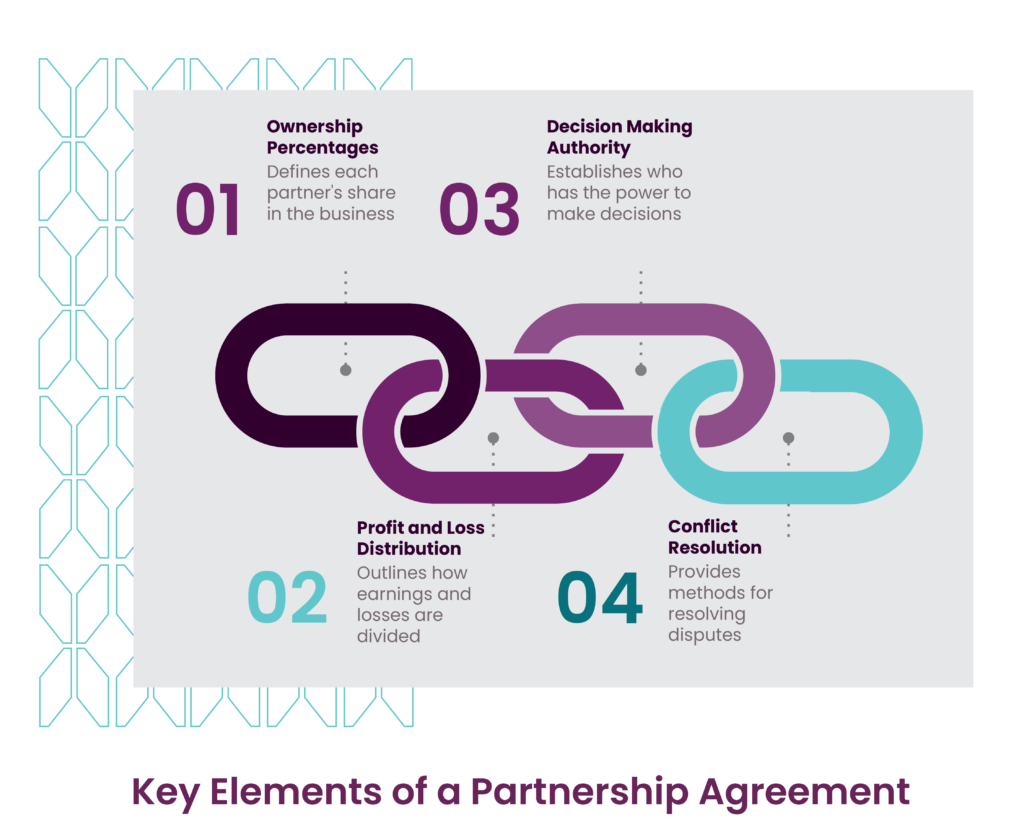
Unlike informal business arrangements, a formal partnership agreement creates enforceable obligations that courts will recognise and uphold. The document serves multiple purposes:
- Clarifies ownership percentages
- Determines how profits and losses will be distributed
- Establishes decision-making authority
- Provides mechanisms for resolving conflicts.
Partnership agreements differ from other commercial contracts in several important ways. While a standard vendor agreement might govern a single transaction or limited engagement, a partnership agreement contemplates an ongoing relationship where parties share both risks and rewards. The partners become jointly invested in outcomes, which requires more comprehensive documentation of their respective contributions, expectations, and exit rights.
Without a written partnership agreement, parties may find themselves subject to default state laws that do not reflect their actual intentions or business needs.
Why Legal Partnership Agreements Matter for Business Success
According to research by Jonathan Hughes and Jeff Weiss in Harvard Business Review, business partnerships fail at a rate of roughly 70%. When partners rely on verbal understandings or assumptions about their arrangement, disagreements become far more difficult and expensive to resolve.
What seemed like a minor detail at the outset can escalate into litigation when significant money is at stake. The financial impact is substantial: according to ACC/Everlaw 2024 data*, roughly 39% of companies with revenues under $100 million spend up to $50,000 per litigation matter, while about 33% of companies exceeding $1 billion in revenue spend more than $200,000 per matter*. These figures represent direct costs alone, before accounting for management distraction, damaged relationships, and operational disruption.
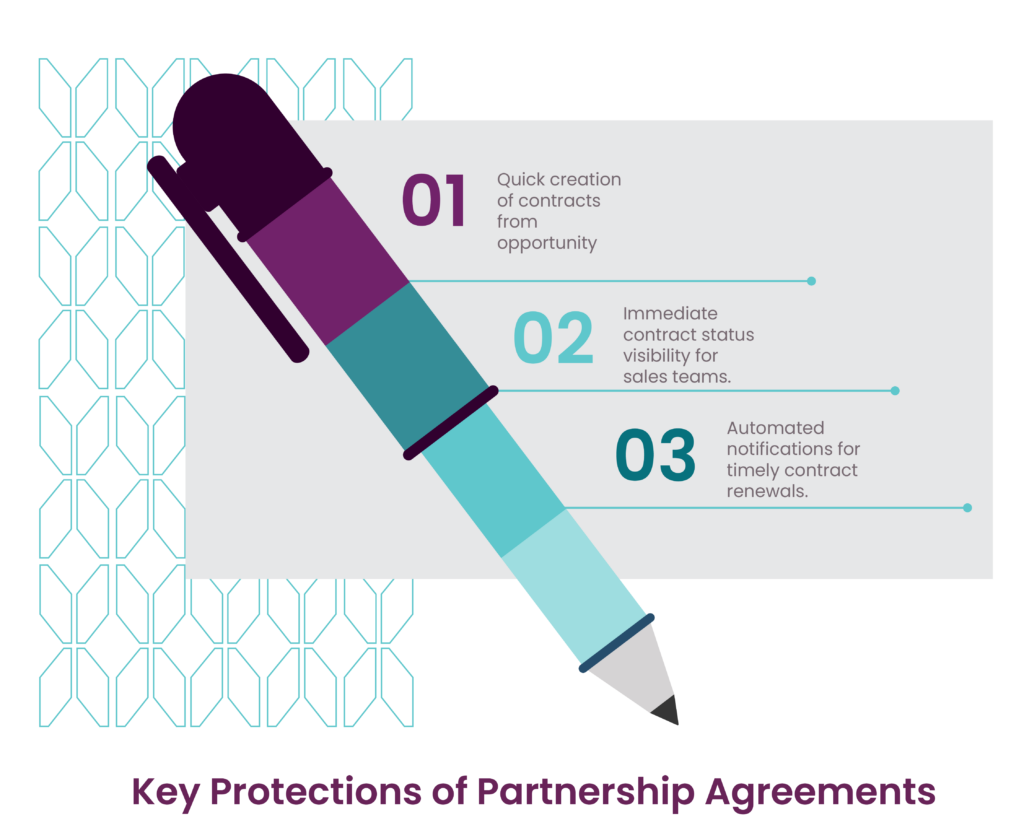
A comprehensive partnership agreement provides several critical protections:
- It establishes clear expectations from the beginning of the relationship. When partners understand their specific roles, responsibilities, and rights, they are less likely to encounter conflicts that could damage both the business and their professional relationship.
- The agreement creates a binding contract that courts can enforce. If one partner fails to fulfil their obligations or acts against the partnership’s interests, the other partners have legal recourse based on the documented terms.
- Partnership agreements address scenarios that partners might prefer not to contemplate when launching a new venture. What happens if a partner becomes incapacitated? How will the partnership handle a buyout request? What triggers dissolution? Planning for these contingencies protects the business and all parties involved.
The legal protection extends to liability allocation, profit distribution disputes, and succession planning.
Types of Partnership Contracts and When to Use Each
Partnership law recognizes several distinct structures, each with different implications for liability, control, and taxation. The type of partnership you select will determine what specific terms and conditions your agreement must address.
General Partnership Agreement and General Partnership Contract
Under a general partnership agreement, all partners share equal responsibility for the business and assume personal liability for its debts and obligations. Each partner can typically bind the partnership to contracts and financial commitments, which means every partner bears risk for the actions of the others.
The general partnership contract does not create a separate legal entity from the partners themselves. This structure offers simplicity and flexibility but comes with significant exposure. If the partnership incurs debts it cannot pay, creditors may pursue the personal assets of any general partner.
General partnerships work well for smaller ventures where partners trust each other completely and prefer minimal administrative requirements. Professional practices such as law firms, medical offices, and accounting groups have traditionally used this structure, though many have since transitioned to limited liability forms.
The appeal of a general partnership contract lies in its ease of formation. Partners can establish the arrangement without state registration in most cases, though a written agreement remains essential for protecting everyone’s interests.
Limited Partnership Agreement
A limited partnership agreement establishes a more complex structure involving two categories of partners:
- General partners manage the business operations and assume unlimited personal liability for partnership obligations.
- Limited partners contribute capital but take no active role in management decisions.
The critical distinction in a limited partnership agreement concerns liability protection. Limited partners risk only the amount of their investment. Their personal assets remain shielded from partnership debts and legal claims, provided they do not participate in managing the business.
This structure appeals to investors who want financial exposure to a venture without operational involvement. Real estate projects, investment funds, and entertainment productions frequently use limited partnerships because they allow entrepreneurs to attract capital while maintaining control over business decisions.
The limited partnership agreement must clearly define which partners fall into each category and what activities would cause a limited partner to lose their protected status. These provisions require careful drafting to ensure the intended liability protections remain intact.
Limited Liability Partnership Agreement
A limited liability partnership offers protection to all partners regardless of their management role. Under this structure, partners participate in running the business while enjoying liability shields similar to those of corporate shareholders.
The limited liability partnership agreement protects individual partners from personal responsibility for the negligence or misconduct of other partners. This feature makes the structure particularly attractive for professional service firms where one partner’s malpractice should not expose colleagues to personal financial ruin.
Limited liability partnerships require formal state registration and ongoing compliance with regulatory requirements. The administrative burden exceeds that of general partnerships, and not all states permit this structure for every type of business.
Despite these requirements, the liability protection justifies the additional complexity for many organizations. Partners can share management responsibilities and business profits while maintaining separation between their professional activities and personal assets.
Key Components of a Business Partnership Agreement
Every business partnership agreement should address certain fundamental elements regardless of the partnership type selected. Omitting any of these components creates ambiguity that may lead to disputes.
- Partnership details and purpose. The agreement should state the partnership’s legal name, business address, and primary activities. Including a clear description of the partnership’s purpose helps ensure all partners share the same understanding of what the business will do.
- Capital contributions. Each partner’s initial investment must be documented, whether that contribution takes the form of cash, property, intellectual property, or professional expertise. The agreement should specify how contributions will be valued and credited to each partner’s capital account.
- Ownership percentages. The allocation of ownership interests determines profit sharing, voting power, and distribution rights. These percentages may or may not correspond directly to capital contributions, depending on what the partners negotiate.
- Profit and loss distribution. Partners must agree on how the business will allocate gains and losses. Some partnerships distribute according to ownership percentages, while others use different formulas based on partner roles or other factors.
- Decision-making authority. The agreement should specify who can make various types of decisions and what voting thresholds apply. Major decisions might require unanimous consent, while routine matters could proceed with majority approval.
- Partner duties and restrictions. Defining each partner’s responsibilities prevents confusion and establishes accountability. The agreement may also impose restrictions such as noncompete obligations or limits on outside business activities.
- Dispute resolution procedures. Including provisions for mediation or arbitration can help partners resolve disagreements without resorting to expensive litigation.
Using a Business Partnership Agreement Template Effectively
A business partnership agreement template can provide a useful starting point for drafting, but templates require careful evaluation and substantial customization. No generic document will address the specific circumstances of every partnership. Understanding how to write a partnership agreement starts with recognising that templates are a starting point, not a destination.
When reviewing a sample partnership agreement, assess whether it covers all the essential components discussed earlier. Many templates omit important provisions or include language that may not align with your jurisdiction’s requirements. A template designed for one state may include terms that are unenforceable elsewhere.
The most valuable templates come from reputable legal sources and include explanatory notes that help users understand each provision’s purpose. Avoid templates that seem overly brief or fail to address contingencies such as partner withdrawal and dispute resolution.
Treat any partnership agreement template as raw material rather than a finished product. Customise the language to reflect your specific arrangement, add provisions that address your unique circumstances, and delete terms that do not apply. Most importantly, have qualified legal counsel review the customised document before any partner signs.
Partnership Dissolution Agreement: Planning for Change
A partnership may end at some point, whether through mutual agreement, partner departure, or other circumstances. A partnership dissolution agreement establishes the procedures for winding down operations and distributing assets when that time comes.
Addressing dissolution terms at the outset may seem premature, but the alternative creates significant risk. Partners who must negotiate exit terms during an actual dissolution often find themselves in adversarial positions. Emotions run high, and the cooperative spirit that characterised the partnership’s formation may have long since evaporated.
The dissolution provisions should specify what events trigger dissolution, such as unanimous partner consent, bankruptcy, or the death of a key partner. The agreement should outline procedures for liquidating assets, satisfying creditors, and distributing remaining value to partners according to their ownership interests.
Partner withdrawal short of full dissolution also requires attention. When one partner wants to exit while others wish to continue the business, the agreement should provide mechanisms for valuing and purchasing the departing partner’s interest. Buyout formulas, payment terms, and restrictions on selling to outside parties all deserve careful consideration.
Planning for these transitions protects both departing partners and those who remain.
State-Specific Requirements: Partnership Agreement California and Beyond
Partnership law varies significantly across jurisdictions, and understanding these differences matters for enforceability. What works in one state may prove inadequate or even invalid in another.
California, for example, follows the Revised Uniform Partnership Act, which establishes default rules governing partnerships that lack written agreements on specific issues. A partnership agreement California teams create should explicitly address any areas where the partners wish to deviate from these statutory defaults. Otherwise, the state’s rules will fill any gaps, potentially in ways the partners never intended.
Other US states have adopted their own versions of partnership statutes, sometimes with significant variations. Registration requirements, liability protections, and dissolution procedures can all differ depending on where the partnership operates or is formed.
Partnerships conducting business across multiple states face additional complexity. The agreement should specify which state’s laws govern the partnership and consider how that choice affects enforceability in other jurisdictions where the partnership has operations.
Consulting legal counsel familiar with the relevant state laws ensures your agreement addresses jurisdiction-specific requirements.
Managing Partnership Agreements with Contract Lifecycle Management
Contract management teams handling partnership agreements face distinct challenges. These documents require careful drafting, extended negotiation cycles, ongoing compliance monitoring, and eventual renewal or termination. Traditional approaches relying on email chains, shared drives, and manual tracking create inefficiencies and increase risk.
Contract Lifecycle Management platforms address these challenges through centralised document management, automated workflows, and intelligent analysis capabilities. For legal and procurement teams managing multiple partnership relationships, CLM solutions provide visibility and control that spreadsheets and file folders cannot match.
The benefits extend across the entire agreement lifecycle. During drafting, CLM platforms ensure teams work from approved templates and the current language. During negotiation, collaboration tools track changes and maintain version control. After execution, the system monitors obligations, deadlines, and renewal dates.
Organizations managing complex partner ecosystems gain particular value from CLM implementation. When partnership terms inform revenue recognition, procurement decisions, or risk exposure calculations, accurate and accessible contract data becomes essential.
Centralizing Partnership Contract Creation and Templates
CLM solutions, like Malbek, enable teams to build, store, and deploy standardized partnership agreement templates while maintaining flexibility for transaction specific customization. Rather than starting each agreement from scratch or hunting through email archives for previous versions, contract professionals access approved templates directly from the platform.
A well-designed partnership operating agreement template library includes options for different partnership types, jurisdictions, and business units. Clause libraries provide pre-approved language for common provisions, reducing drafting time while ensuring consistency with organizational standards.
The centralised approach also supports governance requirements. Legal leadership can control which templates and clauses are available, ensuring that all partnership contracts reflect current legal requirements and business policies. When regulations change or litigation outcomes prompt revised language, updates propagate across the template library.
Malbek’s AI-powered template capabilities take this foundation further, enabling teams to generate initial drafts and customise provisions based on deal parameters.
Accelerating Review, Negotiation, and Compliance
Partnership agreements often involve extended negotiation cycles with multiple rounds of redlines and comments. Manual tracking of these changes consumes significant time and creates opportunities for error. Provisions may be inadvertently modified or deleted without proper review.
CLM platforms with advanced AI capabilities analyse incoming documents and identify deviations from standard terms. Rather than reading every word of a lengthy agreement, reviewers receive highlighted summaries of provisions requiring attention. This targeted approach reduces review time while improving accuracy.
Malbek’s Ensemble LLM approach applies multiple large language models to contract analysis, with each model’s output verified against others. This chain of verification mechanisms generates confidence scores that ensure reliable results. When reviewing partnership contracts against established playbooks, the system identifies unfavorable clauses, flags compliance concerns, and recommends revisions.
Automated playbook enforcement ensures that partnership agreements consistently meet organizational standards. The system alerts reviewers when proposed terms fall outside acceptable parameters and provides guidance on approved fallback positions. For contract managers overseeing numerous partnership relationships, these guardrails maintain quality without requiring individual review of every provision.
Post execution, the CLM platform continues adding value through obligation tracking and compliance monitoring. Key dates, performance requirements, and renewal deadlines remain visible, enabling proactive management rather than reactive scrambling when issues arise.
The Right Partners for Your CLM Journey
Selecting the right CLM platform is only part of the equation. The technology must connect seamlessly with your existing systems, and successful implementation often requires expertise beyond the software itself.
Malbek’s partner ecosystem addresses both needs. Technology partners, including Salesforce, DocuSign, and SAP Ariba, extend the platform’s reach across your enterprise stack. Solution partners bring implementation expertise, managed services, and industry-specific knowledge to help organizations get the most from their CLM investment. Partners like Epiq and Elevate, along with consulting leaders such as Deloitte and Accenture, guide organizations through every stage of the contract management journey.
Just as choosing the right business partner determines a venture’s success, the right combination of technology and expertise shapes how effectively your organization adopts CLM.
Conclusion
Partnership agreements are not the most exciting part of starting a business venture, but they may be the most important. The time you invest in getting these documents right pays dividends for years, whether that means avoiding a dispute entirely or having clear procedures when disagreements arise.
The good news is that managing partnership agreements does not have to consume your team’s time and energy. The right tools make a real difference in how efficiently you can draft, negotiate, and monitor these contracts across their entire lifecycle.
If your organization is ready to bring structure and visibility to partnership contract management, Malbek can help. Our CLM platform combines AI-powered analysis with intuitive workflows to help legal, procurement, and finance teams work smarter. From intelligent template libraries to automated compliance monitoring, Malbek gives you the tools to manage partnership agreements with confidence.
Ready to see what Malbek can do for your contract management process? Visit our platform page to learn more or request a demo.
——————————–
*source: https://www.everlaw.com/blog/case-studies/acc-report-corporate-litigation-costs/