




Procurement Contract: The 5 Types of Procurement Contracts

Not all contracts are created equal. The wrong contract structure can expose your organization to runaway costs, murky supplier accountability, or disputes that drag on long after the project is finished. The right one creates a clear, enforceable framework that protects both parties and sets the relationship up for success.
This article walks you through the five main types of procurement contracts: what they are, how they work, and when each one is the right tool for the job. Whether you are a seasoned contract manager or a procurement or legal leader evaluating how your team handles supplier agreements, this guide gives you a practical foundation to work from.
What Are Procurement Contracts? (And Why They Matter More Than You Think)
Here is a question worth pausing on: What are procurement contracts, really? They are legally binding agreements between a buyer and a supplier. They define what goods or services will be delivered, at what price, under what conditions, and what happens if something goes wrong.
A procurement contract is the operating manual for your supplier relationships. It sets expectations, allocates risk, defines accountability, and gives both parties a reference point throughout the life of the agreement.
Without a solid contract in place, even a strong verbal agreement can unravel. Payment terms become disputed, delivery expectations go unmet, and when things go sideways, neither party has a clear basis for resolution.
Contracts and procurement go hand in hand. Doing business without a proper agreement in place is an unnecessary gamble, regardless of how solid the relationship feels. The financial consequences of getting it wrong are substantial: research by World Commerce & Contracting and Deloitte, drawing on data from more than 1,200 organizations, found that companies lose an average of 8.6% of contract value due to inadequate contract management, with the worst performers surrendering more than 20%. Done well, a purchasing contract becomes the foundation on which a reliable, long-term supplier relationship is built.
The Building Blocks of a Purchasing Contract
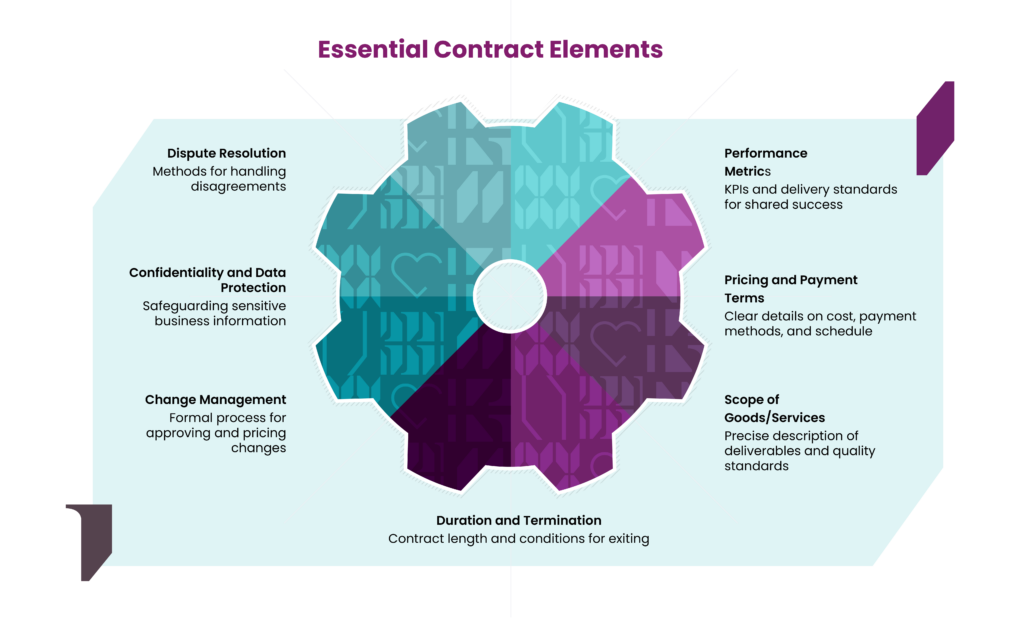
Before diving into the different contract types, it helps to understand what every well-constructed procurement contract should include. These are the elements that separate a contract that holds up under pressure from one that falls apart the moment a dispute arises.
- Scope of goods or services: This is the most fundamental element: a precise description of what the supplier is expected to deliver, including quality standards, specifications, and key milestones.
- Pricing and payment terms: Whether the price is fixed or variable, the contract must spell out how much will be paid, how it will be paid, and when.
- Performance metrics: Clear KPIs and delivery standards give both parties a shared definition of success and a basis for accountability.
- Duration and termination conditions: A contract should define how long it runs, under what conditions either party can exit, and how much notice is required.
- Dispute resolution: This is often overlooked until it is urgently needed. A good contract outlines whether disputes will be handled through mediation, arbitration, or litigation, and in which jurisdiction.
- Confidentiality and data protection: Particularly important in technology and professional services agreements, where sensitive business information regularly changes hands.
- Change management provisions: Scope changes happen. Having a formal process for approving and pricing changes prevents costly misunderstandings later.
The challenge is that these foundations are far less common in practice than they should be. A joint survey by EY Law and the Harvard Law School Center on the Legal Profession, covering 1,000 professionals across legal, procurement, and commercial contracting functions, found that roughly 78% of organizations have no systematic process for tracking contractual obligations, and nearly 70% have no standard template requirement for drafting contracts. When these basics are absent, the risk of missed obligations, inconsistent terms, and costly disputes increases considerably.
The 5 Types of Contracts in Procurement
Choosing the right contract structure is a strategic decision with real consequences. The contract types in procurement covered below each serve a distinct purpose, and it helps to understand how they differ in nature: fixed price, cost reimbursement, and time and materials define how costs and risk are structured within a deal, while framework agreements and FIDIC contracts govern the conditions and standards under which those structures are applied.
For a broader look at how these contract categories fit into everyday business operations, see Malbek’s overview of 4 Types of Contracts Commonly Used in Business.
Fixed Price Contracts: Certainty for Well-Defined Projects
A fixed price contract is exactly what it sounds like: the buyer agrees to pay a set amount for a defined scope of work, regardless of what it actually costs the supplier to deliver it. This structure places most of the financial risk on the supplier, who must absorb any cost overruns.
Fixed price contracts are best suited to situations where the scope is clear, the deliverables are well-defined, and costs are relatively predictable. Think manufacturing components with stable material costs, or a software implementation with a fully scoped project plan.
Risk allocation in fixed price contracts is straightforward. The buyer gets cost certainty, and the supplier takes on delivery risk. This creates a strong incentive for suppliers to work efficiently, though it can also lead to quality trade-offs if a supplier has underestimated costs.
There are three main variations worth knowing:
- Firm Fixed Price (FFP): The simplest form. The buyer pays one agreed price, with no adjustments or incentives built in. Best for low-uncertainty purchases where the scope is rock solid.
- Fixed Price Incentive Fee (FPIF): The base price is fixed, but the supplier can earn a bonus for meeting or exceeding defined performance targets: early delivery, exceptional quality, or cost savings. This variant works well when you want the cost predictability of a fixed contract but also want to encourage above-par performance.
- Fixed Price with Economic Price Adjustment (FP-EPA): The agreed price can be adjusted based on predefined external factors, such as inflation indices or raw material price changes. This is useful for longer-duration contracts where locking in a price that ignores market volatility would be unrealistic for the supplier.
Cost Reimbursement Contracts: Flexibility When Scope Is Uncertain
Sometimes you simply cannot define the full scope of a project upfront. Research engagements, complex construction projects, and custom product development are all situations where the work evolves as it progresses. That is where the cost reimbursement contract earns its place.
Under this model, the buyer reimburses the supplier for actual, documented costs incurred (labor, materials, overhead) and pays an additional fee on top. The buyer assumes more financial risk than in a fixed price arrangement but gains the flexibility to adapt as the project develops.
There are four common subtypes:
- Cost Plus Fixed Fee (CPFF): The supplier is reimbursed for allowable costs plus a fixed fee that does not change based on performance. This keeps supplier profit predictable, though it removes the incentive to control costs aggressively.
- Cost Plus Incentive Fee (CPIF): The supplier is reimbursed for costs plus a variable fee tied to performance targets, often related to cost control or schedule adherence. This gives suppliers a reason to keep expenses down.
- Cost Plus Award Fee (CPAF): The additional fee is discretionary, determined by the buyer’s assessment of overall performance. This works well when quality or innovation is the priority but difficult to quantify in advance.
- Cost Plus Percentage of Cost (CPPC): The supplier earns a fee calculated as a percentage of total costs. This variant requires close oversight, since the supplier’s earnings increase as spending increases.
Cost reimbursable structures are common in defense, pharmaceutical research, and complex infrastructure projects: anywhere that meaningful uncertainty makes a fixed price impractical.
Time and Materials Contracts: Speed and Adaptability, With Trade-Offs
When you need to get started quickly and the scope is still taking shape, a time and materials contract offers the most flexibility of the three primary contract types.
Under this structure, the buyer pays for the actual hours worked at an agreed rate, plus the cost of materials consumed. It is a common structure for IT consulting, professional services, and maintenance work (any engagement where effort is hard to predict in advance).
Pros of time and materials contracts:
- Fast to execute, since a detailed scope definition is not required upfront
- Highly adaptable as project needs evolve
- Transparent: buyers can see exactly where hours and costs are going
- Shared financial risk, since costs reflect actual effort rather than padded estimates
Cons of time and materials contracts:
- Budget unpredictability, since total costs are unknown until completion
- Suppliers have limited incentive to work quickly
- Scope creep is a real risk without a clearly defined cap
- Requires active monitoring to keep hours and material costs in check
A time and materials contract almost always includes a not to exceed (NTE) clause, which caps total expenditure and gives the buyer a budget ceiling to plan against. Without it, this structure can become expensive very quickly.
Framework Agreements: Long-Term Supplier Contracts Built for Repeat Purchasing
Many procurement relationships extend beyond a single transaction. When an organization regularly purchases similar goods or services from the same supplier (or a set of pre-approved suppliers), a framework agreement is often the smarter approach.
A framework agreement (also called a framework contract or standing offer arrangement) is a long-term arrangement that establishes the terms and conditions under which future purchases will be made, without committing to a specific quantity or schedule upfront. When a purchase is needed, the buyer simply calls off against the existing framework rather than renegotiating a new sourcing contract from scratch.
What are framework agreements in procurement most useful for? They work well in public sector procurement, large enterprise purchasing programs, and any supply chain contracts situation where volumes are recurring but timing is unpredictable. They reduce administrative burden, accelerate the ordering process, and allow organizations to negotiate better pricing based on anticipated volume, even before committing to specific orders.
The key distinction from a standard purchasing contract is that a framework agreement creates the conditions for trade, rather than obligating a specific transaction. Individual call-off orders made within the framework carry their own delivery and pricing specifics, governed by the overarching terms already in place.
FIDIC Contracts: The Standard for Complex Construction and Engineering
FIDIC contracts are primarily relevant to procurement teams in infrastructure, civil engineering, and large-scale construction. For professionals in other sectors, they represent a useful context on how complex project risk is structured rather than a day-to-day framework. FIDIC (the International Federation of Consulting Engineers) publishes standardized contract forms used globally on major construction and engineering projects.
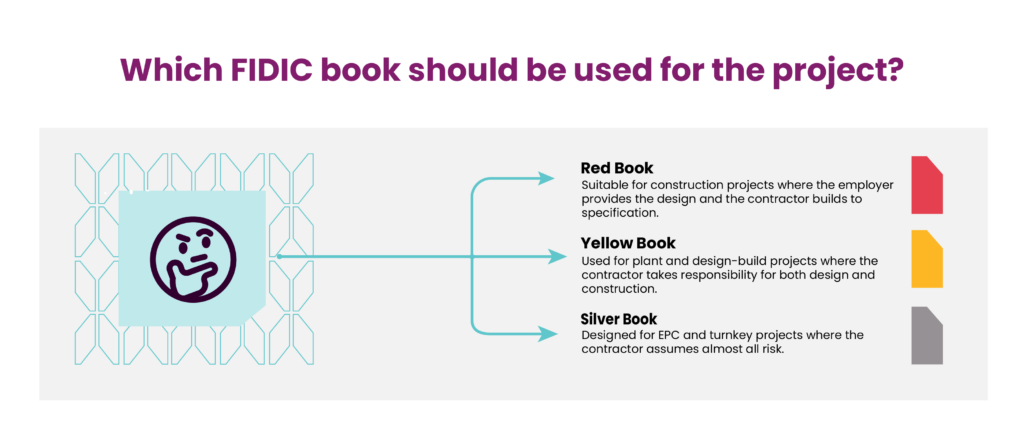
The three most widely used books are:
- The Red Book governs construction projects where the employer (buyer) provides the design and the contractor builds to that specification. The contractor carries significant construction risk, but design risk sits with the employer.
- The Yellow Book is used for plant and design-build projects, where the procurement contractor takes responsibility for both design and construction. Risk is more balanced, and this structure is common in power generation, water treatment, and industrial plant projects.
- The Silver Book is designed for EPC (Engineering, Procurement, and Construction) and turnkey projects. Here, the contractor assumes almost all risk: design, construction, and performance. The employer pays a lump-sum price and receives a fully operational facility. This makes the Silver Book the closest FIDIC equivalent to a firm fixed price structure.
When to Use Fixed Price vs. Cost Reimbursable Contracts
This is the question most procurement teams wrestle with on complex projects, and there is no universal answer. The right choice depends on how well you can define scope, how much risk each party can absorb, and what behavior you want to incentivize in your supplier. Time and materials, framework agreements, and FIDIC contracts each have clearer natural use cases covered in their respective sections above; the comparison below focuses on the two structures where the decision is least obvious.
Choose a fixed price contract when:
- The scope is clearly defined and unlikely to change significantly
- Cost predictability is a priority for your budget planning
- The market is competitive, and suppliers can accurately estimate costs
- You want to shift the delivery risk to the supplier
Choose a cost reimbursement contract when:
- The full scope cannot be determined upfront
- The project involves significant uncertainty or innovation
- You need flexibility to adapt as requirements evolve
- The relationship with the supplier involves collaborative problem-solving rather than defined delivery
A useful procurement contract example: a company commissioning an office fit-out with detailed architectural drawings in hand suits a firm fixed price contract. The same company commissioning an experimental R&D project with no defined end-state suits a cost plus incentive fee arrangement, giving both parties room to adapt while keeping supplier motivation strong.
The most common mistake procurement teams make is defaulting to a fixed price because it feels safer, without accounting for the change orders and disputes that inevitably arise when the scope was never really defined in the first place.
How Contract Management Software Transforms Procurement Contract Oversight
Even the most carefully drafted procurement contract only delivers value if it is actively managed throughout its lifetime. And for teams handling large volumes of supplier contracts, manual oversight is simply not scalable. A 2024 report by World Commerce & Contracting and Deloitte, surveying more than 370 international organizations, found that 76% of legal and contract professionals report significant friction and inefficiencies in their contracting processes, and only 39% believe their contracts are actually achieving their intended goals. Those are not numbers that improve on their own.
This is where purpose-built contract lifecycle management (CLM) platforms make a meaningful difference. Worth noting, too, is that the contract type itself shapes what ongoing management requires: a cost-plus arrangement demands continuous cost validation and scope documentation, while a fixed price contract calls for active monitoring of change orders and scope creep. Good CLM software addresses both: it makes contracts searchable, auditable, and actionable at every stage of the process.
For a full breakdown of how CLM works across the entire contract lifecycle, Malbek’s Ultimate Guide to Contract Lifecycle Management is a useful next step. For a closer look at the specific features that matter most in a procurement context, see Procurement Contract Management: Essential CLM Features.
Malbek is built around this principle, using an AI powered Ensemble LLM approach that combines multiple leading large language models. Each model’s output is validated by the next in sequence, delivering more accurate, reliable contract analysis than any single model could provide on its own.
For procurement teams, this translates into practical capability. Smart tagging automatically surfaces and maps key clauses across an entire contract portfolio, so reviewers can assess a supplier contract in seconds rather than hours. AI powered playbook enforcement evaluates incoming contracts against predefined standards and flags deviations in real time, reducing the risk of unfavorable terms slipping through during high-volume review periods.
Clause assessments and AI recommendations help teams quickly identify whether terms are balanced, favorable, or flagged for revision, bringing genuine analytical depth to the negotiation process rather than relying entirely on individual judgment.
For organizations managing complex supply chain contracts across multiple contract types and supplier relationships, Malbek’s master data storage capability connects counterparty and supplier data directly into contract workflows. This ensures data accuracy is maintained across old and new contracts, reducing the manual effort required to keep supplier records consistent.
The result is a contract management in a procurement environment where oversight is built into the system itself, rather than depending on individual attention spans.
Conclusion: Choosing the Right Contract Type Is Just the Beginning
Selecting the right type of contract in procurement is a critical decision, one that shapes risk exposure, supplier behavior, and cost outcomes from the moment a deal is signed. The contract type, though, is only part of the equation.
The organizations that get the most out of their supplier relationships are the ones that treat procurement contracts as living documents: actively managed, regularly reviewed, and supported by systems capable of tracking performance and flagging issues before they become problems.
Understanding the five types of procurement contracts covered here gives your team a stronger foundation. Pairing that knowledge with the right contract management infrastructure is how that foundation becomes a genuine competitive advantage.
To see how Malbek supports procurement teams across every contract type and stage of the lifecycle, request a demo and walk through the platform with a member of the Malbek team.
Sources
- World Commerce & Contracting / Deloitte. The ROI of Contracting Excellence. 2023. https://www.deloitte.com/us/en/services/tax/articles/contract-management-lifecycle-insights.html
- EY Law / Harvard Law School Center on the Legal Profession. Inefficient Contracting Remains Major Challenge for Businesses. 2021. https://www.prnewswire.com/news-releases/inefficient-contracting-remains-major-challenge-for-businesses-eyharvard-law-school-center-on-the-legal-profession-survey-finds-301290512.html
- World Commerce & Contracting / Deloitte. The Purpose of Contracts. 2024. https://www.globenewswire.com/news-release/2024/11/11/2978631/0/en/World-Commerce-Contracting-Report-Reveals-Critical-Decline-in-Business-Contract-Effectiveness.html