




Opportunity Assessment: How BusinessIQ Helps C-Suite Leaders Find Value Fast

Opportunity assessment is often a periodic exercise. A procurement team launches a sourcing review. Finance requests a cost reduction program. Strategy initiates due diligence ahead of an acquisition. Operations reacts to a tariff shifts or supplier disruptions. In each case, leadership is trying to answer the same underlying question:
“Where is the next meaningful source of value, and what stands in the way of capturing it?”
The challenge is not simply finding an idea. It is determining, with evidence, whether an opportunity is real, how large it is, what dependencies shape it, and how quickly the organization can act on it.
In practice, however, opportunity assessments often break down because the most important commercial evidence is scattered across contracts, amendments, statements of work, pricing schedules, exhibits, emails, ERP records, and spend files. Spend analysis may show where money is going. A contract repository may show renewal dates but traditional CLM was built to manage agreements. But neither, on its own, provides a sufficiently complete view of pricing logic, obligations, thresholds, concessions, exposure, relationship history, or cross-portfolio dependencies.
Opportunity Assessment Tool Built for the C-Level
That is where BusinessIQ changes the conversation. BusinessIQ is the first Commercial Intelligence Platform — built not to manage contracts, but to transform your entire contract repository into a living Intelligence Core that surfaces millions of dollars in hidden commercial opportunity. Rather than treating opportunity assessments as a static spreadsheet exercise, BusinessIQ enables organizations to assess opportunities using live intelligence from all signed agreements, powered by LIVEGraph℠ technology with Ensemble LLM. For procurement, legal, sales operations, finance, and executive leadership, that means faster access to evidence, better cross-functional visibility, and more confidence in the actions chosen.
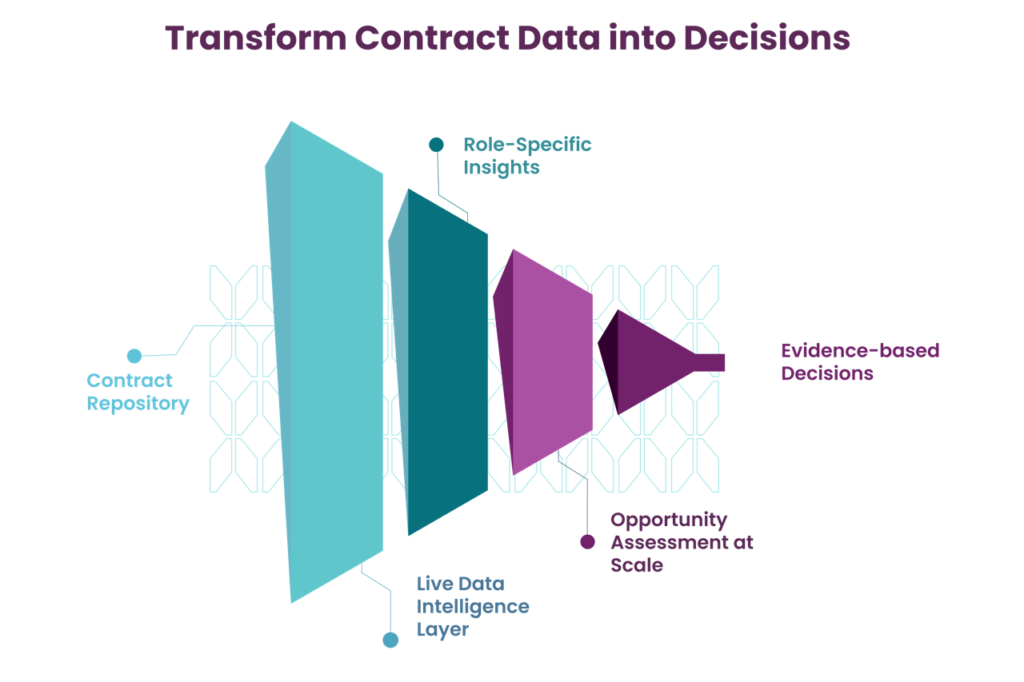
Different Roles – Different Needs
For C-level decision-makers, the distinction matters. A CPO may want to understand where supplier pricing structures, renewal mechanics, or termination rights create sourcing leverage. A CFO may need better visibility into committed spend, pricing evolution, milestone ownership, and value leakage.
A Chief Commercial Officer or Chief Revenue Officer may want to review customer contract changes across amendment history to identify margin pressure, non-standard concessions, or expansion signals. In each case, the core challenge is the same: opportunity assessment only becomes strategic when decision-makers can trace opportunities back to reliable contract intelligence.
In each case, the underlying requirement is the same: opportunity assessment only becomes strategic when decision-makers can trace opportunities back to reliable contract intelligence — not assumptions, not summaries, not stale metadata.
What is an opportunity assessment?
At its core, opportunity assessment is a disciplined process for deciding where value exists, what will be required to realize it, and whether it is worth pursuing. In procurement, outside experts typically define opportunity analysis as the process of identifying ways to capture value through sourcing, based on requirements, suppliers, spend, and existing sourcing methods.
Useful Opportunity Assessment Framework Questions
A useful opportunity assessment framework therefore does more than list possible savings. It establishes a baseline, evaluates alternatives, quantifies upside, identifies dependencies, and clarifies risk. That is why strong frameworks usually ask variations of the same questions:
- What problem or inefficiency are we actually trying to address?
- Where is the value pool: savings, revenue, leverage, resilience, speed, compliance, or growth?
- Which suppliers, contracts, customers, business units, or categories are involved?
- How large is the opportunity, and how confident are we in that estimate?
- What alternatives already exist, and what constraints shape execution?
- What is the recommendation: pursue, defer, redesign, or stop?
Traditional opportunity assessments leave blind spots
Traditional opportunity assessments usually fail for one reason: they rely on incomplete evidence.
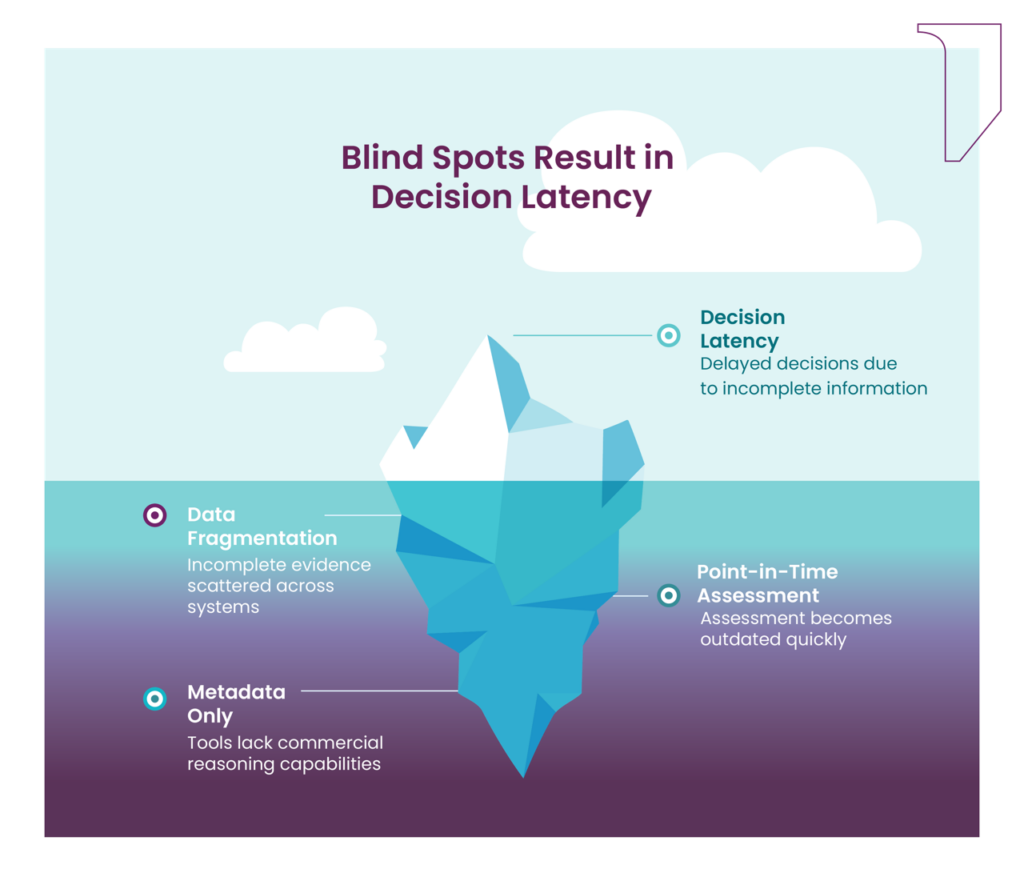
1st Blindspot: Data Fragmentation
That evidence problem starts with data fragmentation. Spend data may sit in ERP or AP systems. Supplier performance data may live elsewhere. Contract metadata may exist in a CLM, but often at a high level: counterparty, term dates, renewal dates, maybe a few extracted clauses. Critical commercial logic remains buried inside pricing tables, amendments, service schedules, appendices, or non-standard language. When teams attempt a sourcing opportunity assessment under those conditions, they end up piecing together a business case from partial views rather than from the full commercial record.
Opportunity assessments are expected to produce a clear business case, an implementation plan, ROI visibility, trusted spend categorization, pragmatic estimates, a list of key initiatives, and stakeholder agreement on the resources required to deliver the plan. Spend analysis best practice similarly starts by collecting, consolidating, classifying, cleaning, and analyzing data, including vendor contracts. When that underlying contract layer is weak, the assessment becomes slower, more manual, and less reliable.
2nd Blindspot: The Assessment is Valid at a Singular Point in Time
A second blind spot is that most assessments are point-in-time. A team pulls a sample. A consultant interviews stakeholders. A spreadsheet model estimates upside. A wave plan is created. Then market conditions shift, an amendment is signed, a supplier changes pricing, a tariff is introduced, or a renewal date approaches. The assessment is already out of date. LIVEGraph℠ is designed to solve exactly this — it is a continuously learning intelligence layer, not a snapshot.
3rd Blindspot: It’s Metadata Only
A third blind spot is that conventional tools are usually optimized either for workflow or for reporting, not for commercial reasoning. A traditional CLM can help teams manage requests, approvals, negotiation, and execution. A BI dashboard can visualize extracted data. But if the organization wants to know:
• which contract families contain inconsistent rate cards across business units,
• which supplier agreements contain thresholds that create negotiation leverage,
• which customers have expansion rights that sales is not pursuing,
• which amendments changed the original economics of a relationship,
• which sole-source suppliers create downstream exposure across customer commitments, or
• which acquisition targets contain overlapping commercial relationships,
then metadata alone is not enough.
This is why opportunity assessments often become labor-intensive and sample-based. Analysts read contracts manually. Legal validates language. Procurement triangulates pricing. Finance rebuilds the economics. Strategy waits for a summary deck. The process can still produce value, but it is expensive, episodic, and difficult to repeat at speed. Traditional CLM was built for operational workflow — approvals, requests, execution. BusinessIQ was built for commercial intelligence: the kind that reveals what your contracts actually mean for cost, revenue, risk, and leverage across the entire portfolio.
The Result: Decision Latency
For C-level leaders, the result is familiar: decision latency. A renewal window closes before the team has finished its analysis. A tariff shift hits before supplier exposure is mapped. An acquisition closes before contract risk is fully understood. By the time the answer arrives, the negotiation window may have moved, the board question may have changed, or the operational risk may already have materialized.
Common Types of Opportunity Assessment
Procurement Opportunity Assessment
A procurement opportunity assessment typically focuses on sourcing categories, supplier relationships, contract terms, rate structures, and purchasing behavior. It may look for consolidation opportunities, rebate recovery, pricing inconsistencies, duplicate spend, or better negotiation leverage.
Spend Assessment
A spend opportunity assessment begins with expenditure visibility. It examines who is buying, what is being bought, when, where, why, and how much. That foundation is essential, but it is only a starting point. Spend data can show patterns; it usually cannot explain the contractual mechanisms behind those patterns.
Cost Reduction
A cost reduction opportunity assessment is narrower. Its purpose is to find savings initiatives that can be implemented with measurable bottom-line impact. This often requires category reviews, benchmarks, a prioritised initiative pipeline, and agreement from stakeholders on resources and execution sequencing.
Purchasing Process
An opportunity assessment in purchasing often emphasizes purchasing process efficiency, supplier strategy, risk trade-offs, and alignment with broader business goals. It reflects the evolution of procurement from a transactional function into a strategic contributor.
Business Opportunity
A business opportunity assessment extends beyond purchasing into growth, market entry, revenue expansion, restructuring, M&A, and portfolio design. In that setting, the question is not only “what can we save?” but also “what should we pursue next, and why now?”
In all of these contexts, contracts are the common thread — the source of truth for what the organization has actually agreed to, and therefore where the real opportunity evidence lives.
The One Source of Truth for All: Your Contract Repository
BusinessIQ is most relevant when opportunity assessment depends on contracts as the underlying source of commercial truth. That includes procurement, revenue, supply chain, M&A, and many C-suite planning decisions. If the answer depends on what the organization has actually agreed to — rather than what it believes it agreed to — then the contracts are the evidence. And if contracts are the evidence, you need more than a repository. You need an Intelligence Core.
How Malbek BusinessIQ Strengthens Opportunity Assessment
Malbek BusinessIQ helps organizations move from assumption-based opportunity assessment to evidence-based opportunity assessment — and the reason it can do this reliably comes down to architecture. Most tools extract a fixed set of metadata fields and call it intelligence. BusinessIQ is built on four layers that work together to deliver something fundamentally different:
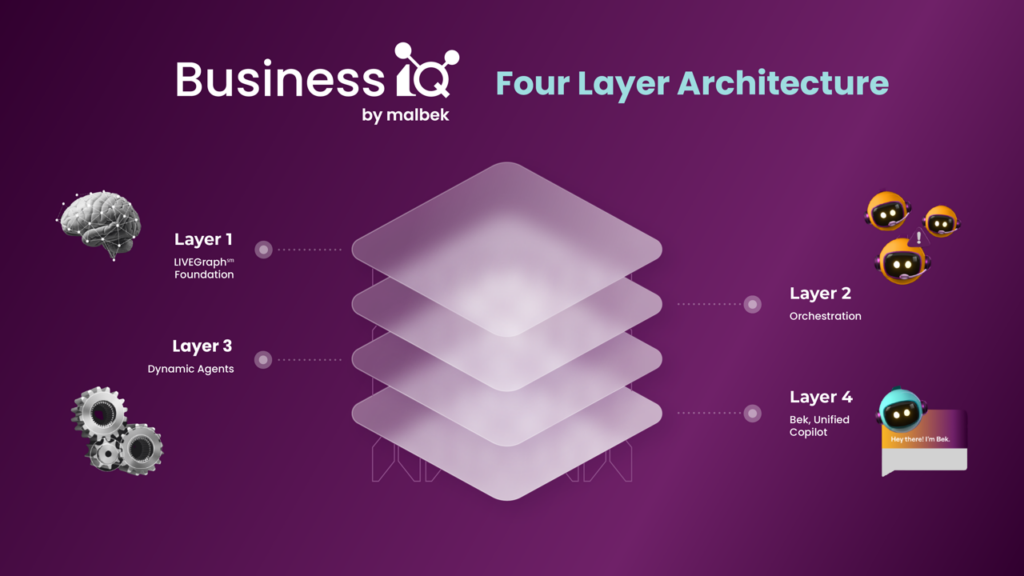
Layer 1 — LIVEGraph℠ Foundation:
Ensemble LLM processes every contract paragraph by paragraph, table by table, exhibit by exhibit — building a fluid taxonomy across thousands of data points (not the 50–200 standard extractions most tools manage). This is the Intelligence Core™.
Layer 2 — Dynamic Agents:
Based on the unique shape of your repository, the system dynamically creates specialized agents — risk agents, renewal agents, obligation agents, revenue agents — each staying in its lane. A pharmaceutical company gets different agents than a SaaS company. The architecture adapts to your commercial universe.
Layer 3 — Orchestration:
When you ask a complex question — “What’s our financial exposure if we terminate this vendor tomorrow?” — the orchestration layer determines which agents to activate, coordinates their work across the contract population, and synthesizes a coherent answer. You’re not running a single query; you’re running a coordinated intelligence operation.
Layer 4 — Bek, Unified Copilot:
The conversational interface that makes all of this accessible in plain language. Bek bridges CLM operations and BusinessIQ intelligence in one conversation — ask about a workflow, surface a risk cluster; ask about a revenue exposure, pull the underlying contract detail.
These aren’t standalone modules. They are the reason BusinessIQ produces board-grade intelligence rather than probabilistic guesses.
BusinessIQ focuses on deep analysis of executed agreements using AI-powered capabilities that surface repository intelligence, support contract-wide interrogation, analyze contract families across amendment history, and strengthen obligation management.
Light Up the LIVEGraph℠: See Opportunity Patterns Across your Contract Repository
Most contract tools were built on a fixed extraction model: identify fifty or a hundred predetermined data points, pull them from every contract, report on what was found. If a piece of commercial intelligence wasn’t on the preset list — a volume discount threshold buried in a pricing exhibit, an inflation adjustment clause entitling you to price increases you’re not collecting, a termination right that creates real negotiation leverage — the system scanned right past it.
LIVEGraph℠ works differently. Rather than applying a fixed taxonomy to your contracts, it builds a fluid one — processing every document paragraph by paragraph, table by table, exhibit by exhibit using Ensemble LLM. Multiple large language models process the same contract data, cross-reference their outputs, and reconcile into accurate, reliable indexes. The result is thousands of data points available across your repository, not 50 or 200. And because LIVEGraph℠ adapts to the unique shape of your contract portfolio — your agreements, your commercial relationships, your business model — no two Intelligence Cores look the same.
For opportunity assessment, this matters because leaders rarely start with a single contract question. They start with a portfolio question: Where are the pricing outliers? Which supplier agreements contain thresholds that create negotiation leverage? Where do certain obligation structures concentrate across business units or regions? LIVEGraph℠ surfaces those patterns visually across the repository and enables drill-down into the underlying contract detail — including exactly where in the contract language the insight was found. That is what turns a hypothesis into evidence, and evidence into a defensible business case.
Context Threading℠: Turning Business Analytical Questions into Scaled Contract Review
LIVEGraph℠ builds the Intelligence Core. Context Threading℠ is how you interrogate it.
In real business operations, a commercial relationship is never contained in a single document. A supplier engagement might span a master service agreement, three amendments, five statements of work, a pricing schedule update, and a force majeure addendum — each filed separately, each modifying the others in ways that only become visible when read together. Traditionally, understanding the current state of that relationship meant spreading documents across a conference table and manually cross-referencing them for days.
Context Threading℠ solves this by pulling a single thread of commercial meaning through the entire portfolio. It understands dependencies and inheritance — it knows the termination clause in the master agreement governs the newest statement of work even if that SOW never restates it. It identifies risk clusters, opportunity clusters, and dependency clusters across your entire commercial ecosystem. It can surface a contradiction between a revenue commitment buried in an exhibit and a risk allocation in the main agreement’s indemnification section that a human analyst would likely never catch.
For opportunity assessment, this changes the pace of analysis entirely. Instead of asking a contract team to manually review hundreds of documents for a specific issue, decision-makers can investigate opportunity hypotheses at scale through Bek, Malbek’s unified AI copilot:
- Which supplier contracts contain termination rights that create near-term leverage?
- Where do pricing commitments or renewal mechanics suggest renegotiation opportunity?
- Which agreements contain service-level provisions that may support performance-based discussions?
- Where do commitment terms signal savings risk, commercial exposure, or consolidation potential?
Because Context Threading℠ extracts patterns from actual contract language — pre-verified through Ensemble LLM with no probabilistic guessing — every result links back to exact contract citations. That is not a broad AI summary. It is board-grade intelligence your CFO, board, and auditors can trust without needing to verify it themselves.
Commercial Breadcrumbs: Understand How Value Changes Over Time in a Hierarchy
Many strategic opportunities only become visible when the original agreement and all amendments are analyzed together. Malbek’s contract family analysis addresses that need by reviewing the progression of a contractual relationship and showing how important provisions changed over time.
The analysis produces a contract timeline visualization and highlights changes across duration and renewal terms, pricing evolution, licensing structures, payment terms, services scope, service-level commitments, pricing tiers, termination rights, financial terms, total contract value, prorated payments, and governance or compliance provisions.
This is highly relevant to opportunity assessment because value is often lost incrementally, not all at once. An amendment changes a rate here. A renewal concedes a threshold there. A scope change quietly shifts economics across a multi-year relationship. Taken individually, none of these looks alarming. Viewed together through Commercial Breadcrumbs, the pattern of value erosion — or hidden leverage — becomes visible.
For a CPO or CFO, contract family analysis supports better judgments about renegotiation strategy, value erosion, and supplier relationship economics. For commercial leaders, it can reveal customer-side concession patterns and renewal dynamics that affect growth quality.
Obligation Management: Turn Opportunity into Executed Reality
Identifying an opportunity is only half the work. The other half is making sure it actually happens.
This is where many organizations quietly lose value they already found. A renegotiation surfaces a rebate entitlement that was never claimed. A sourcing review identifies renewal leverage that expires before anyone acts on it. A financial analysis flags usage-based overages that are contractually billable but never invoiced. The insight existed. The action didn’t follow.
BusinessIQ’s Automated Obligation Tracking closes that gap. On contract activation, key obligations and milestones are automatically extracted, assigned to owners, and surfaced with proactive reminders as critical dates approach. Renewal windows, payment milestones, performance triggers, audit rights, pricing adjustment clauses — these don’t live passively in the repository. They become active, tracked commitments with accountability attached.
For opportunity assessment, this matters more than most teams realize. Some of the highest-value opportunities in any portfolio are not new opportunities at all — they are existing rights that were negotiated, signed, and then never operationalized. Volume discounts that were never triggered. Price escalation rights that were never exercised. Service-level credits that were never claimed. Obligation tracking is what turns contract intelligence from discovery into control, and from control into captured value.
The opportunity isn’t just in what your contracts could say. It’s in what they already say that no one is acting on.
BusinessIQ: The Executive View of Opportunity Assessment
Opportunity assessment is often delegated to category managers, procurement analysts, legal teams, or operations leaders. That is appropriate at the working level, but the implications are increasingly executive.
BusinessIQ was built for the C-suite because that is where commercial intelligence creates the most leverage. Every role below has a version of the same problem: billion-dollar decisions made on stale, fragmented data. BusinessIQ changes that.
CPO
Where can the organization improve supplier economics, enforce contractual rights, rationalize vendor exposure, or identify contract-based sourcing leverage faster?
CFO
Where is value leaking through pricing changes, payment mechanics, missed obligations, or hidden commitments? Which contract patterns affect cash flow, margin, and forecast confidence?
Chief Commercial Officer or Chief Revenue Officer
Where have customer-specific amendments changed pricing, scope, or service commitments in ways that affect expansion strategy, margin quality, or renewal posture?
Chief Legal Officer and General Counsel
Which opportunity areas carry legal complexity, clause inconsistency, or governance implications that must be understood before commercial action?
COO or Business Operations Leader
Which obligations, service levels, operational commitments, or milestone structures create process bottlenecks or improvement opportunities across the business?
Data-backed Decisions for the Board
BusinessIQ is relevant for them because it turns contract intelligence into a decision support layer. Instead of waiting for static summaries, executives can work from board-grade intelligence — traceable to exact contract citations, reliable enough for the boardroom, and available in hours rather than weeks.
An Opportunity Assessment Framework In Practice
Organizations do not need to replace their existing opportunity assessment framework to benefit from BusinessIQ. In most cases, Malbek makes the existing framework more reliable.
A practical model looks like this:
1. Define the commercial question
Start with the business outcome rather than the technology. The question may be cost reduction, supplier consolidation, commitment visibility, contract standardization, renewal leverage, revenue protection, or obligation compliance.
2. Use repository intelligence to identify patterns
With LIVEGraph℠, examine live contract attributes and patterns that may surface revenue exposure, outliers, concentration risk, language variation, or negotiation clusters across the portfolio.
3. Run targeted repository analysis
Use Bek — Malbek’s unified AI assistant — to investigate specific opportunity hypotheses across the contract population. Every finding links back to exact contract language, not just AI-generated summaries.
4. Review contract family history where leverage may be hidden
Where a relationship has evolved through multiple amendments, use contract family analysis to understand how pricing, terms, commitments, and rights changed over time.
5. Convert insights into accountable actions
Operationalize the outcome through obligation tracking, reminder structures, reporting, and workflow alignment so that identified opportunities are not lost in execution.
6. Prioritize at the portfolio level
Evaluate opportunities by value, effort, timing, stakeholder complexity, and strategic importance. This is where BusinessIQ can strengthen executive prioritization by supplying better evidence on what is feasible and material.
How BusinessIQ Changes Opportunity Assessment
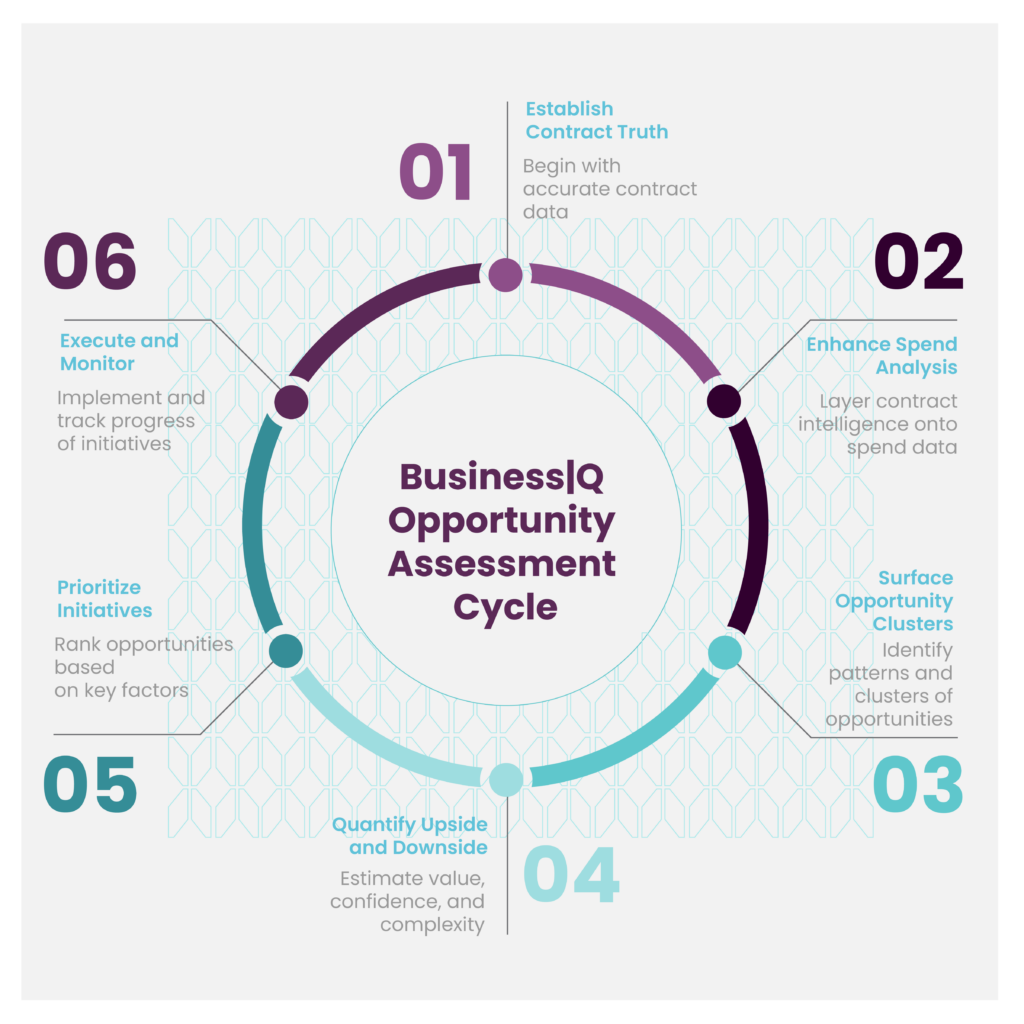
1. It starts with contract truth, not assumptions
A good opportunity assessment begins with a baseline. The problem is that most baselines are reconstructed from summaries, extracted fields, or system records that lag behind the contracts themselves. Years of amendments may never make it into ERP, CRM, or supplier master data. That gap matters because opportunity assessment depends on the current commercial reality, not on the last clean dataset.
BusinessIQ is designed to reduce that gap. By working across contract families, amendments, tables, exhibits, and supporting commercial language, it helps teams establish a more complete baseline of what the organization has agreed to.
LIVEGraph℠ processes the full commercial record — not just the metadata layer — so the baseline reflects what was actually agreed to, including every amendment, exhibit, and pricing schedule.
2. It makes spend analysis more useful
Spend analysis remains foundational. Teams still need to know who is buying, what they are buying, when, where, why, and how much. But a spend opportunity assessment becomes materially more useful when contract intelligence is layered onto spend patterns.
For example, spend data may show fragmented purchasing across multiple suppliers. BusinessIQ can help explain whether those suppliers are actually governed by different rate structures, volume thresholds, rebate conditions, exclusivity provisions, or termination constraints. The spend pattern shows the symptom. The contracts show the mechanism.
3. It surfaces opportunity clusters across the portfolio
Opportunity is rarely isolated. It tends to form clusters.
In procurement, those clusters may include supplier consolidation, pricing variance, missed discounts, unfavorable rate cards, duplicate vendors, contract buying opportunities, and renewal leverage.
In finance, opportunity clusters may include revenue leakage, unbilled usage, hidden obligations, concentration risk, rebate exposure, and faster diligence during transactions. In Malbek’s use case materials, BusinessIQ is described as a way to surface contract-driven revenue risk and hidden financial exposure quickly enough for board and deal contexts.
In commercial strategy, the clusters may be customer overlap, cross-sell rights, renewal risk, pricing inconsistencies, portfolio duplication, or whitespace created through acquisitions.
The advantage of BusinessIQ is that it is built to identify these patterns at portfolio scale.
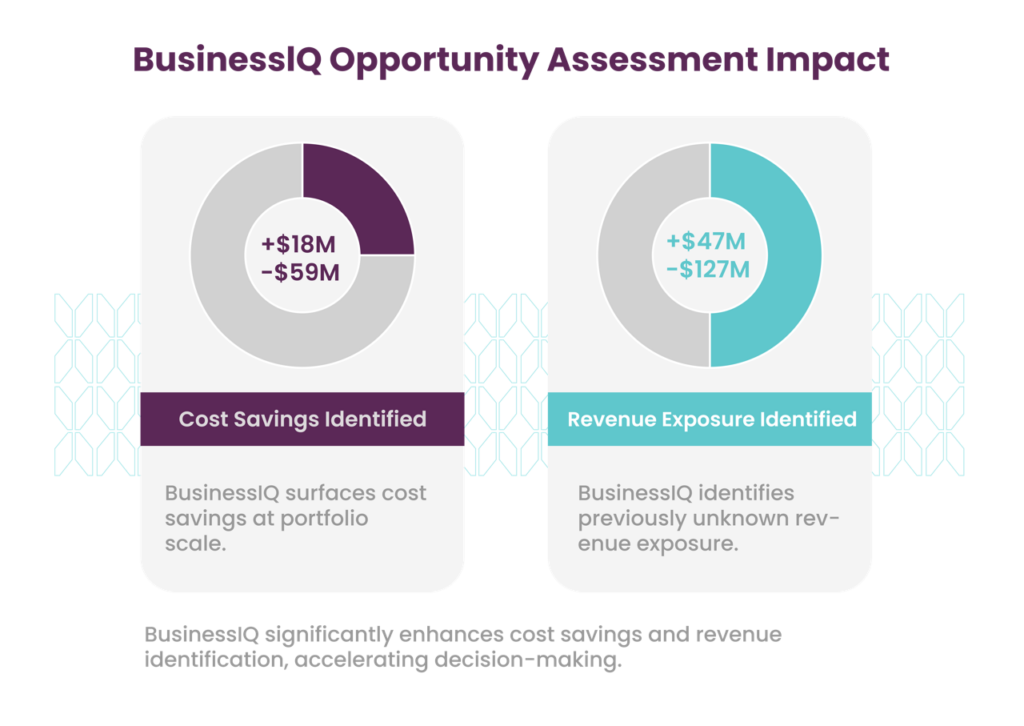
Customers have used this capability to surface $18M–$59M in cost savings and identify $47M–$127M in revenue exposure they didn’t know existed. That does not eliminate the need for human judgment. It changes the speed and completeness with which analysts and executives can get to the judgment stage.
4. It helps quantify both upside and downside
An executive-grade opportunity assessment cannot stop at “we found something interesting.” It needs to estimate value, confidence, timing, and implementation complexity.
This is where contract-native intelligence is particularly useful. Because the commercial logic sits in the agreements, teams can move beyond broad category assumptions and into more defensible quantification. They can segment contract populations, compare rate cards, examine
It also matters in revenue and strategy assessments. If sales believes there is expansion whitespace, the contracts can confirm whether modules, seats, geographies, or entities can be added without re-approval. If finance suspects revenue leakage, the agreements can show whether usage-based overages are enforceable, discounted, capped, or already conceded elsewhere. If M&A leaders want to know where the synergies are, the contracts can show customer overlap, vendor duplication, conflicting commitments, or consolidated leverage.
In other words, BusinessIQ shifts opportunity assessment from directional estimates to board-grade, decision-ready evidence — the kind that can justify a sourcing initiative, validate a deal thesis, or stop a bad commercial decision before it closes.
5. It supports prioritization, wave planning, and execution
A common failure mode in opportunity assessment is that the organization identifies too much at once. The output becomes a long list of ideas rather than a prioritized program.
A practical opportunity assessment plan might therefore rank initiatives according to:
- value at stake,
- contract timing,
- negotiation readiness,
- implementation complexity,
- cross-functional dependency,
- regulatory or operational risk, and
- executive sponsor relevance.
That prioritization is where BusinessIQ becomes especially relevant for senior decision-makers. A Chief Procurement Officer may not need every contract detail; they need a defensible view of which sourcing initiatives should move first. A CFO may not need every line item; they need a credible exposure and return profile. A CSCO may need to know which supplier risks are worth immediate intervention because they affect revenue, not just operations.
6. It makes opportunity assessment continuous
Perhaps the most important difference is continuity.
Traditional opportunity assessments are often event-driven: new leadership, budget pressure, a merger, a tariff shock, an IPO, or a transformation program. BusinessIQ enables a different operating model. Instead of treating opportunity assessment as a one-time project, the organization can treat it as an ongoing intelligence capability.
That means new questions can be asked as conditions change:
• What changed in supplier exposure after the latest amendments?
• Which renewals in the next 90 days contain the most leverage?
• Where are current price protections ending?
• Which customers exceed contracted usage but are not being invoiced?
• Which agreements with a single vendor cross business-unit boundaries and create consolidation potential?
• Which clauses create downstream delivery or compliance exposure if a supplier fails?
Continuous opportunity assessment is strategically important because business conditions do not wait for the next annual review cycle. Contract truth changes. Opportunity windows open and close. The organizations that will command their commerce in the next decade are the ones treating opportunity assessment not as an annual event, but as a continuous intelligence discipline. BusinessIQ makes that possible.
BusinessIQ is not replacing analysis; it is improving the evidence
BusinessIQ is not positioned as a replacement for commercial analysts, procurement professionals, finance teams, or domain experts. It is better understood as an acceleration layer.
Judgment still belongs to the business. Category leaders still interpret supplier strategy. Finance still validates economics. Strategy still chooses which opportunities fit the portfolio. Legal still evaluates enforceability and regulatory exposure.
What changes is the quality of the starting point.
Conclusion
Opportunity assessment is no longer just a procurement workshop, a consultant-led savings study, or a pre-deal diligence exercise. For large enterprises, it is becoming a recurring discipline for deciding where value can be captured across supplier relationships, customer contracts, financial commitments, and operational dependencies.
The organizations that win will not be the ones with the most contracts. They will be the ones who can read those contracts like a CFO reads a balance sheet — in real time, with certainty, at portfolio scale.
That is what Malbek BusinessIQ makes possible. By transforming your contract repository into a living Intelligence Core™, BusinessIQ moves organizations from managing agreements to commanding commerce. From reactive to proactive. From stale data to commercial consciousness.
The opportunity is already in your contracts. BusinessIQ helps you find it.
FAQ
What is procurement opportunity assessment?
Procurement opportunity assessment is the process of identifying where procurement can create additional value through sourcing, supplier strategy, spend visibility, contract optimization, process improvement, and risk mitigation. It typically results in a business case, a prioritized initiative list, and an implementation plan.
What is the difference between spend analysis and opportunity assessment?
Spend analysis explains expenditure patterns: who bought what, from whom, when, where, why, and how much. Opportunity assessment uses that baseline to decide what to change. It adds commercial context, strategic prioritization, feasibility analysis, and risk evaluation.
What is a Contract Management Risk and Opportunity Assessment Tool?
A contract management risk and opportunity assessment tool is a system that helps an organization review its contracts to identify:
- risks: terms, obligations, dates, clauses, or patterns that could create legal, financial, operational, or compliance exposure
- opportunities: clauses, rights, pricing structures, renewal windows, amendment histories, or commercial patterns that could improve savings, revenue, leverage, efficiency, or governance
In plain terms, it is a tool that turns a contract repository into something you can evaluate strategically, not just store.
Can BusinessIQ be Used as a Contract Management Risk & Opportunity Assessment Tool?
Yes. In practical terms, BusinessIQ is relevant wherever risk and opportunity depend on what contracts actually say. That includes procurement exposure, supplier concentration, renewal leverage, revenue recovery, M&A diligence, and operational dependencies across contract populations.
What Kinds of Opportunity Assessments is BusinessIQ Built for?
Opportunity assessment covers many use cases. Malbek BusinessIQ is especially valuable in scenarios where contracts hold a meaningful share of the evidence.
Procurement opportunity assessment
For procurement teams, BusinessIQ supports category and supplier reviews by surfacing pricing patterns, termination rights, commitment structures, and obligation data across the repository. This can improve cost reduction planning, renegotiation targeting, and sourcing readiness.
Sourcing opportunity assessment
When organizations are preparing for sourcing events or supplier reviews, contract-backed analysis provides a stronger baseline than spend data alone. It helps teams understand what rights already exist, what non-standard terms are in place, and where amendment history may influence supplier strategy.
Spend and cost reduction opportunity assessment
Traditional spend analysis remains essential, but contract intelligence adds important detail. It helps teams see not only where money is being spent, but how the commercial rules around that spend are written. That improves the quality of cost reduction initiatives.
AI opportunity assessment
Many organizations are interested in AI opportunity assessment but struggle to identify concrete, high-value use cases. BusinessIQ provides a practical answer: apply AI to signed agreements to extract evidence, accelerate analysis, and improve actionability in areas tied directly to cost, risk, obligations, and commercial performance.
Risk and opportunity assessment
Opportunity and risk are usually connected. A pricing opportunity may carry service risk. A termination right may create negotiating leverage but also operational disruption. A missed milestone may represent both value leakage and compliance exposure. Because Malbek connects findings back to contract details, teams can evaluate both sides of the decision more effectively.
Is BusinessIQ an AI opportunity assessment platform?
Yes — and more precisely, BusinessIQ is the first Commercial Intelligence Platform purpose-built to make opportunity assessment faster, broader, and more reliable. It applies LIVEGraph℠ technology with Ensemble LLM to your contract repository to surface commercial opportunities, revenue exposure, and risk patterns at a scale and speed that traditional analysis cannot match. The result is board-grade intelligence that supports procurement, finance, strategy, operations, and commercial teams — not just a single function.
Which C-suite roles benefit most from BusinessIQ in opportunity assessment?
The strongest fit is for the Chief Procurement Officer, Chief Financial Officer, Chief Commercial Officer, Chief Strategy Officer, and Chief Supply Chain Officer. These roles are directly responsible for cost, growth, leverage, resilience, risk, and strategic allocation of resources.