




Types of Sales Contracts: Fixed Price, SOW, Order Form, Sales Agreement & More

How much of your team’s time goes into renegotiating sales contract terms that could have been structured correctly from the start? For experienced contract managers, the answer often points to the same root cause: contract type selection. One important distinction worth making early: contract structures like MSAs, SOWs, and order forms serve a different function than commercial models like fixed price or cost plus, though the two are frequently combined within a single agreement.
A general sales contract, a sales agreement, and an MSA with supporting SOWs: each structure carries distinct strengths, and choosing the right one for a given transaction is one of the highest leverage decisions in the contract lifecycle. Getting that decision right means faster execution, stronger compliance outcomes, and fewer surprises between signature and delivery.
Why Contract Type Selection Is a Strategic Decision
Most teams treat contract type selection as a formality. Someone grabs the template that looks closest to what they need, fills in the blanks, and sends it to legal for review. This approach works fine when transactions are simple and repetitive. It falls apart when deal complexity increases or when the relationship between buyer and seller extends beyond a single transaction.
According to one benchmark study from the Association of Corporate Counsel, 94% of legal and business teams reported delays between contract request and final signature, most often due to internal approvals and scope changes.
The type of sale contract you choose determines how disputes will be resolved, how risk is allocated, and how much flexibility both parties retain as circumstances change. A sales agreement with detailed performance benchmarks requires different tracking and oversight than a straightforward order form, and when your team processes hundreds or thousands of contracts a year, those structural differences compound quickly. Each contract type also determines what data can be captured and analyzed downstream, from pricing and margin visibility to obligation tracking and renewal forecasting. Getting the match right from the start reduces renegotiation cycles, minimizes approval delays, and protects the organization from preventable exposure.
What’s the Purpose of a Sales Contract Beyond Legal Protection?
What’s the purpose of a sales contract if you strip away the obvious legal protections? The answer reveals why contract type selection matters more than most organizations realize.
A well chosen contract of sale does three things beyond enforceability.
- It aligns internal stakeholders by giving procurement, legal, finance, and the business unit a shared framework, which leaves less room for conflicting assumptions about delivery timelines, payment terms, or performance expectations.
- It creates negotiation leverage because a party that enters a discussion with the right contract type signals preparedness and professionalism.
- It establishes operational clarity by dictating what needs to be tracked, who needs to approve changes, and what triggers escalation.
- It defines the obligations that must be tracked post-signature—deliverables, milestones, renewals, and compliance requirements, which vary significantly by contract type.
While this guide focuses primarily on sales-side contracts, many of these structures are also used in procurement. The same contract type can behave differently depending on whether your organization is the buyer or seller, particularly in terms of risk allocation and control of terms.
Types of Sales Contracts and When Each One Fits
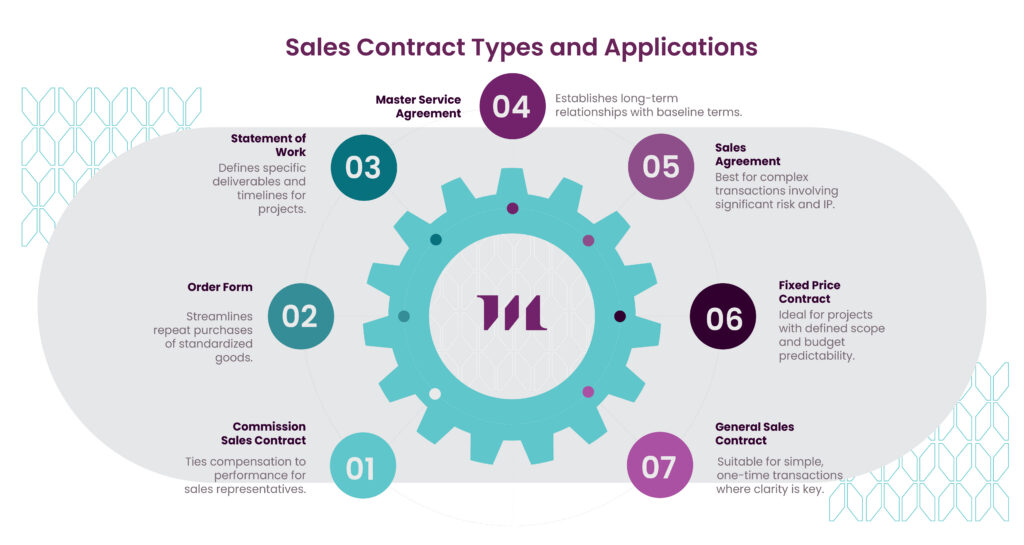
Ask 10 contract managers which contract type they reach for most, and you will likely get 10 different answers depending on their industry, deal volume, and risk tolerance. That variety makes sense because the real skill in contract management is selecting the right structure for the transaction in front of you. The sections below cover the most common types of sales contracts, with practical guidance on when each one earns its place.
General Sales Contract
A general sales contract is the workhorse of commercial transactions. It covers the essential terms of a sale, including the parties involved, a description of the goods or services, pricing, delivery conditions, and basic liability provisions. For straightforward, one time transactions where both sides understand what is being exchanged, this contract type delivers exactly what is needed without unnecessary complexity.
Experienced teams reach for a general sales contract when simplicity outweighs structural depth. A common sales contracts sample would be a wholesale supplier selling a defined quantity of materials to a manufacturer at an agreed price, with standard delivery and payment terms. Where teams run into trouble is when they stretch this structure beyond its intended scope. The moment a transaction involves ongoing deliverables or evolving requirements, a different contract type is almost always the better choice. A common mistake is using general sales contracts for ongoing relationships, which leads to repeated renegotiation and inconsistent terms over time.
Fixed Price Contract
A fixed price contract locks in the total cost of goods or services at the outset, giving both parties cost certainty for the duration of the agreement. This makes it a popular choice in construction, government procurement, and any industry where budget predictability is a priority.
That predictability comes with a tradeoff. If project scope shifts, material costs rise, or timelines extend beyond initial estimates, the seller absorbs the financial impact unless the contract includes provisions for change orders. Fixed price contracts work best when the scope is clearly defined, both parties have enough information to price the deal accurately, and the transaction is bounded enough that neither side faces outsized risk. Teams that default to this structure for complex, evolving engagements often find themselves renegotiating midstream, which erodes the very certainty the contract was supposed to provide. It’s worth noting that a fixed price is a commercial model rather than a standalone contract structure, and is often embedded within agreements like SOWs or sales agreements.
Sales Agreement
A sales agreement is a broader, more detailed legal sales contract that goes well beyond the basics covered in a general sales contract. It typically includes comprehensive warranty provisions, indemnification clauses, confidentiality requirements, dispute resolution mechanisms, and detailed conditions of sale.
The practical distinction comes down to scope and risk tolerance. When a transaction involves significant financial exposure, intellectual property considerations, or regulatory requirements, a sales agreement provides the structural detail necessary to protect both sides. That detail typically extends to liability exposure as well: sales agreements commonly include caps on damages, carve-outs for fraud or gross negligence, and defined indemnity obligations that allocate risk between the parties. Real estate transactions, enterprise software licensing, and large scale equipment purchases commonly rely on this type of contract of sale. The key question for contract managers is whether the transaction’s complexity justifies the additional drafting and negotiation time.
Master Service Agreement (MSA)
Think of an MSA as the foundation for a long-term business relationship rather than a document tied to any single transaction. A Master Service Agreement establishes the baseline terms and conditions, including liability allocation, intellectual property rights, payment structures, and dispute resolution procedures, that will govern all future work between the two parties. At this stage, paper strategy becomes critical—whether the parties are negotiating on the seller’s paper or the buyer’s—because it directly impacts negotiation speed, redlining complexity, and risk posture.
The strategic value of an MSA lies in what it eliminates: the need to renegotiate foundational terms with every new project or engagement. Once in place, subsequent transactions can be executed through simpler documents like SOWs or order forms that reference the master agreement. Getting an MSA right requires upfront investment, because the initial negotiation is typically more intensive than a standard sale contract. Teams that rush through this process often pay for it later, when ambiguities in the baseline terms create friction in every downstream agreement. These issues are often compounded when there is no clear hierarchy established between the MSA and downstream documents like SOWs or order forms.
Statement of Work (SOW)
A Statement of Work is the project level document that defines what will actually be delivered, when, and to what standard. Where an MSA establishes the relationship framework, an SOW gets specific: deliverables, milestones, acceptance criteria, timelines, and pricing for a particular engagement.
The most effective SOWs are detailed enough to prevent scope disputes but flexible enough to accommodate reasonable adjustments through defined change management processes. Because SOWs define execution-level detail, they are often the primary source of operational obligations that must be actively tracked after signature. An overly rigid SOW leaves zero room for inevitable adjustments, while an overly vague one invites scope creep. SOWs are commonly paired with MSAs in professional services, IT consulting, and construction, though they also serve well as standalone sales contracts for defined project engagements.
Order Form
An order form is a standardized document designed to make repeat purchasing fast and consistent. Instead of drafting a new contract for every transaction, the buyer fills in quantities, product selections, and delivery preferences. Once both parties sign, the order form becomes a legally binding agreement for that specific purchase. This efficiency makes order forms ideal for companies that sell standardized goods or services in volume.
A governance detail that teams sometimes overlook is what happens when an order form references an MSA or broader sales agreement. Conflicts between the terms in each document can create ambiguity about which provisions control, so establishing a clear hierarchy of documents before rolling out order forms is essential. Typically, the MSA governs in the event of conflict, followed by the SOW, with the order form controlling only transaction-specific details, but this hierarchy must be explicitly defined.
Commission Sales Contracts
Commission sales contracts tie compensation directly to performance, making them a standard structure in sales organizations across industries. These contracts define commission rates, qualifying transactions, payment timing, quota structures, and clawback provisions that apply when deals fall through or customers cancel.
Unlike other types of sales contracts on this list, commission sales contracts are internal facing agreements between a company and its sales representatives rather than between a buyer and a seller. That distinction matters because disputes over commission payments escalate quickly into employee relations issues, and ambiguity in commission terms is one of the most common sources of sales team attrition. Well structured commission sales contracts specify exactly what event triggers a payment, whether that is contract execution, delivery, or payment receipt, and align those triggers with the company’s revenue recognition policies. Unlike other contract types discussed here, these are internal agreements, which introduces a different set of legal and operational considerations.
What Special Rules Apply to Sales Contracts?
If you have ever wondered what special rules apply to sales contracts beyond standard contract law, the answer depends on the jurisdiction and the type of goods or services involved.
In the US, the Uniform Commercial Code (UCC) Article 2 governs the sale of goods and imposes specific requirements that differ from general contract principles. For example, the UCC allows a contract of sale to be enforceable even without specifying every term, as long as the parties intended to form an agreement. The Statute of Frauds adds another layer, requiring written documentation for sales contracts involving goods valued at $500 or more. Under UCC Article 2, any sale of goods for $500 or more generally must be in writing and must specify quantity, or the agreement risks being unenforceable in court. Another important concept under UCC Article 2 is the ‘battle of the forms,’ where conflicting terms in buyer and seller documents can still result in a binding contract, with courts determining which terms apply.
International transactions introduce the United Nations Convention on Contracts for the International Sale of Goods (CISG), which applies automatically to cross border sales between parties in signatory countries unless the contract explicitly opts out. Industry specific regulations in government procurement, healthcare, and financial services add further compliance requirements that override general commercial practice.
Choosing the Right Contract Type: A Decision Framework
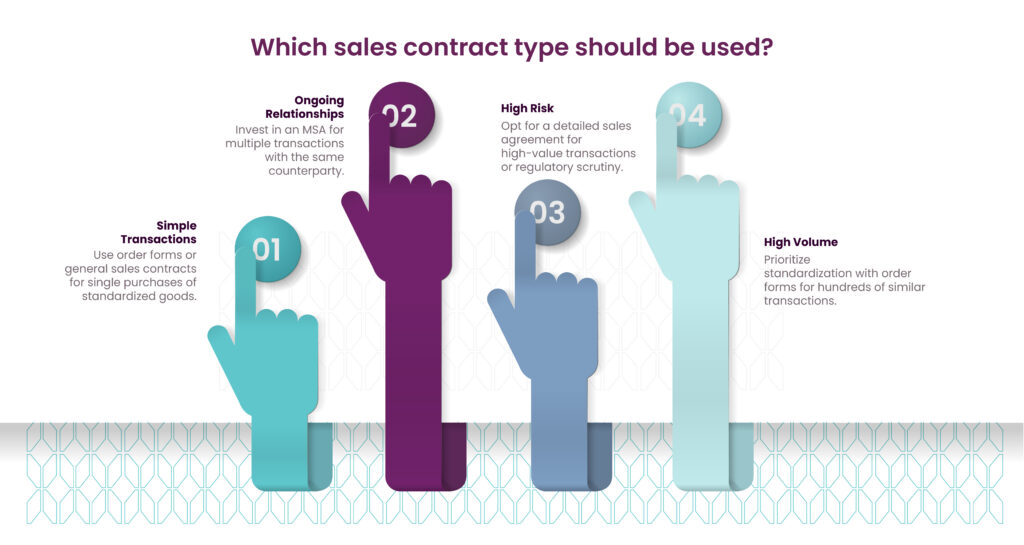
Here is something the standard articles about types of sales contracts rarely offer: a repeatable framework for deciding which contract type fits your situation. Four variables should drive the decision.
- Transaction complexity determines the minimum level of contractual detail required. A single purchase of standardized goods can run on an order form or general sales contract, while a multiphase service engagement demands an SOW, likely backed by an MSA.
- Relationship duration dictates whether you need a one time agreement or a framework for ongoing dealings. If you expect multiple transactions with the same counterparty, investing in an MSA now saves significant time and legal costs later.
- Risk exposure shapes how much protective language the contract needs. High-value transactions and agreements subject to regulatory scrutiny call for the comprehensive protections of a detailed sales agreement rather than a lightweight general sales contract.
- Operational volume influences whether standardization should be a priority. Teams processing hundreds of similar transactions per quarter benefit from the consistency of order forms, while teams handling fewer, complex deals need individually negotiated agreements.
When these four variables are evaluated together, the appropriate contract type usually becomes clear.
Where Sales Contract Management Breaks Down at Scale
Anyone who has navigated contract management challenges as a portfolio grows knows the pattern. What works at fifty contracts per quarter starts cracking at five hundred.
Version control becomes a persistent issue when multiple stakeholders contribute edits across scattered systems. Approval bottlenecks emerge when routing logic is manual. Compliance risk increases when regulations change, and there is no efficient way to identify which active contracts are affected. These problems share a common root: manual processes that cannot scale with contract volume. For teams managing diverse types of sales contracts, each with different approval paths and lifecycle stages, the operational complexity multiplies faster than headcount can keep up. Data fragmentation becomes a major issue as different contract types store critical information in inconsistent formats across systems.
How CLM Platforms Turn Contract Types Into Workflow Advantages
If the previous section described the problem, this one describes the infrastructure that solves it. Contract Lifecycle Management platforms transform contract type selection from a one time administrative task into a continuous operational advantage.
Malbek, a CLM platform built with AI at its core from day one, addresses these scale challenges through capabilities designed for high volume contract management. The hierarchy conflicts between MSAs, SOWs, and order forms discussed earlier in this article can be systematically enforced through structured workflows that define which document controls in any given scenario, eliminating the ambiguity that leads to disputes. The platform’s Ensemble LLM approach uses multiple large language models working together, dynamically selecting the best model for each use case and validating outputs through a chain of verification mechanisms with confidence scoring at every step. This delivers more accurate and reliable results for contract review, clause extraction, and compliance analysis than single model approaches.
Malbek’s automated playbook feature runs compliance checks against reference standards without manual intervention, flagging deviations and recommending corrective action. Smart tagging capabilities classify and map clauses across the entire agreement portfolio, making it possible to search, analyze, and report on contract terms at scale. The obligation tracking challenge that surfaces most often with SOWs and performance based agreements is addressed through automated milestone and renewal alerts, ensuring that post-signature commitments are monitored rather than forgotten. The authoring assistant and clause assessment tools help teams draft, evaluate, and route contracts based on favorability and risk alignment. Bek, Malbek’s AI chatbot, guides users through contracting workflows via typed prompts or voice commands.
For organizations managing multiple types of sales contracts simultaneously, Malbek’s centralized repository and intelligent workflow routing ensure that each contract type follows the correct approval path and remains accessible for audit throughout its lifecycle. Because the platform routes contracts dynamically based on contract type, risk level, and deal value, the decision framework outlined above becomes an operational reality rather than a theoretical exercise.
FAQ
What are the key differences between MSA and SOW?
An MSA establishes the overarching terms for a long-term relationship, covering foundational issues like liability, intellectual property, and dispute resolution. An SOW defines specific deliverables, timelines, and pricing for an individual project. MSAs are broad and enduring, while SOWs are narrow and project specific. In practice, an SOW often operates under an existing MSA, inheriting its baseline terms while adding project level detail.
Fixed price vs cost-plus sales contracts – What is the difference?
A fixed price contract sets a firm total cost at the outset, placing the financial risk of cost overruns on the seller. A cost plus contract reimburses the seller for actual costs plus an agreed fee or percentage, shifting more risk to the buyer. Fixed price works best when the scope is well defined. Cost plus suits projects where the scope is uncertain or likely to evolve.
What are the essential clauses for sales agreements?
Every strong sales agreement should include the following core provisions:
- Clear identification of the parties
- A detailed description of goods or services
- Pricing and payment terms
- Delivery conditions and logistics responsibilities
- Warranty provisions
- Indemnification language
- Limitation of liability
- Confidentiality obligations
- Termination rights and exit conditions
- A dispute resolution mechanism (mediation, arbitration, or litigation)
Force majeure and amendment clauses are also considered standard for agreements involving significant value or extended timelines.
When to use order form vs purchase order?
An order form is typically a seller issued document that allows the buyer to select from predefined options and submit a binding request. A purchase order originates with the buyer and specifies what they want to purchase, at what price, and under what conditions. Order forms work well for standardized, recurring purchases, while purchase orders suit transactions where the buyer needs to dictate terms or maintain a buyer initiated document trail. When both documents are exchanged with conflicting terms, the UCC’s “battle of the forms” doctrine may determine which provisions govern, so reviewing the other party’s document carefully is essential.
What are common mistakes in sales contract structuring?
Five structuring mistakes come up repeatedly across contract management teams:
- Using SOWs without an MSA in place. Each new SOW requires full negotiation of baseline terms, creating inconsistency and wasted cycles across engagements with the same counterparty.
- Misaligning the pricing model with the contract structure. Embedding a fixed price model in a contract where scope is likely to shift creates renegotiation pressure that the structure was never designed to handle.
- Failing to define a document hierarchy. When an order form, SOW, and MSA all govern the same relationship without a clear order of precedence, conflicting terms become inevitable.
- Overloading MSAs with operational detail. MSAs should establish relationship level terms, while project level specifics belong in SOWs. Mixing the two makes the MSA harder to negotiate and harder to reuse.
- Using inconsistent templates across teams. When different departments draft sales contracts from different starting points, compliance gaps and version control issues multiply with every new agreement.
Bringing It All Together
The difference between a contract portfolio that runs smoothly and one that generates constant friction often comes down to a single upstream decision: whether the team chose the right contract type for each transaction. That decision doesn’t just affect negotiation, but also determines how revenue is recognized, how obligations are tracked, and how contract data can be analyzed across the business.
Three principles worth keeping close as you evaluate your contract workflows:
- Contract type selection is a strategic decision, and the four variables of complexity, duration, risk, and volume should guide every choice.
- Foundational agreements like MSAs deserve disproportionate investment upfront, because every SOW, order form, and renewal that follows inherits their strengths or their weaknesses.
- Manual processes that work at low volume will break at scale, and the gap between those two states closes faster than most teams expect.
Malbek’s CLM platform is built to help contract teams act on all three. Request a demo to see how automated playbooks, Ensemble LLM analysis, and contract intelligence can support your team’s next step.
Sources
- Association of Corporate Counsel, “2023 True Impact CLM Benchmark Report,” https://www.acc.com/sites/default/files/resources/upload/2023-True-Impact-CLM_Benchmark-Report.pdf
- JD Supra, “Quantity Requirements Under UCC Art. 2,” https://www.jdsupra.com/legalnews/quantity-requirements-under-ucc-art-2-4121172/