




What Is Commercial Intelligence? Definition, Types, and Outcomes

Every year, businesses lose close to $2 trillion in global economic value to poor agreement management. That figure comes from 2024 research by Deloitte, which also found that organizations burn more than 55 billion hours wrestling with information locked inside contracts and other documents — data that rarely reaches the systems where decisions get made.
The data exists. The intelligence doesn’t. That is the difference between storing information and using it. The organizations pulling ahead turn a static contract repository into an Intelligence Core — a living, queryable layer that reads every agreement and surfaces what it means, not just where it sits. Most of what a company knows about its own commercial relationships sits dormant in signed agreements, scattered across two dozen systems, waiting for someone to ask the right question.
For a CFO forecasting cash flow, a Chief Procurement Officer renegotiating supplier terms, or a Chief Strategy Officer weighing an acquisition, that dormant data is the difference between a confident decision and an educated guess. The leaders who turn it into insight move faster and protect more value than the ones who can’t.
Commercial intelligence is the discipline built to close that gap. In this article, we’ll define what commercial intelligence is, separate it from the business intelligence you already use, map the related intelligence types it draws on, show what it delivers for the C-suite, and lay out how to evaluate a platform. Let’s start with the definition.
What Is Commercial Intelligence?
Commercial intelligence is the discipline of turning an organization’s commercial data — its contracts, transactions, and supplier and customer relationships — into forward-looking insight that drives revenue, cost, and risk decisions. Where traditional reporting tells you what already happened, commercial intelligence points to what will or could happen next, and what to do about it.
What is commercial intelligence?
Commercial intelligence is the practice of analyzing an organization’s commercial data — especially the terms and obligations buried in its contracts — to surface forward-looking insight about revenue, cost, and risk. It converts scattered records into decisions leaders can act on.
The mechanism is straightforward in principle, even if the technology behind it is not. Raw commercial data is extracted from its sources, analyzed for patterns and relationships no human reviewer could catch across thousands of documents, and translated into insight a decision-maker can use. The quality of the output depends entirely on how much of that data the system can actually read and connect.
That’s why contracts matter so much here. A signed agreement is statement-of-truth data: the obligations, prices, renewal dates, penalties, and liabilities a company has formally committed to. It is the most authoritative record of a commercial relationship that exists — and in most organizations, the least analyzed. Commercial intelligence, sometimes discussed under the broader banners of corporate intelligence or data intelligence, treats contract data as a primary source rather than an archive.
Commercial Intelligence vs. Business Intelligence
Business intelligence reports what already happened; commercial intelligence predicts what will or could happen and points to the next move. The distinction matters because the two are easy to conflate, and conflating them leads teams to expect foresight from tools built for hindsight.
Business intelligence (BI) is the established discipline of collecting historical data and presenting it through dashboards, reports, and visualizations — revenue by quarter, spend by category, performance against targets. Enterprise business intelligence does this at scale across departments. It is descriptive and backward-looking by design, and very good at answering “what happened?”
Commercial intelligence answers a different question: “what should we do next, and where is the value or risk we can’t yet see?” It draws heavily on unstructured data — contract language, terms, obligations — that BI dashboards typically never touch. A BI dashboard can tell you supplier costs rose 6% last quarter. Commercial intelligence can tell you which contracts contain the price-escalation clauses driving that increase, which ones renew before you can renegotiate, and what your exposure looks like if the trend holds.
That difference has a name. A contract repository — even a well-organized one — is an archive that answers “where is the contract?” Intelligence Core answers “what are the contracts telling us?” The shift from a static repository to a living, queryable Intelligence Core is what separates a commercial intelligence platform from the CLM and BI systems most teams already run.
The Intelligence Types Behind Commercial Strategy
Commercial intelligence is the umbrella discipline, but it draws on several more specialized intelligence types. Seeing how they fit together clarifies what a complete commercial intelligence capability actually requires.
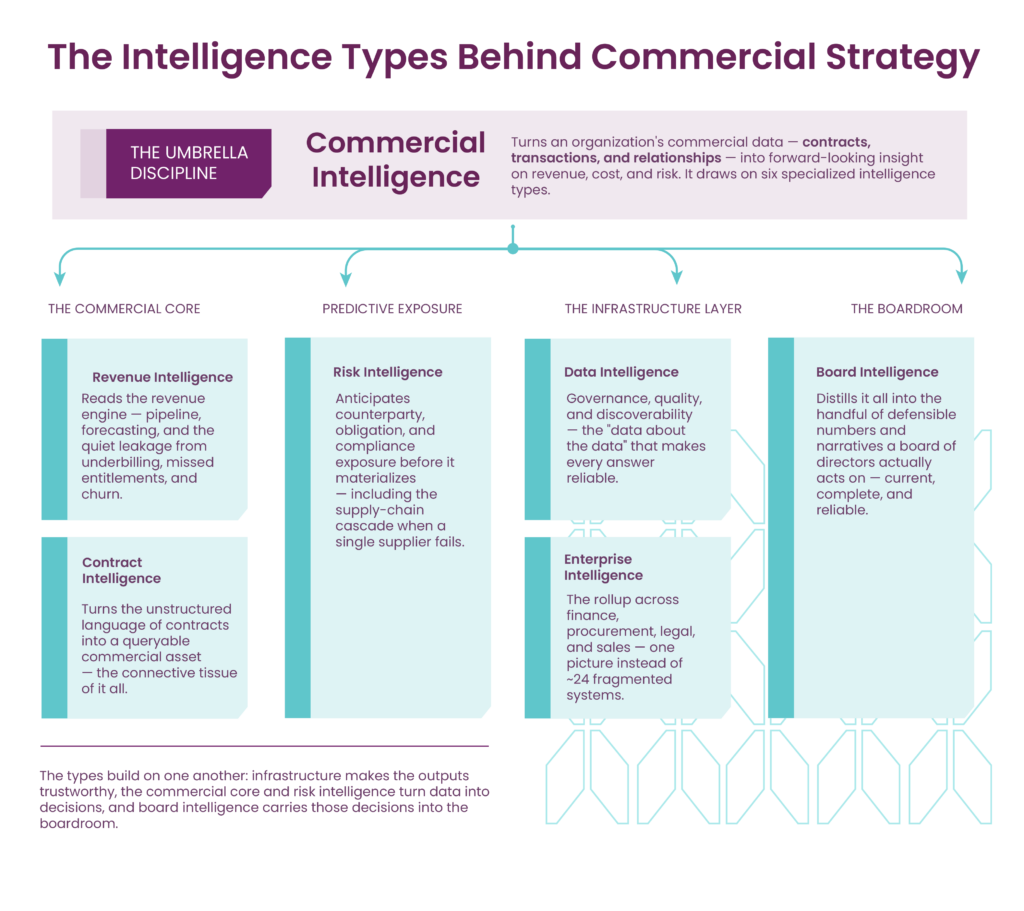
Revenue and Contract Intelligence: The Commercial Backbone
Revenue intelligence applies analysis and AI to the revenue engine — pipeline, forecasting, and the quiet revenue leakage that comes from underbilling, missed entitlements, or predictable churn. A revenue intelligence platform helps commercial teams see where money is being won and lost close to real time.
Contract intelligence extracts structured, usable insight from the unstructured language of contracts: obligations, renewal terms, liabilities, and the relationships between them. Because contracts are where commercial commitments are actually recorded, contract intelligence solutions are the connective tissue of commercial intelligence — the link between what a company agreed to and what it can act on. If you’re asking what contract intelligence is and why it matters at the executive level, the short answer is that it turns the most authoritative commercial record a company holds into a queryable asset.
Risk Intelligence: Predictive and Supply-Chain Exposure
Risk intelligence uses data and analytics to anticipate threats before they materialize rather than reacting after they do. In a commercial context, predictive risk intelligence is applied to counterparties, obligations, and compliance exposure — flagging the contract that auto-renews on unfavorable terms, the supplier whose dependency creates single-point-of-failure risk, or the clause that triggers liability under a regulation that just changed.
Supply chain risk intelligence is a particularly high-stakes branch. A single supplier’s failure can cascade through dependent contracts, and the exposure is often invisible until it lands. Mapping those dependencies before disruption strikes is one of the clearest examples of commercial intelligence earning its keep.
Data and Enterprise Intelligence: The Infrastructure Layer
Beneath the commercial outputs sits the infrastructure that makes them trustworthy. Data intelligence is the governance, quality, and discoverability layer — the “data about the data” that determines whether the insight a system produces can be relied on at all. Without it, commercial intelligence produces confident answers built on incomplete or duplicated inputs.
Enterprise intelligence describes the rollup: insight integrated across departments and systems, so finance, procurement, legal, and sales work from the same picture rather than fragmented views. Enterprise intelligence solutions exist precisely because, as World Commerce & Contracting research found, contract data in medium-to-large businesses is typically spread across roughly 24 separate systems. Unifying that fragmented data is a prerequisite for intelligence that spans the whole organization.
Board Intelligence: From Insight to the Boardroom
Board intelligence distills commercial and operational data into the handful of numbers and narratives a board of directors actually acts on. It overlaps with board business intelligence and the software for board of directors used to prepare governance materials. What separates board-grade intelligence from a standard report is reliability: a board makes decisions worth tens or hundreds of millions of dollars, and the intelligence it acts on has to be defensible, current, and complete.
What Commercial Intelligence Delivers for the C-Suite
Commercial intelligence pays off in three currencies the C-suite cares about: discovered money, avoided exposure, and decisions made with confidence rather than guesswork.
Start with the cost of doing nothing. World Commerce & Contracting (formerly IACCM) has tracked average contract value erosion at close to 9% — the share of a contract’s value that quietly leaks away through missed obligations, unfavorable renewals, and overlooked terms. The spread is telling: top performers hold that erosion to around 3%, while the worst performers lose 15–20%. The difference is rarely company size. It’s how actively the commercial data is read and used.
Commercial intelligence attacks that gap through opportunity assessment — the systematic surfacing of revenue, savings, and negotiation leverage hidden in commercial data. In procurement, a cost reduction opportunity assessment identifies where consolidated spend, renegotiated terms, or curbed off-contract spending can recover margin. A procurement opportunity assessment grounded in actual contract data, rather than spreadsheets and memory, tends to find money that manual review misses.
The broader outcomes follow the same logic: revenue protection by catching leakage before it compounds, cost reduction by exposing unfavorable terms while there’s still time to act, proactive risk mitigation by surfacing exposure ahead of disruption, and faster M&A diligence by reading a target’s entire contract portfolio in hours instead of weeks. Each is a board-level outcome, which is why commercial intelligence is increasingly a C-suite concern rather than a back-office one.
Commercial Intelligence by Industry: Healthcare, Manufacturing, and Finance
Commercial intelligence reshapes itself for each vertical. The data and the questions change; the method holds.
Healthcare and Life Sciences
In healthcare and life sciences, the term healthcare commercial intelligence often refers to market and provider intelligence — data on physicians, facilities, and prescribing patterns used by sales and marketing teams. That’s a distinct discipline from the contract-derived commercial intelligence discussed here, and it’s worth keeping the two straight when evaluating pharmaceutical commercial intelligence tools or healthcare business intelligence software.
The contract-derived view answers different questions, and for pharma and healthcare leaders they’re often the more financially material ones: optimizing and forecasting rebate liability before it surprises the quarter, resolving payer-contract conflicts that quietly cost reimbursement, accelerating M&A due diligence on a target’s agreements, and analyzing clinical trial agreements for obligations and risk.
The scale of the challenge is real. A large pharma manufacturer with 2,500+ payer contracts across multiple therapeutic areas once faced a board-level question no one could answer quickly: “Which products have supplemental rebates, by product, by channel?” Compiling that manually would have taken weeks. With BusinessIQ’s LIVEGraph℠ already indexing the contract portfolio, Context Threading™ identified 67 contract families carrying $127M in supplemental rebate liability — and a segment of 23 payers flagged for restructuring — in time to deliver a board-ready presentation in one hour.
The Bek query that unlocked it:
“Show me all payer contracts with supplemental rebate clauses, grouped by product and channel, and flag any where the rebate terms differ across therapeutic areas.”
Manufacturing
In manufacturing, the contract risk that keeps a Chief Supply Chain Officer up at night isn’t always the risk they can see, it’s the cascade they can’t. A single supplier failure can ripple through dozens of dependent contracts before anyone has mapped the exposure.
That’s exactly what one Automotive Tier 1 supplier faced when tariffs were announced affecting their Canadian supply base. The question from leadership was immediate: “What are the downstream effects, and what’s our total exposure across manufacturing commitments?” Context Threading™ mapped the answer in under five minutes: one affected supplier had provisions across 28 contracts, 12 had price protection and 16 did not, and two of those 16 represented the most critical supply chain dependencies. Within six hours, the Chief Supply Chain Officer had negotiated ahead of the disruption. $128M in exposure was averted.
The Bek query that started the clock:
“Which of our supplier contracts lack price protection clauses, and what’s our total exposure if tariffs increase raw material costs — show me the downstream contracts dependent on each affected supplier.”
Financial Services
In financial services, the commercial risk buried in contracts tends to be quieter but no less costly — vendor consolidation opportunities left on the table, regulatory-compliance exposure scattered across hundreds of agreements, and covenant terms that carry real penalties when missed.
For a PE-backed software company managing 23,000+ contracts across seven acquired product lines, the question was consolidation: which enterprise customers had relationships with multiple portfolio companies, and where was the pricing inconsistent? Context Threading™ surfaced 1,247 customers with contracts across two or more portfolio companies, including 134 enterprise accounts with four or more — one major bank alone had six separate contracts totaling $12M annually at inconsistent rates. A unified commercial approach to those 134 accounts generated $67M in incremental ARR.
The Bek query that revealed it:
“Which customers appear across more than one portfolio company, what is their total contract value across all entities, and where are there pricing inconsistencies for the same or equivalent services?”
How to Evaluate a Commercial Intelligence Platform
The commercial intelligence category is young, which means sound evaluation criteria matter more than feature checklists. When comparing commercial intelligence tools or a broader enterprise business intelligence solution, weigh the few things that separate genuine intelligence from dressed-up reporting:
- Depth and completeness of extraction. How much of a contract does the platform actually read — a few dozen metadata fields, or the full text including tables and exhibits? Shallow extraction produces shallow intelligence.
- Accuracy and verifiability. Can you trust the output enough to put it in front of a board? Look for how the platform validates its own answers and whether it shows its work, not just whether it sounds confident.
- Onboarding effort. Does the platform require a lengthy data migration, or can it work against your existing repositories? The faster it reaches first insight, the sooner it earns its cost.
- How you query it. Day-to-day usefulness depends on whether a non-technical executive can ask a question in plain language and get a reliable answer, or whether every query routes through an analyst.
- Board-readiness and security. The output has to be defensible, and the underlying data has to be access-controlled — especially the contract terms that rank among a company’s most sensitive records.
Because commercial intelligence is still a new category, the buying criteria aren’t yet standardized the way they are for established BI tools. Evaluating against these fundamentals, rather than a checklist of features, is the safer path while the category matures.
Commercial Intelligence with Malbek BusinessIQ
By now the tension is clear: the commercial data already exists, but the intelligence to act on it usually doesn’t. Many organizations have centralized their contracts and still can’t answer a question as basic as “where is our largest renewal risk this quarter?” without weeks of manual review.
Malbek BusinessIQ is built to close exactly that gap. It’s positioned as the first Commercial Intelligence Platform — a category distinct from contract lifecycle management, designed to turn a contract repository into an Intelligence Core: a living, queryable layer of commercial insight rather than a static archive. The shift it represents is from treating contracts as operational records to treating them as strategic intelligence assets.
Malbek didn’t add intelligence to an existing category — it created a new one. Not to stake a marketing claim, but because no CLM tool and no AI point solution was built to answer the questions the C-suite actually needs answered in real time. BusinessIQ exists because that need was real and unmet.
Three technologies do the work. LIVEGraph℠ builds a continuously learning map of commercial relationships across the entire portfolio by processing every contract paragraph by paragraph, table by table, exhibit by exhibit — creating thousands of indexed data points (versus the 50–200 of standard extractions). Ensemble LLM cross-references outputs across multiple models and reconciles them for consistency. Context Threading™ then pulls threads of commercial meaning across that index, surfacing patterns, dependencies, and opportunities invisible to traditional analysis — producing intelligence reliable enough to put in front of a board. Bek, Malbek’s conversational AI assistant, makes the whole thing accessible: a CFO can ask, “Show me every contract with a price-escalation clause renewing in the next 90 days,” and get an answer in minutes.
The results are measured in real money. One pharmaceutical CFO used BusinessIQ to surface $127 million in rebate liability in 30 days. This is the kind of exposure that, left unread in the contracts, would have hit the quarter unannounced. That’s the difference between managing contracts and commanding commerce. This is a shift from a static repository to living commercial consciousness a leadership team can run on.
Frequently Asked Questions About Commercial Intelligence
Conclusion
The commercial data is already yours. Every obligation, price, renewal, and liability your organization has committed to is sitting in a contract somewhere — and for most companies, the vast majority of it has never been read closely enough to inform a decision. That’s the gap commercial intelligence exists to close: not by collecting more data, but by putting the data you already have to work.
The shift is from managing contracts as operational records to commanding commerce with the intelligence locked inside them. For the CFO, CPO, CCO, CSO, and CSCO, that shift increasingly separates the organizations that see risk and opportunity coming from the ones that find out too late.
You’ve mastered your contracts. The next move is commanding your commerce.