




The Missing Layer in Your Decision Intelligence Stack: Contracts

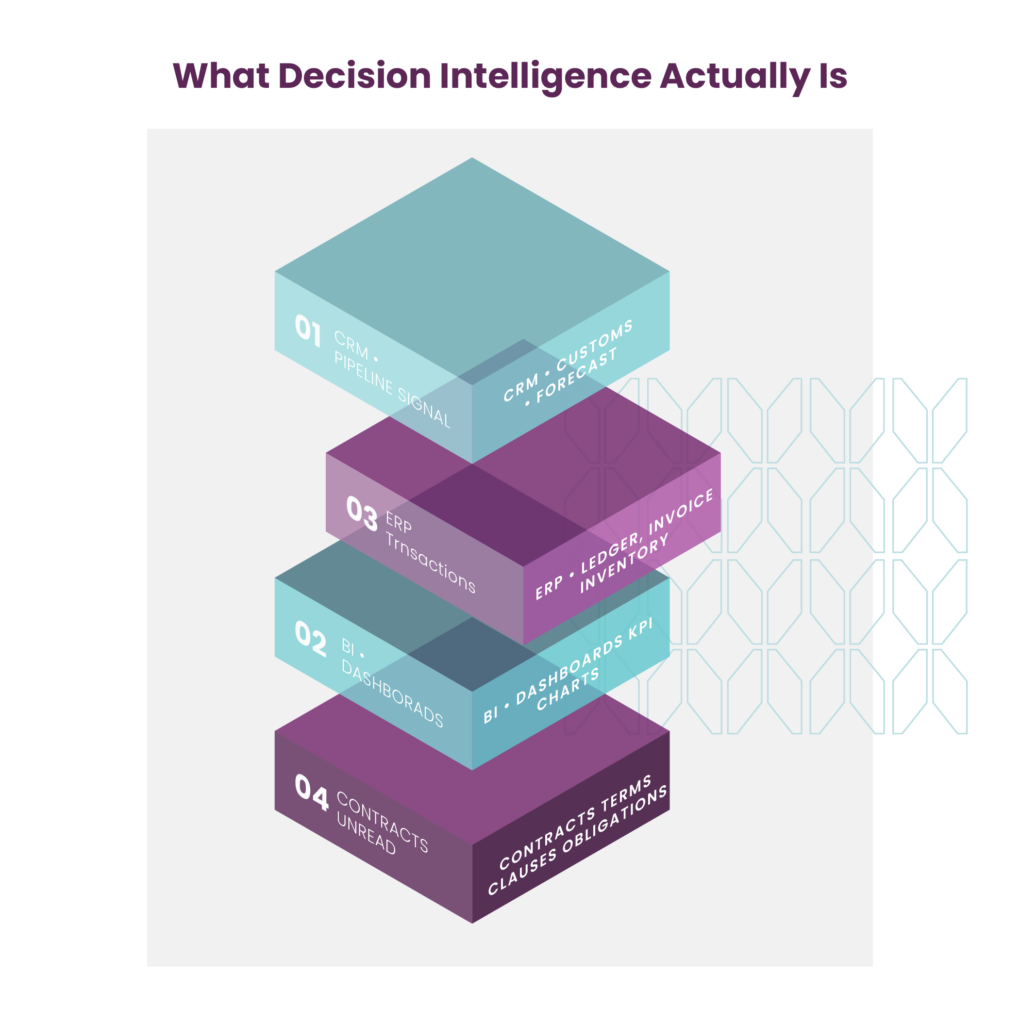
Your CRM tells you which deals are in the pipeline. Your ERP tells you what you’ve shipped and billed. Your BI dashboards tell you what happened last quarter and where the variance came from. None of them can tell you what your company is actually committed to — because that lives in your contracts, and most decision intelligence stacks have never read them.
That’s the gap. Decision intelligence has matured around structured operational data: transactions, tickets, marketing touches, sensor readings, financial postings. The commercial commitments that govern every one of those data points — pricing, obligations, indemnities, renewal economics, escalation clauses — sit in PDFs and Word files no model has ingested. For a CFO modeling renewal cash flow, a CCO measuring discount leakage, a CPO mapping supplier risk, or a General Counsel tracking regulatory exposure, the absence of contract data is the difference between a decision and a guess.
This article makes the case for treating contracts as the missing data layer in your decision intelligence stack. We’ll cover what DI actually is, why contracts belong inside it, which decisions improve when they’re in the model, and what it takes to operationalize all of this without handing your judgment over to a black box.
What Decision Intelligence Actually Is (And Where BI Stops)
Decision intelligence (DI) is the discipline of engineering decisions the way an organization engineers any other repeatable process. Gartner, which has tracked the field across its strategic technology trend reports, frames DI as a practical discipline that improves how decisions are made and how their outcomes are evaluated, managed, and refined through feedback. In its 2025 AI Hype Cycle, Gartner labeled DI a “transformational” technology, with current adoption at 5–20% and a two-to-five-year horizon to mainstream maturity.
The simplest way to understand DI is to compare it with traditional business intelligence. BI visualizes data you’ve already collected and structured — last quarter’s revenue, this month’s churn, average deal cycle by region. It tells you what happened and, with effort, why. Decision intelligence goes further: it combines data, models, and human judgment to recommend or automate what to do next. A BI dashboard shows that supplier concentration has crept up over four quarters. A DI system flags which renewals to renegotiate, in what order, with which fallback positions, and what the projected cost reduction looks like.
The shift from BI to DI usually happens when descriptive dashboards stop answering the strategic questions you’re being asked. When a CFO needs to know not just what Q3 revenue was but what Q4 revenue will be given current renewal exposure and known clause-driven risks — and what to do about it — BI alone runs out of room. DI brings three components together to fill that gap: data (operational, financial, and contractual), models (predictive and prescriptive), and human expertise (the judgment that says which recommendation to act on and which to override).
Why Contracts Are the Missing Data Layer
Most DI implementations train on the same data sources: CRM records, ERP transactions, support tickets, marketing automation logs, web analytics. These are clean, structured, and easy to feed into a model. Contracts are none of those things. They’re long-form documents, written in lawyer-readable prose, stored in repositories no one queries.
The scale of that gap is well documented. A 2023 benchmark study from World Commerce & Contracting (WorldCC) found that in medium-to-large organizations, contract data is housed in an average of 24 different systems — email, shared drives, departmental repositories, signed-PDF folders, and case management tools. The same body of research has long held that a typical Fortune 1000 company maintains between 20,000 and 40,000 active contracts at any given time. Even when those contracts are technically “digital,” the substantive terms — pricing, obligations, liability caps, MFN clauses, termination rights — remain locked in unstructured text no analytics tool has parsed.
The consequence isn’t theoretical. WorldCC’s most recent benchmarking work pegs average contract value erosion at nearly 9 percent — the share of contracted value that quietly disappears through missed renewals, unbilled obligations, unenforced SLAs, and overlooked penalty clauses. A separate 2024 report from WorldCC and Deloitte found that only 39% of legal and contract professionals believe contracts are achieving their intended goals, and that 76% report inefficiencies in contract processes.
Translate that into decision-making terms. A revenue forecast that doesn’t model MFN, ramp, and rebate clauses will overstate Q4. A supplier risk model that ignores auto-renewal exposure and termination-for-convenience asymmetries will understate concentration risk. A pricing decision blind to non-standard discount terms in active deals will miscalculate what your effective floor really is. Contracts aren’t just legal documents. They’re the structured record of every commercial commitment your business has made — if you can get them out of the PDF.
The Decisions Contracts Inform — By Function
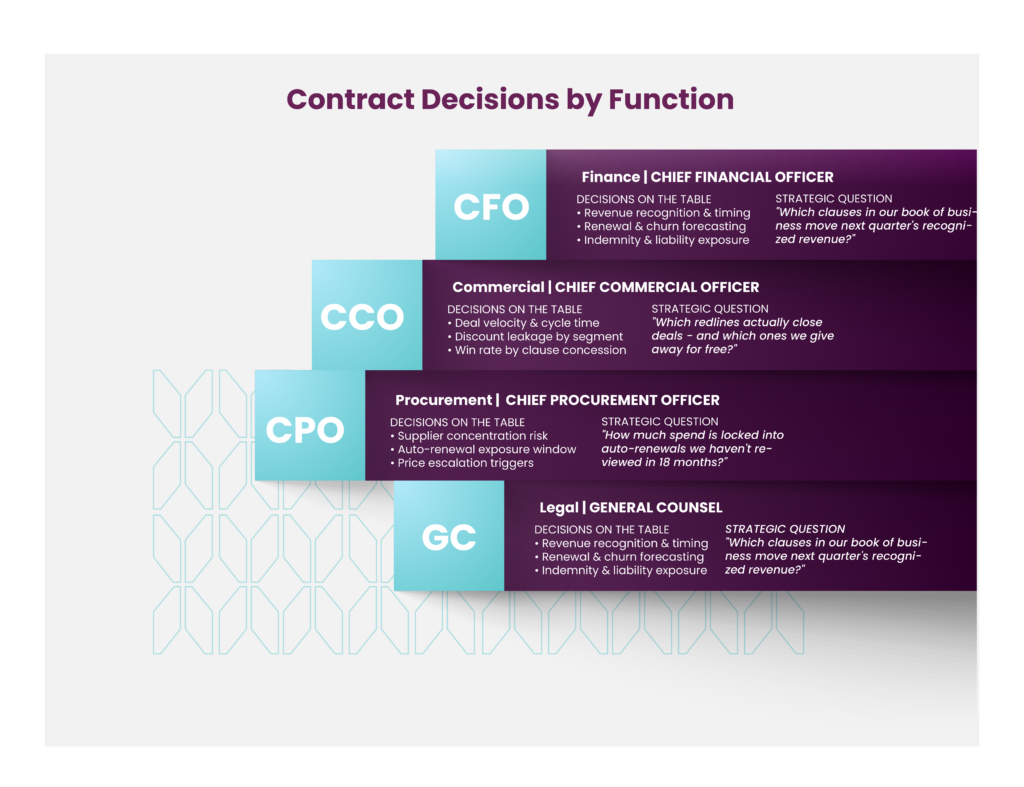
Contract data isn’t a single use case. It’s the connective tissue between four functions whose decisions sit on top of contractual terms. The strategic question isn’t “should we extract more contract data” — it’s “which decisions, in which functions, are currently being made without it.”
For the CFO — Revenue, Cash, and Exposure
Finance leaders make three classes of decisions that depend directly on contract terms. Revenue recognition timing under ASC 606 hinges on performance obligations defined clause by clause, often with variability buried in milestone language no spreadsheet sees. Renewal forecasting and obligation-driven cash flow projections require knowing exactly which contracts auto-renew, which require active extension, which carry price escalators, and which include early-termination clauses with penalty offsets. Indemnity and liability exposure across the portfolio is the third — and the one most finance teams can’t quantify until a customer actually invokes a clause.
The strategic question a CFO can’t answer well from the GL alone: “What is our aggregate liability cap exposure if our top three customers invoke indemnity simultaneously, and which contracts include the carve-outs we’d actually be able to enforce?”
For the CCO — Deal Velocity and Discount Leakage
Commercial leaders manage two contract-driven levers that BI dashboards typically miss. The first is deal velocity by clause deviation: every non-standard term added in negotiation extends the legal review cycle, sometimes by days. Knowing which clause types most often slow deals down — and which reps consistently introduce them — converts a vague complaint about “slow legal” into a targeted process fix. The second is discount leakage: not the headline discount on the order form, but the cumulative cost of non-standard payment terms, extended warranty, free professional services, or favorable termination rights granted to close.
The strategic question: “Which sales reps consistently agree to non-standard payment terms, and what’s it costing us in DSO?” Without contract data structured for analysis, that question gets answered by anecdote.
For the CPO — Supplier Risk and Renewal Exposure
Procurement leaders increasingly own three risk decisions that depend on portfolio-level contract intelligence. Supplier concentration risk — how much spend sits with how few vendors — is the standard one. Auto-renewal exposure is the second: contracts that quietly renew at unfavorable terms because no one tracked the notice window. The third is price-escalation clause inventory: knowing across the supplier base which contracts include CPI-linked escalators, which include fixed annual increases, and what the cumulative exposure looks like over the next 36 months.
The strategic question: “Which auto-renewals fire in the next 90 days, and what’s the cumulative spend at stake if we don’t intervene?” The contracts already contain the answer. Most procurement teams don’t have a way to ask.
For the GC — Risk Posture and Regulatory Exposure
General counsel make decisions that depend on patterns across the contract portfolio rather than on individual agreements. Clause deviation patterns answer the question of how far the portfolio has drifted from the playbook standard, and where. Regulatory exposure mapping identifies which contracts fall under GDPR, HIPAA, the EU AI Act, DORA, or sector-specific rules — and whether the relevant clauses have been updated as those rules have evolved. Litigation precedent feeds back into the playbook itself: which clause language has actually triggered disputes, and which contracts still use it.
The strategic question: “Which contracts use the indemnity language we lost on in the last arbitration, and what’s the renewal sequence to remediate them?”
The Decision Intelligence Maturity Curve, Applied to Contracts
Decision intelligence maturity follows a recognizable arc — descriptive, diagnostic, predictive, prescriptive. Most contract operations are stuck on the first rung. Moving up the curve is where the value lives, and each stage requires the previous one to be working.
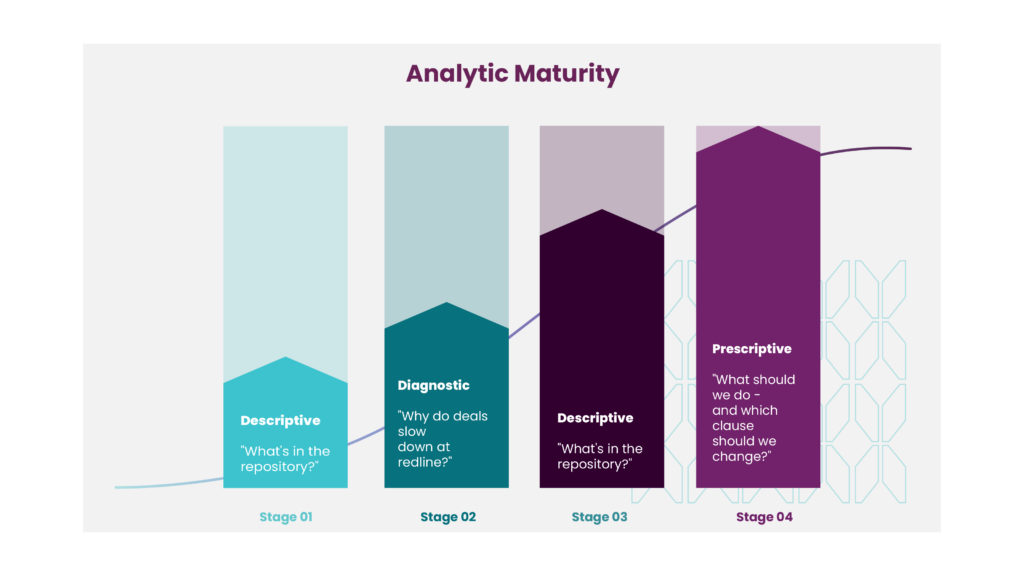
Descriptive answers what’s in the repository. How many active contracts do you have, who owns them, what types are they, when do they expire? This is where most CLM implementations stop. It’s necessary, and it’s not enough.
Diagnostic answers why. Why do certain deals slow down — is it a specific clause type, a specific reviewer, a specific counterparty pattern? Why do certain renewals lapse? Why does Q3 revenue consistently come in under forecast? Diagnostic analysis requires the contracts to be structured well enough that you can group, filter, and compare them. That’s a metadata extraction problem before it’s an analytics problem.
Predictive answers what’s likely to happen. Which renewals are at risk based on payment history, support volume, and clause-level economics? Which deals in the pipeline are likely to slip past quarter-end given the clause complexity already on the table? Which supplier contracts are most likely to trigger a price escalation event in the next two quarters? Prediction is where AI becomes load-bearing — pattern recognition across thousands of contracts isn’t something humans do well, and isn’t something traditional analytics tools were built for.
Prescriptive answers what to do about it. Recommended fallback positions for a specific clause given counterparty type and historical outcomes. Approval routing optimized for cycle time without sacrificing risk control. Redline suggestions grounded in playbook standards plus a record of what’s actually been accepted before. This is where contract decision intelligence stops being analytics and starts being a working part of the operating model.
The progression matters because skipping stages doesn’t work. A prescriptive recommendation built on top of a descriptive layer with no diagnostic understanding underneath it will produce confident-sounding suggestions that are wrong in subtle, expensive ways. Each stage earns the next one.
AI and the Human-in-the-Loop
Decision intelligence is explicitly about combining machine pattern recognition with human judgment, not replacing it. For contract decisions — where the cost of being wrong includes regulatory penalties, litigation exposure, and irrecoverable revenue — that distinction matters more than in most domains.
Black-box AI fails for contract decisions for a specific reason: legal and finance buyers won’t act on a recommendation they can’t trace. A recommendation that says “approve this clause” without showing the source language, the playbook precedent, and the confidence level might as well not exist. The audit trail isn’t a nice-to-have. It’s the thing that makes the recommendation usable in a regulated business.
Practical AI for contract decision intelligence has three traits. It’s explainable: every recommendation cites the source clause, the comparable precedents, and the model’s confidence. It’s ensemble-based: cross-referencing outputs from multiple models reduces hallucination on legal language, where a single misread word changes the meaning of an obligation. And it’s governed: the organization has defined which decisions are augmented (AI suggests, human approves) versus automated (AI acts within explicit guardrails, with full audit logging).
The governance question is the one most organizations underinvest in. Who approves AI-suggested redlines for a $5M deal? Who’s accountable when the AI flags a clause as low-risk and it isn’t? Who reviews the AI’s misses and feeds them back into the model? Decision intelligence without those answers is just analytics with a sharper interface.
How to Operationalize Contract Decision Intelligence
Moving from idea to working contract decision intelligence is a sequenced project, not a platform purchase. The teams that get this right tend to follow a similar pattern.
- Define the decisions first. Don’t pick a platform until you’ve named the three to five strategic questions the system needs to answer. “What’s our renewal exposure for the next two quarters?” is a decision. “Better contract analytics” is not. The decisions drive the metadata model, not the other way around.
- Extract structured metadata from existing contracts. AI-driven extraction turns the back-catalog into queryable data: parties, effective dates, renewal terms, payment terms, liability caps, governing law, key clause types. This is the unglamorous step that makes everything downstream possible. Skip it and your DI model is reading the first 100 contracts thoroughly and ignoring the other 19,900.
- Connect CLM to your CRM and ERP. Closed-loop decisions require closed-loop data. Salesforce knows the deal stage; the contract knows the negotiated terms; the ERP knows what was actually invoiced. A renewal forecast is materially better when those three sources agree on what the contract says, the deal is, and the revenue has been.
- Build governance for AI-assisted recommendations. Define explicitly which decisions are augmented versus automated, who owns approval thresholds, and how AI misses are surfaced and corrected. The goal is not to slow AI down — it’s to make its outputs trustworthy enough for the CFO and GC to act on them.
- Track outcomes. A decision intelligence program without outcome tracking never compounds. Did the recommended fallback position actually shorten the cycle? Did the flagged renewal actually churn? Without that feedback, the model can’t improve and the program stalls.
From Contract Data to Commercial Intelligence with Malbek
If decision intelligence is the discipline of engineering better decisions, contract intelligence is the data layer that makes those decisions defensible. Building it in-house means solving four problems at once: extracting structured terms from unstructured agreements, applying AI you can audit, connecting the result to the rest of your stack, and packaging it for executives who don’t want to learn a query language.
This is what Malbek BusinessIQ is built for. BusinessIQ is the first Commercial Intelligence Platform — a category distinct from CLM, built on Malbek’s AI-powered CLM platform and turning the entire contract repository into an Intelligence Core that the C-suite can actually query. Where traditional BI visualizes data you already structured, BusinessIQ extracts the data from your contracts in the first place — then maps the relationships, risks, and opportunities across the portfolio. LIVEGraph℠, BusinessIQ’s continuously learning knowledge graph, maps every commercial relationship, obligation, risk, and opportunity across the portfolio. Context Threading™ pulls threads of commercial meaning paragraph by paragraph, table by table, exhibit by exhibit — surfacing the patterns that matter to a CFO, CCO, CPO, or CSO and the directors and analysts who support them.
The AI underneath is Malbek AI, built on an Ensemble LLM architecture that cross-references outputs from multiple models. Where a single model might confidently misread a clause, the ensemble flags the disagreement — eliminating the kind of silent hallucination that makes black-box AI a non-starter for legal and finance use. Every recommendation traces back to its source clause and precedent. Bek, Malbek’s conversational AI agent, gives executives a natural-language interface to the whole layer — “Ask Bek: what’s our Q4 rebate liability across all our pharmaceutical contracts?” — without forcing them through a dashboard.
This is the pivot from contracts as operational records to contracts as strategic intelligence assets. The result is the maturity curve made operational. Descriptive intelligence on what’s in the repository. Diagnostic intelligence on where deals slow down and value erodes. Predictive intelligence on which renewals and clauses carry risk. Prescriptive intelligence on what to do about it — surfaced where the decision gets made, audit-ready, and connected to the systems already running the business. You’ve mastered your contracts. The next move is commanding your commerce.
Conclusion
Decision intelligence without contract intelligence is decision intelligence with a blind spot. Most of the strategic questions that land on a CFO, CCO, CPO, or General Counsel’s desk depend, somewhere in their answer, on what the contracts actually say. As long as that data sits in unstructured PDFs across two dozen repositories, even the best DI platform is modeling around the most important variable in the equation.
The organizations that close that gap don’t do it by adding another dashboard. They treat their contract repository as a strategic data asset. They extract structured intelligence from it, connect it to the rest of the stack, and build the governance that makes AI-assisted recommendations defensible to the people who have to act on them.
The work is sequenced and unglamorous, but the payoff is real: revenue forecasts that account for the clauses driving them, supplier risk models that reflect actual exposure, sales analytics that reach down into discount leakage, and a legal function that can answer portfolio-level questions in minutes instead of months. See how Malbek BusinessIQ turns the commercial intelligence already sitting in your contracts into decisions your leadership can make with confidence. Schedule a demo to explore what that looks like for your organization.