



Contract Management Integration: Master CLM Tool Integration

Ever wondered why some legal teams finish contract reviews in minutes or hours while others take days or weeks? The secret often lies not only in the contract management software itself, but in how well it connects with other business systems. When your contracts live in isolation, every approval becomes a treasure hunt across multiple platforms, every data update requires manual entry, and critical business insights remain locked away in digital silos.
Contract management integration transforms this fragmented experience into a unified ecosystem where data flows seamlessly between systems. Sales and legal teams can easily transfer customer and commercial terms directly from Salesforce, finance departments see contract obligations reflected in SAP, and procurement teams initiate and track vendor agreements through Coupa — all without leaving their preferred platforms. This interconnected approach saves time, reduces data entry, and changes how organizations use contract intelligence to drive business decisions.
The stakes are significant. Organizations managing contracts in isolation miss revenue opportunities, face compliance risks, and waste countless hours on manual data reconciliation. Those who master CLM integration, however, unlock the full potential of their contract data, turning legal agreements into strategic business assets that inform decisions across every department.
Understanding CLM Integration
Think of your contract management system as the heart of your organization’s commercial relationships. Just as the heart needs arteries and veins to deliver blood throughout the body, your CLM needs integrations to pump contract data to every corner of your business. Without these vital connections, even the most sophisticated contract management platform becomes just another isolated database.
CLM integration encompasses the technical connections, data flows, and process automations that link your contract management system with other enterprise applications. These connections enable automatic data synchronization, trigger cross-system workflows, and ensure that contract intelligence informs business operations in real-time. Whether it’s pushing signed agreements to your document repository, pulling vendor information from procurement systems, or triggering invoice creation upon contract execution, integrations eliminate the manual handoffs that slow down business velocity.
The transformation from manual processes to integrated workflows addresses several critical challenges. Data accuracy improves dramatically when information flows directly between systems rather than through error-prone manual entry. Compliance becomes manageable when contract obligations automatically trigger alerts and workflows in relevant systems. Most importantly, teams gain visibility into the complete contract lifecycle without switching between multiple applications, enabling faster decisions and better outcomes.
The Evolution from Standalone CLM to Integrated Contract Management Platform
Early CLM systems often operated as digital filing cabinets. They were better than paper documents, but still disconnected from core business processes. These standalone systems required users to manually update contract data across multiple platforms, leading to version control nightmares and missed obligations.
Today’s leading CLM platforms embrace an API (Application Programming Interface) architecture that prioritizes connectivity. This evolution reflects that contracts touch every aspect of business operations. Sales contracts inform revenue recognition, procurement agreements drive supply chain planning, and employment contracts trigger HR workflows. A CLM platform with the best integration capabilities recognizes these connections and provides the technical infrastructure to support them seamlessly.
Key Integration Considerations: Compatibility, Security, and Scalability
A CLM solution might offer hundreds of pre-built connectors, but if they don’t include your critical systems or require extensive customization, the integration journey becomes costly and complex.
Security considerations multiply with each integration point. Every connection between systems creates a potential vulnerability, making enterprise security protocols non-negotiable. Look for platforms that support OAuth 2.0 authentication, encrypted data transmission, and role-based access controls that extend across integrated systems.
Scalability ensures that as your contract volume grows and integration needs evolve, the platform can accommodate increased data flows without performance degradation or architectural overhauls.
Core Enterprise System Integrations: CRM and ERP
Your CRM holds customer relationships, your ERP manages operations, while contracts bridge these domains. When these systems operate independently, sales teams create quotes without visibility into existing contract terms, while finance processes invoices without access to negotiated payment schedules. This disconnect creates friction, delays, and missed opportunities across the revenue cycle.
Effective CLM integration with core enterprise systems creates a single source of truth for commercial relationships. Contract data enriches CRM records with negotiated terms and renewal dates, while ERP systems automatically enforce contract pricing and payment terms. This bidirectional data flow ensures that every team works with accurate, current information, eliminating the confusion and conflicts that arise from data silos.
Contract Management Software with Salesforce Integration
Many sales teams live in Salesforce, tracking opportunities from first contact through closed/won celebrations. Yet too often, the contract process forces them to switch systems, breaking their workflow and creating visibility gaps. Contract management software Salesforce integration solves this disconnect, embedding contract capabilities directly within the CRM environment.
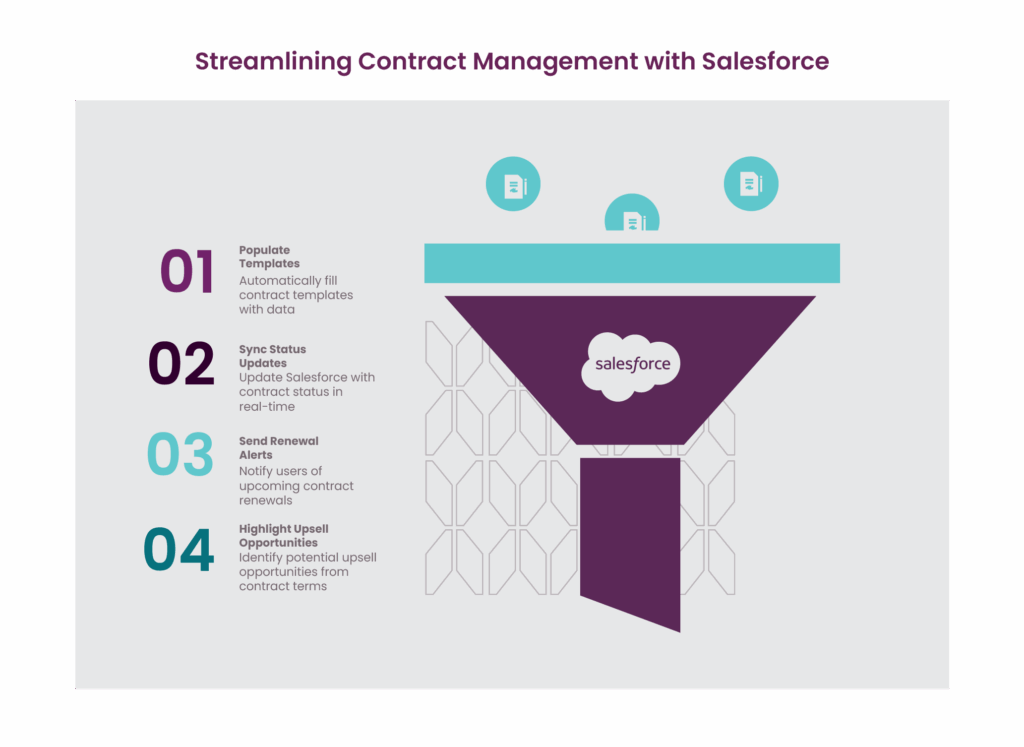
This integration transforms how sales and legal teams collaborate:
- Automatically populates contract templates with opportunity data, removing manual entry and ensuring consistency
- Syncs contract status updates back to Salesforce for real-time deal visibility
- Sends automated alerts for upcoming renewals
- Leverages contract terms to highlight upsell opportunities
- Accelerates deal velocity and strengthens commercial relationships through accurate contract intelligence
SAP CLM Integration: Bridging Contracts with Enterprise Operations
SAP runs the operational backbone of countless enterprises, managing everything from procurement to financial reporting. An SAP CLM integration ensures that contract terms seamlessly inform these critical business processes. Purchase orders automatically reflect negotiated pricing, payment terms flow directly into accounts payable, and contract milestones trigger operational workflows without manual intervention.

This deep integration extends beyond simple data synchronization:
- Updates SAP master data in real-time with contract amendments to ensure teams work with the current terms
- Creates compliance tasks in SAP workflows based on contract obligations
- Feeds SAP performance metrics into contract renewal negotiations
- Enables a closed-loop system where contracts drive operations, and operational data enhances contract management
Financial and Procurement System Integration
A significant number of contracts contain financial implications, like payment terms, pricing structures, volume discounts, or penalties. When these systems operate in isolation, organizations leave money on the table through missed discounts, incorrect invoicing, and poor spend visibility.
CLM ERP integration transforms financial operations from reactive to proactive:
- Prevents pricing errors at the source through integrated systems
- Gives procurement teams real-time visibility into contract compliance
- Automates accruals for finance based on contract milestones
- Delivers financial intelligence to support strategic decision-making
Coupa Integration: Procurement Contracts Made Simple
Procurement professionals juggle multiple vendors, complex pricing agreements, and ever-changing requirements. Coupa integration brings order to this complexity, connecting contract terms directly with procurement workflows. Approved vendor contracts automatically update Coupa catalogs with negotiated pricing, while purchase requisitions validate against contract terms before approval.
The integration extends throughout the source-to-pay cycle:
- Triggers RFP processes upon contract expiration to ensure a continuous supply
- Integrates contract compliance data into spend analytics to reveal savings and maverick spending
- Generates vendor scorecards in Coupa based on contract performance obligations
- Elevates procurement from a tactical function to a strategic value driver
Power BI Integration: Contract Analytics and Business Intelligence
Power BI integration transforms raw contract data into actionable intelligence that drives business strategy. Instead of static reports showing contract counts and values, integrated analytics reveal trends, risks, and opportunities hidden within contract portfolios.
This integration provides organization-wide visibility into contract performance and risk:
- Displays real-time metrics like cycle times and compliance rates in interactive dashboards
- Uses predictive analytics to flag contracts at risk of delays or disputes
- Offers role-specific views—sales sees revenue at risk; legal tracks clause usage
- Extends contract intelligence beyond legal to all business functions for data-driven decisions
Document Management and Collaboration Integrations
Contracts are documents, but they’re also living business assets that require careful management throughout their lifecycle. The challenge is storing contracts and ensuring the right people can access, update, and act on them at the right time.
Integrations with productivity tools such as Microsoft Word address the full spectrum of document-related needs:
- Maintains version control so teams work from the latest agreements
- Enforces access controls to safeguard sensitive information
- Enables real-time negotiation and review to reduce email and document confusion
- Keeps executed contracts accessible and actionable across their entire lifecycle
eSignature CLM Integration with DocuSign, AdobeSign, and SignNow
eSignature CLM integration represents one of the top choices for digital contract management with e-signature integration, eliminating the final bottleneck in contract execution.
Advanced implementations leverage top e-signature providers’, like DocuSign, AdobeSign, and Signnow, full capabilities within CLM workflows:
- Uses conditional routing to send agreements to the right signatories based on value or terms
- Adjusts authentication requirements by agreement type and compliance needs
- Triggers post-signature actions like document storage and obligation tracking
- Embeds signature collection into a seamless, end-to-end contract workflow
Storage Integration: Google Drive, Box, and SharePoint
Where do your contracts live? For many organizations, the answer is “everywhere”… From local drives, email attachments, shared folders, and various cloud repositories.
Google Drive, Box, and SharePoint integration consolidates this chaos, providing secure, centralized storage in the cloud. These integrations ensure that contracts are both protected and accessible.
Integration capabilities extend beyond basic file storage:
- Syncs metadata to keep contract attributes consistent everywhere
- Inherits permissions to balance security with appropriate access
- Applies automated filing rules by contract type, party, or business unit
- Enables cross-platform search to locate contracts easily from any system
- Eliminates the need to hunt through multiple tools for contract documents
Slack Integration
Instant messaging is revolutionizing how teams collaborate on contracts. Slack integration brings contract management into the communication channels teams already use, enabling real-time collaboration without context switching. Contract notifications appear alongside project discussions, keeping everyone informed and aligned.
Through Slack integration, contract management is embedded into everyday team collaboration:
- Sends smart notifications that highlight critical updates without causing overload
- Delivers approval requests with context and quick actions for mobile decision-making
- Posts automated milestone updates in team channels to boost transparency
- Makes contract management a seamless part of daily workflows, not a separate task
Security, Compliance, and Identity Management
Trust is the foundation of every contract, and in the digital realm, security enables trust. As contracts contain sensitive commercial terms, personal information, and strategic intelligence, protecting this data becomes mission-critical.
With contracts flowing between multiple systems and stakeholders, security must be embedded throughout the integration architecture. Identity management ensures only authorized users have access to sensitive agreements. Compliance tools monitor adherence to regulatory requirements. Audit trails track every interaction across integrated systems. These capabilities work together to create a security fabric that protects contract data while enabling business agility.
Okta Integration: Secure Identity and Access Management
Password spreadsheets and sticky notes have no place in enterprise contract management. Okta integration brings enterprise-grade identity management to CLM platforms, enabling single sign-on (SSO) and advanced authentication without compromising usability. Users access contract systems with their standard corporate credentials, eliminating password fatigue while enhancing security.
The integration extends beyond basic authentication:
- Automatically provisions CLM accounts with role- and department-based permissions
- Adds multi-factor authentication for sensitive contracts and high-value approvals
- Instantly deprovisions access when employees leave to protect confidential data
- Maintains precise, timely access control across the entire organization
OneTrust GRC Integration: Automated Compliance Management
OneTrust integration transforms compliance from a manual checking exercise to an automated assurance process. The platform continuously monitors contracts against regulatory requirements, flagging potential issues before they become violations.
Integration capabilities span the complete compliance lifecycle:
- Automatically evaluates contracts for data privacy risks involving personal information
- Integrates vendor risk assessments with contract terms and performance metrics
- Triggers compliance reviews on regulation changes or upcoming renewals
- Reduces risk and manual workload, allowing legal teams to focus on strategic priorities
Advanced Integration Capabilities
Standard integrations solve common problems, but every organization faces unique challenges that require specialized solutions. Advanced integration capabilities extend CLM platforms beyond pre-built connectors to address specific industry needs, regional requirements, and custom workflows. These specialized integrations often provide the greatest value, solving longstanding pain points that generic solutions can’t address.
The key to advanced integration success lies in flexibility and extensibility. Platforms that lock organizations into rigid integration patterns quickly become constraints rather than enablers. Look for CLM solutions that provide robust APIs, support custom development, and maintain active partner ecosystems. These capabilities ensure that as your business evolves, your contract management platform can adapt without requiring wholesale replacement.
DeepL Translation Integration: Global Contract Management
Business doesn’t stop at borders, and neither should contract management. DeepL integration brings AI-powered translation directly into contract workflows, enabling truly global operations. Unlike basic translation tools that produce literal but often meaningless translations, DeepL understands context and nuance, producing translations that maintain legal precision across languages.
The integration goes beyond simple document translation:
- Uses multi-language templates to ensure consistency while meeting local requirements
- Enables parallel workflows for simultaneous multi-language reviews
- Automatically detects language and routes contracts to the right reviewers
- Supports global operations without sacrificing local relevance
API and Developer Tools: Building Custom Integrations
Sometimes the integration you need doesn’t exist—yet. Robust APIs and developer tools enable organizations to build custom integrations that address unique requirements. Whether connecting to proprietary systems, creating specialized workflows, or integrating with emerging technologies, API access provides the flexibility to extend CLM platforms beyond their out-of-the-box capabilities.
Comprehensive API documentation accelerates development while reducing maintenance burden. RESTful endpoints support standard integration patterns, while webhooks enable real-time event processing. Software development kits (SDKs) in popular programming languages further simplify custom development. Authentication mechanisms ensure security while enabling appropriate access. These developer-friendly features transform CLM platforms from closed systems to extensible foundations for contract innovation.
Choosing the Right CLM Platform: Integration Best Practices
The integration capabilities of your CLM platform can make or break your digital transformation initiative. While building integrations is important, the real test comes with ongoing maintenance—adapting to evolving business needs and managing updates when integrated solutions change. Too many CLM implementations fail not at launch, but months later, when IT resources aren’t available to adjust integrations for new requirements or system updates.
Malbek’s approach to integration demonstrates why architecture matters. It’s built with AI and connectivity at its core from day one, rather than treating integrations as afterthoughts. More critically, Malbek empowers business administrators to manage integrations independently through its configurable wizard interface. When Salesforce updates its API, when new contract types require different data flows, or when business processes evolve, your contract management team can adapt integrations without submitting IT tickets or engaging expensive consultants. This self-service capability transforms integration from a technical constraint into a business enabler.
Malbek’s integration methodology stands apart through its configurable wizard approach, eliminating the custom code requirements that plague other enterprise CLM implementations. The platform’s Master Data storage capability captures supplier and counterparty details from existing ERP or supplier management systems, creating a single source of truth that ensures data accuracy across old and new contracts. This architectural decision reflects a deep understanding that contracts sit at the center of business operations, not in isolation.
Evaluating Which CLM Tool Offers the Best Integration with ERP Systems
When assessing which CLM tool offers the best integration with ERP systems, Malbek’s native integration capabilities provide a compelling answer. Unlike platforms that rely entirely on custom code for all but a few pre-built integrations, Malbek offers configurable connections that adapt to your specific ERP configuration without requiring extensive development resources. This approach proves particularly valuable for organizations running SAP, Oracle, or Microsoft Dynamics, where business processes vary significantly between implementations.
Malbek’s bi-directional integrations ensure that contract data doesn’t just flow one way—updates in either system reflect immediately across the integrated environment. Contract amendments automatically update ERP master data, while operational data from ERP systems informs contract renewals and negotiations. The platform’s API framework, built on OAuth 2.0 with comprehensive webhook support, enables real-time synchronization that keeps pace with business operations. This depth of integration transforms contracts from static documents into dynamic business assets that actively drive operational efficiency.
Conclusion
Contract management has evolved from a back-office function to a strategic business capability, and integration is the catalyst for this transformation. Organizations that master CLM integration unlock value that extends far beyond efficient contract processing. They gain real-time visibility into commercial relationships, automate complex business processes, and transform contract data into competitive intelligence.
The future promises even deeper integration possibilities. Artificial intelligence will enhance integration intelligence, automatically identifying optimization opportunities and predicting integration needs.
Success in contract management integration requires choosing platforms that prioritize connectivity, implementing thoughtfully with clear business objectives, and maintaining focus on user adoption throughout the journey. Organizations that embrace integrated contract management today position themselves to leverage tomorrow’s innovations, turning legal agreements into living business assets that drive operational excellence and competitive advantage.
Explore Malbek’s extensive integration marketplace and discover how our configurable, AI-powered platform connects seamlessly with your existing technology stack to unlock the full value of your contracts.