




The 6 Elements of a Contract: The Essential Components of Enforcement

Whether you are renewing an existing agreement, entering a lease, or sealing a sales deal, contracts are pivotal in setting the terms and conditions for all parties involved.
You and I have signed all sorts of agreements over the course of our lives. They likely range from agreements for services like home appliance repair or air conditioning repair to things like the purchase of a piece of furniture or a house.
Failure to Fulfill Services – Is your Contract Enforceable?
We also likely have experienced times when there has been a failure with one of these services. The telltale home repair that wasn’t fixed as promised or something wasn’t delivered as promised or on time.
What do you do in these situations? Most likely don’t look to the contract for help, but rather talk to the other party to resolve the issue through replacement, coming back to fix something that wasn’t repaired correctly, and the like.
Yet, when it comes to more complex agreements like the purchase of enterprise software or professional services, a contract becomes a beacon in the resolution of disputes. For example, if a software implementation fails, the contract will dictate what the options are to resolve the issue.
The tricky part of contracts, though, is that sometimes a contract may not be enforceable or legally valid under the law. This can often happen due to poor drafting of the agreement or the agreement is lacking a key element like consideration – what one party agrees to do or both parties agree to do together in exchange for something else.
Why is Contract Enforceability Essential?
Let me share a story to illustrate.
In a prior role, I had to address an incomplete contract that was missing a key contractual element. While both parties had, in theory, agreed to manufacture something in exchange for payment, the terms of the payment and the terms of when the manufactured item was to be delivered were both missing from the agreement. I had to quickly amend the agreement, replacing one that had been put in place prior to my arrival at the company, and insert these key elements.
As it turns out, the part was not delivered in a timely manner and thanks to the amended agreement, my company had the ability to get the issue resolved legally and quickly. Had this not been the case, my company would have paid for something that arrived late and incomplete without any recourse and without the ability to rely on the contract since it was not legally enforceable.
So, what makes a contract legally binding? What are the key elements that ensure its enforceability? In this article, we will explore the 6 essential elements that form the foundation of a legally binding agreement.
What Makes a Contract Enforceable?
1. The Offer: Setting the Stage for the Agreement
Every contract starts with an offer — one party seeking something from another. This offer defines the responsibilities and expectations of each party. For instance, Party A may agree to pay a certain price per month to Party B for renting office space. The offer becomes official when the receiving party acknowledges it.
2. Acceptance: Sealing the Deal
Acceptance is the second crucial element of a contract. It is often a topic of debate, but formally, acceptance occurs when the contract is signed. Any counteroffer or negotiation of additional terms is considered a rejection of the original agreement, starting the process anew.
3. Awareness: The Meeting of Minds
For a contract to hold weight, both parties must be fully aware that they are entering into a new agreement. This “meeting of minds” ensures that both sides understand and agree to be bound by the contractual obligations. Lack of awareness could render the contract void if a party signed it under duress or if there was fraud, misinterpretation, or undue influence involved.
4. Consideration: The Heart of the Contract
Consideration is what gives life to a contract. It refers to the exchange of something of value between the parties, such as property, services, or insurance. Notably, consideration doesn’t have to be in monetary form; even non-monetary exchanges can validate the contract.
Consideration often takes the form of money, e.g. someone paying someone in exchange for a service or a product or some combination of the two, but it can and often can include other items like promising to do something or not to do something like agreeing to not share confidential information or create a competing product or even something like not selling items within a certain geography.
5. Capacity: Ensuring Legitimate Agreement
Contracts can be intimidating, particularly when representing a company. Legal capacity ensures that parties comprehend the obligations, terms, and consequences of the contract before signing. If a party lacks the capacity to understand, such as being a minor or under the influence of drugs or alcohol, the contract becomes void.
6. Legality: Complying with the Law
All contracts must adhere to the laws of the jurisdiction in which they are signed. Sometimes, federal and state laws may not align, in which case the US Constitution will prevail. Ensuring the contract’s legality is essential for its enforceability.

Contracting Processes & Enforceability
Contracts wield significant influence in the business world, often driving revenue and prosperity for companies. As such, more and more companies are investing in refining their contract processes to ensure maximum potential and seamless implementation.
However, not all contracts are enforceable. Even if filled with legal jargon, a contract may not hold up in court if it lacks any of the six key elements – offer, acceptance, awareness, consideration, capacity, and legality.
Understanding The Most Common Agreements
While contract terms and structure can vary, sometimes even wildly, the most common type is an agreement for Products or Services. This is a contract where one or more parties engage with the other party to purchase goods or services. It is important to note, however, that a contract can be either written or simply verbal.
In a written agreement, the agreed-upon obligations and responsibilities of each party and their respective liabilities, if things go awry, are documented in writing and signed by both parties. Written contracts are legally binding and provide a clear framework for the business relationship.
Are Verbal Contracts Enforceable?
Oral contracts, or verbal contracts, still hold validity under specific circumstances and sometimes form when two parties need something done ad hoc or quickly and want to avoid the costs of putting together a written agreement. However, oral contracts can be far more challenging to prove in court compared to their written counterparts.
In conclusion, contracts are the cornerstone of professional relationships, and understanding their essential elements is crucial for enforceability. Whether it’s a multi-page document or a concise agreement, the six key elements— offer, acceptance, awareness, consideration, capacity, and legality — form the bedrock of any legally binding contract. By appreciating the power and significance of contracts, businesses can navigate contracting with ease and comfort, ensuring beneficial and long-lasting partnerships between parties.
Data-driven Approach in Contracting – Malbek CLM
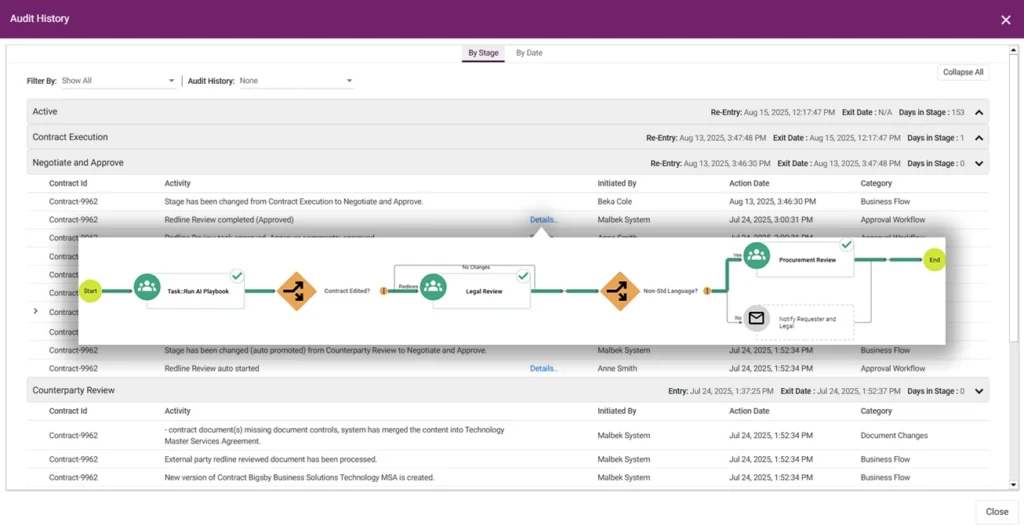
The more that a business understands how its contracts work, the more value your business can unlock by taking a data-driven approach. Data-driven contracting seeks to transform contracts from static documents into dynamic tools for value creation, using data as the foundation. By being more data-centric, organizations can increase the efficiency, effectiveness, and value derived from their contractual relationships. Bringing these essential contracting elements together in a contract lifecycle management solution, like Malbek CLM, not only stores, tracks, manages, and expedites these agreements, but also allows you to form a robust and data-driven contracting function that puts contracting front and center for the business.
Request a demo and see just how much Malbek can dramatically improve your contract experience.
FAQs – 6 Elements of Contract Enforcement
What is an Enforceable Contract?
An enforceable contract is a legally binding agreement that includes all essential elements such as clear offer, acceptance, consideration, legal purpose, and capacity of parties. It provides legal avenues for remedies if a breach occurs.
What are the 6 elements of contracts that are essential for enforceability?
- Offer
- Acceptance
- Consideration (exchange of value)
- Mutual consent
- Legal capacity of all parties
- Lawful purpose
What is Consideration in Contract Law?
Consideration in contract law refers to something of value exchanged between parties, which can be monetary, performing a certain act, or agreeing to abstain from a specific activity. It is an essential component validating the contract’s enforceability.
What is a Breach of Contract?
A breach of contract occurs when:
- A party fails to fulfill its agreed obligations.
- Delivered performance significantly deviates from what was agreed.
- Timelines or deadlines stated in the contract are unmet.
What Makes a Contract Legally Binding?
A contract becomes legally binding when it contains a clearly communicated offer and acceptance, mutual consent from all parties involved, consideration or the exchange of value, the legal capacity of all parties, and a lawful purpose. Without these essential elements, the agreement cannot be enforced legally.
Are Electronic Contracts Enforceable?
Electronic contracts are legally enforceable provided the involved parties explicitly consent electronically, use valid electronic signatures, and clearly understand and articulate the contract terms. Compliance with these criteria establishes the legal validity and enforceability of electronic agreements.
How Exactly Does Malbek Help in Creating Enforceable Contracts?
- AI‑Powered Contract Intelligence
Malbek AI — including its agent Bek — identifies missing or problematic clauses, flagging inconsistencies and legal risk in real time. This ensures that all of the six essential elements of a binding contract (offer, acceptance, consideration, intent, capacity, and legality) are present and correctly documented. - Template & Clause Library Enforcement
The platform enables modular contract atomization through standardized templates, clause libraries, playbooks, and business rules. These enforce organizational standards, ensure consistency across agreements, and help avoid non‑standard terms that may jeopardize legal validity. You can download our E-book on exactly how to achieve this here. - Automated Workflows
Automated review and approval stages ensure each contract flows through required checks—legal review, negotiation, and final execution. Built‑in audit trails, version control, and permissions ensure traceability and accountability at every stage. - Secure Execution with Clickwrap via Klix
Malbek Klix supports clickwrap agreement workflows—requiring explicit user consent (e.g., “I Agree”), maintaining robust audit logs, and ensuring that digital acceptances are captured in a legally defensible manner. This product strengthens enforceability in digital contracting environments. - Centralized Repository with Compliance Monitoring
A secure, centralized repository preserves contract integrity and obligations. The system monitors renewal timelines, deliverables, and compliance requirements, giving contract managers visibility into every active agreement and enabling timely action before enforceability risks arise. - Integrated Ecosystem for Drafting & Negotiation
With deep integration into enterprise systems — such as Salesforce, SAP, Oracle — Malbek CLM auto-populates contract drafts from existing data, accelerating drafting and reducing manual errors. Users can negotiate via embedded redlining, all while CLM-controlled approval structures enforce consistency and full traceability.
By combining these capabilities, Malbek CLM ensures that contracts not only include all legally required elements but are assembled, executed, and managed in a manner that sustains enforceability across their entire lifecycle.