



CLM with Enterprise Integrations: Streamline Enterprise Data Integration

Enterprise application integration has become the defining challenge for contract managers at large organizations. You know the frustrations: the contract lives in one system, customer data in another, procurement somewhere else entirely, and the signature platform? Its own island. Each tool works fine independently, but together they create a fragmented experience where valuable time disappears into the gaps.
An integrated contract management system changes this dynamic. When your CLM connects directly to CRM, ERP, procurement, and eSignature platforms, data flows where it needs to go without manual copying and chasing. This article examines three essential integration categories: CRM connectivity through Microsoft Dynamics 365, procurement alignment with SAP Ariba, and eSignature execution. Each demonstrates how CLM with enterprise integrations transforms contracts from an administrative headache into a competitive advantage.
Why Enterprise Organizations Face Unique Integration Demands
The gap between investigating AI and CLM solutions and actually deploying them in production remains significant. A 2025 research from MIT’s Project NANDA reveals a stark adoption gap: while 60% of organizations have evaluated enterprise AI solutions, only 20% reached the pilot stage, and a mere 5% achieved production deployment. The technology works. The challenge lies elsewhere.
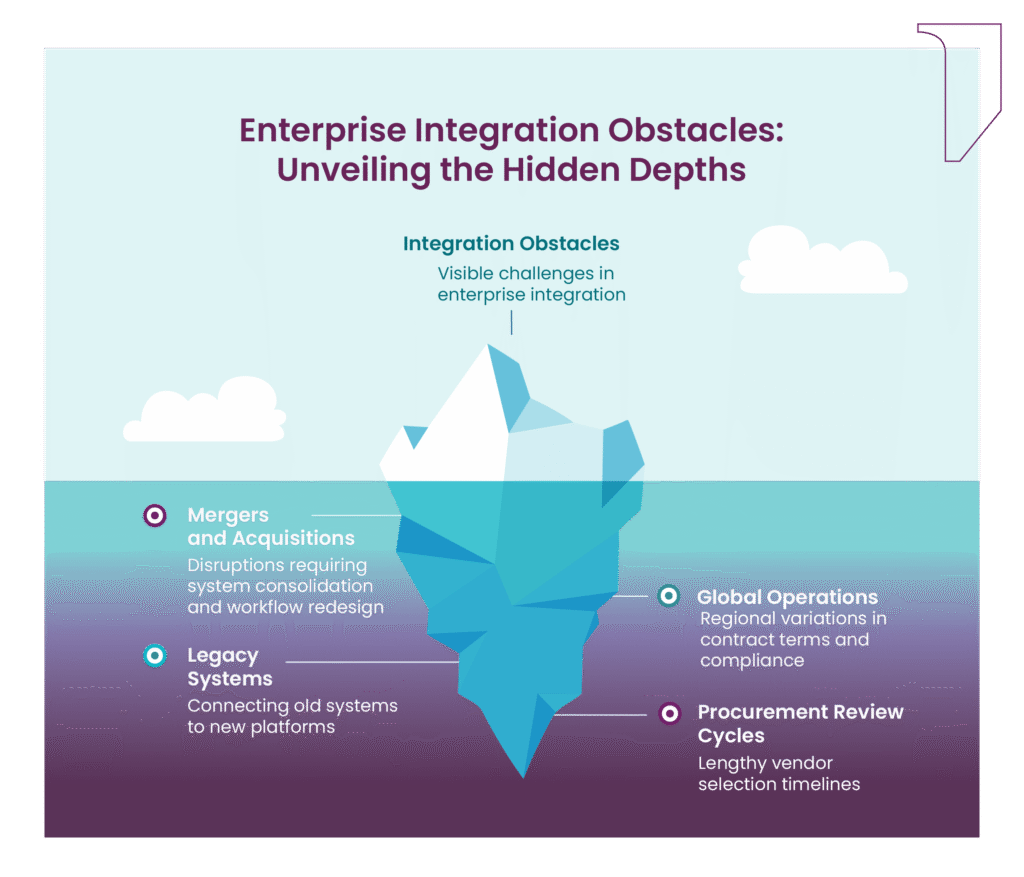
Enterprise organizations encounter integration obstacles that smaller companies rarely face:
- Mergers and acquisitions disrupt existing CLM processes, requiring system consolidation and workflow redesign across newly combined entities.
- Global operations demand regional variations in contract terms, currencies, and compliance requirements.
- Legacy systems that cannot simply be replaced must still connect to new platforms.
- Procurement review cycles routinely add six months or more to vendor selection timelines.
These realities explain why enterprise system integration requires careful planning rather than rapid deployment. The organizations achieving measurable ROI from CLM integration are those that recognize connectivity as a strategic initiative requiring cross-functional coordination, not merely a technical implementation.
The stakes justify this investment. Disconnected contract systems create revenue leakage through billing errors, compliance violations through missed obligations, and operational friction through manual data reconciliation. An enterprise data integration strategy that connects contracts to core business systems eliminates these risks while unlocking contract intelligence that informs decisions across every department.
CRM Integration: Connecting Contracts to Revenue Operations
Sales contracts drive revenue recognition, define customer obligations, and establish the commercial terms that govern ongoing relationships. When CRM and CLM systems operate independently, sales teams create quotes without visibility into existing contract terms, while legal reviews occur outside the context of deal strategy and customer history.
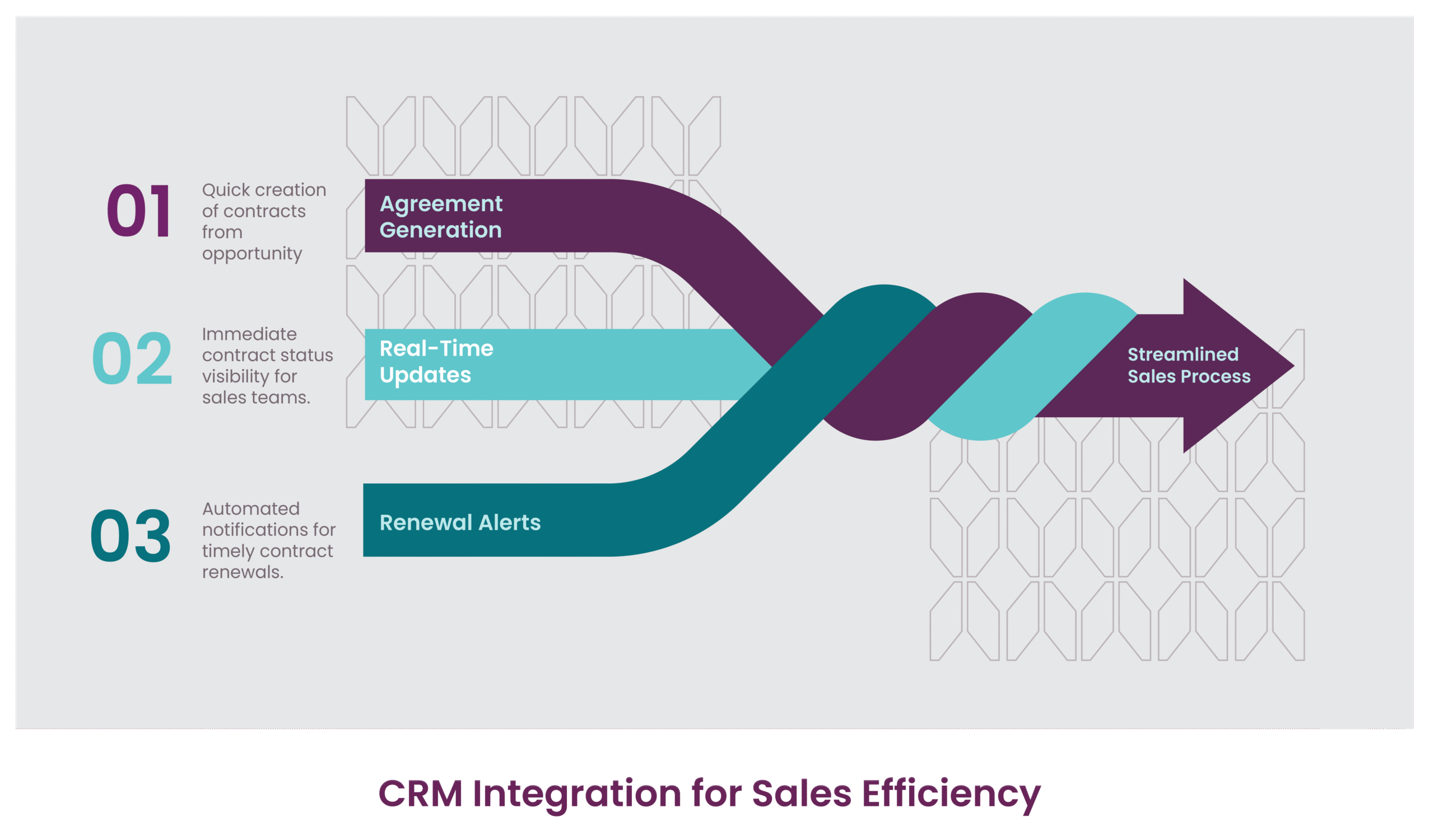
A CRM integration embeds contract capabilities directly within the sales environment:
- Representatives generate agreements from opportunity data without switching platforms.
- Contract status updates appear in real time alongside deal progress.
- Renewal alerts trigger automatically based on contract end dates.
This bidirectional data flow ensures that sales, legal, and finance teams work from consistent, current information throughout the revenue cycle.
CPQ and contract management integration extends this connectivity further. Whether through contract management software Salesforce integration or Microsoft Dynamics connectivity, Configure, Price, Quote workflows that feed directly into contract generation eliminate the manual handoffs between sales operations and legal that delay deal closure. CPQ CLM native integration platforms deliver accelerated contract velocity and reduced errors from repeated data entry.
Microsoft Dynamics 365: Enterprise Application Integration for Global Sales Teams
Microsoft Dynamics 365 serves as the CRM backbone for organizations requiring deep integration with the broader Microsoft ecosystem. For enterprises already invested in Microsoft 365, Azure, and related platforms, Dynamics offers native connectivity that third-party CRM solutions cannot match.
Enterprise application integration between CLM and Dynamics 365 delivers specific operational advantages. Contract templates automatically populate with opportunity data, customer details, and pricing information stored in Dynamics. Sales representatives view contract status, key terms, and renewal dates without leaving their primary workspace. Automated workflows route agreements for approval based on deal value, contract type, or customer tier.
Contract amendments update Dynamics records in real time, ensuring customer success teams always reference current terms. Historical contract data enriches account intelligence, revealing patterns in negotiation outcomes and term preferences that inform future deal strategy. Multi-currency support and regional entity structures accommodate the complexity of global enterprise sales operations.
Procurement Integration: What Is SAP Ariba and How It Transforms Supplier Contracts
What is SAP Ariba? It is the largest procurement network in existence, connecting over five million buyers and suppliers on a single platform. Unlike general ERP systems that manage internal operations, Ariba software focuses specifically on the source-to-pay process: supplier discovery, strategic sourcing, contract negotiation, purchase order management, and invoice processing.
Understanding what is Ariba used for clarifies why CLM integration matters. Procurement teams use SAP Ariba to identify qualified suppliers, conduct competitive bidding, negotiate terms, and manage ongoing supplier relationships.
Without CLM connectivity, the contracts governing these relationships exist separately from the procurement workflows they are meant to control. Purchase orders may not reflect negotiated pricing. Supplier compliance requirements documented in contracts may not flow into performance monitoring. The gap between what was agreed and what is executed creates risk and cost.
A CLM ERP integration bridges this divide. When contract terms automatically inform procurement processes, organizations enforce negotiated pricing at the point of purchase, track supplier performance against contractual SLAs, and maintain spend compliance without manual verification.
SAP Ariba Sourcing and the Procurement Process
The SAP Ariba procurement process encompasses the complete source-to-pay cycle. SAP Ariba sourcing tools enable procurement teams to create RFPs, evaluate supplier responses, and award contracts through structured workflows. The Ariba Network then facilitates ongoing transactions between buyers and suppliers, from purchase order creation through invoice reconciliation.
SAP Ariba procurement integration with CLM ensures continuity between sourcing decisions and contract execution. When a supplier wins a competitive bid, the resulting contract captures the negotiated terms and automatically updates the supplier catalog with approved pricing. Purchase requisitions validate against contract terms before approval, preventing maverick spending and ensuring compliance with negotiated agreements.
The integration supports the full supplier lifecycle:
- Contract expiration dates trigger new sourcing events, ensuring continuous supply without coverage gaps.
- Supplier performance data flows back into contract renewal negotiations, providing objective evidence for term adjustments.
- Compliance certifications documented in contracts inform supplier risk assessments.
SAP-Integrated CLM Tools: Connecting Contracts to SAP Ariba Solutions
SAP Ariba solutions span supplier management, procurement operations, and supply chain collaboration. SAP-integrated CLM tools connect contract management to each of these domains, creating a closed-loop system where agreements drive operations and operational data enhances contract strategy.
The specific benefits for enterprise procurement teams include:
- Spend Compliance Enforcement: Contract pricing automatically populates procurement catalogs. Purchase orders that deviate from negotiated terms are flagged for review before approval, preventing cost overruns at the source.
- Supplier Performance Tracking: Service level agreements defined in contracts establish measurable performance criteria. Supplier scorecards in Ariba reflect contractual obligations, providing objective data for relationship management.
- Risk Visibility: Compliance requirements, insurance certifications, and regulatory obligations documented in contracts flow into supplier risk profiles. Procurement teams identify exposure before it becomes a problem.
- Accelerated Sourcing Cycles: Historical contract data informs future negotiations. Category managers enter RFP processes with baseline terms and performance benchmarks from prior agreements.
Malbek’s native SAP Ariba integration enables this closed-loop connectivity without custom development. The depth of integration determines whether contracts genuinely inform procurement decisions or merely document them after the fact.
eSignature Integration: Completing the Contract Execution Loop
Electronic signature capability, like DocuSign CLM or Adobe Sign integrations, represents the final step in contract execution. Without native eSignature integration, completed negotiations stall at the signature stage, requiring manual exports, separate signing platforms, and re-uploads to the CLM repository. Whether through DocuSign CLM integrations or alternative providers, the goal remains consistent: seamless execution that maintains data integrity across systems.
What to Look for in Enterprise eSignature Integration
When evaluating eSignature providers for CLM integration, enterprise organizations should prioritize several key capabilities.
Compliance certifications matter. Enterprise legal teams require SOC 2 Type II, ISO 27001, HIPAA compliance through BAA, GDPR adherence, and eIDAS support for European Union requirements. Court-admissible audit trails must document the complete signing process for evidentiary purposes.
Native CLM integration capabilities should support the full execution workflow. Contracts route automatically to signatories based on document type or value thresholds. Authentication requirements adjust according to agreement sensitivity and compliance needs. Post-signature actions trigger automatically: executed documents file to designated repositories, obligation tracking initiates, and downstream workflows activate.
Pricing models vary significantly across providers. Organizations processing high volumes of routine agreements—NDAs, SOWs, employment contracts—should evaluate per-seat versus unlimited user licensing to understand true cost at scale. The right eSignature partner delivers enterprise-grade security without enterprise-grade complexity.
Overcoming Enterprise-Scale Integration Obstacles
Common challenges in contract system integration differ significantly between small organizations and large enterprises. Technical connectivity is rarely the primary obstacle. The more significant barriers involve organizational complexity, change management, and operational continuity.
- M&A System Consolidation: Acquired companies bring their own CLM and ERP systems. Integration requires not merely a technical connection but process harmonization, data migration, and user transition. Organizations that have recently completed acquisitions report significant disruption to existing CLM processes, often requiring a complete workflow redesign.
- Change Management at Scale: Deploying new integrated workflows to thousands of users across multiple departments demands structured training, clear communication, and executive sponsorship. The gap between CLM investigation and production deployment often reflects change management challenges rather than technology limitations.
- Multi-Region Compliance: Global enterprises must satisfy FERPA, HIPAA, GDPR, and regional data residency requirements simultaneously. Integration architectures must accommodate these constraints without creating operational fragmentation.
- Procurement Timeline Realities: Enterprise vendor selection routinely extends six months or longer. Organizations should factor this timeline into integration planning rather than assuming rapid deployment.
- Legacy System Dependencies: Critical business systems that cannot be replaced must still connect to new CLM platforms. Integration strategies should prioritize compatibility with existing infrastructure, not require wholesale replacement.
Building Your Enterprise Data Integration Roadmap
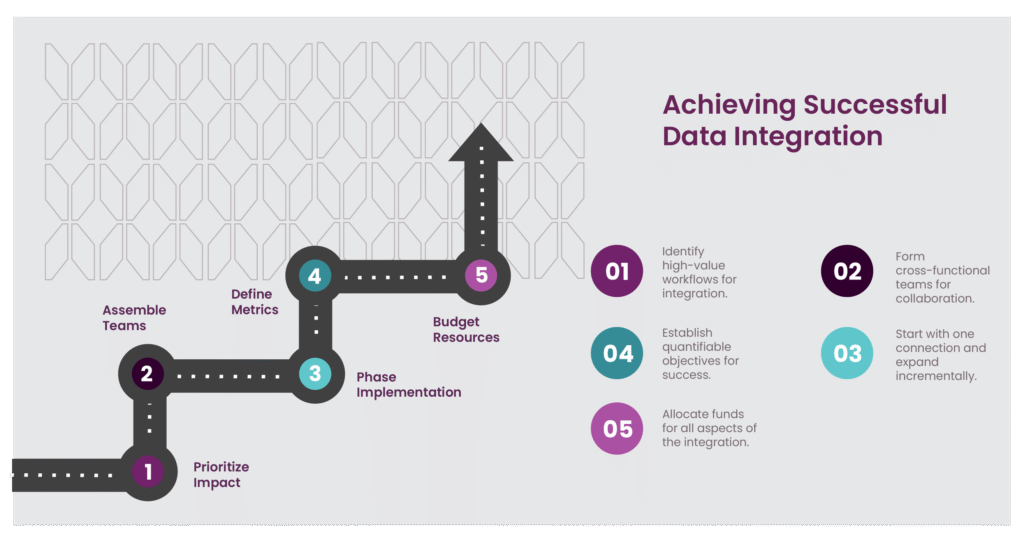
Organizations that achieve measurable ROI from CLM integration share common planning practices.
- Prioritize Based on Business Impact: Not all integrations deliver equal value. Identify the specific workflows where disconnected systems create the greatest friction, cost, or risk. High-volume, repetitive processes often yield the fastest returns.
- Assemble Cross-Functional Teams: Integration affects legal, sales, finance, procurement, and IT. Representatives from each function should participate in requirements definition and testing. Solutions designed without end-user input frequently fail adoption.
- Phase Implementation: Attempting comprehensive integration simultaneously invites failure. Start with one high-value connection, demonstrate success, build organizational confidence, and expand incrementally.
- Define Success Metrics: Establish quantifiable objectives before implementation. Cycle time reduction, error rate improvement, and compliance adherence provide measurable evidence of integration value.
- Budget for the Full Initiative: Technology licensing represents only a portion of the total cost. Training, change management, data migration, and ongoing maintenance require dedicated resources.
When Pre-Built Connectors Aren’t Enough: Enterprise API Integration
Standard integrations address common requirements, but every enterprise faces unique challenges. Proprietary systems, industry-specific workflows, and regional platform variations often exceed what pre-built connectors support.
Enterprise API integration provides the flexibility to address these scenarios. Malbek’s integration methodology eliminates custom code requirements through a configurable wizard approach, while its API architecture enables custom development for unique requirements. RESTful APIs support standard integration patterns, while webhooks enable real-time event processing as contracts progress through lifecycle stages.
The decision to build custom integrations rather than rely on standard connectors should follow careful evaluation. Custom development requires ongoing maintenance as underlying systems evolve. However, for organizations with genuinely unique requirements, API access often provides the only path to full integration.
When assessing CLM platforms, evaluate API documentation quality, authentication mechanisms, rate limits, and developer support resources. Malbek, built with AI and connectivity from day one, provides OAuth 2.0 authentication and comprehensive webhook support. Platforms that treat API access as an afterthought create friction; those built with connectivity as a core principle provide the foundation for flexibility as needs evolve.
Conclusion
CLM with enterprise integration transforms contract management from an administrative function into a strategic capability. When contracts connect to CRM, procurement, and eSignature systems, organizations eliminate manual data entry, enforce negotiated terms automatically, and unlock contract intelligence that informs decisions across departments.
The path forward requires a realistic assessment of organizational readiness, careful platform selection, and phased implementation that builds success incrementally. Enterprise organizations that approach integration as a strategic initiative, rather than a technology project, position themselves to extract maximum value from their contract data.
Malbek, recognized as a Leader in the 2025 Gartner Magic Quadrant for Contract Lifecycle Management, offers native integrations with Microsoft Dynamics, SAP Ariba, and leading eSignature providers. See how these connections work in your environment — request a personalized demo.