




BAA Agreement: What Does BAA Stand for? What Does BAA Compliant Entail?

If your organization handles Protected Health Information through third party vendors, you already know that getting a Business Associate Agreement or BAA agreement in place is supposed to be straightforward. In practice, it rarely is. As healthcare organizations expand their vendor ecosystems and adopt cloud infrastructure, AI tools, and SaaS platforms, the complexity of maintaining HIPAA BAA compliance has grown well beyond what a single template and a signature can address.
Recent benchmarking data reveals that third-party vendors cause 72% of healthcare data breaches.1 This statistic highlights why every Business Associate Agreement serves as a critical frontline defense rather than a simple administrative formality.
While we will cover what does BAA stand for and the core BAA requirements every agreement must satisfy, the real focus is on the operational challenges that experienced contract managers face daily: managing vendor due diligence, handling subcontractor chains, evaluating conditional compliance clauses from cloud providers, and building a contract management infrastructure that keeps pace with regulatory demands.
Whether you are tightening your existing compliance program or evaluating how Contract Lifecycle Management (CLM) technology could reduce risk across your agreement portfolio, this guide offers practical insights you can put to work immediately.
BAA Agreement Fundamentals: What Does BAA Stand For and Why Does It Matter?
So what does BAA stand for, exactly? BAA stands for Business Associate Agreement, a legally binding contract required under the Health Insurance Portability and Accountability Act (HIPAA). The BAA meaning in business centers on one critical objective: protecting Protected Health Information (PHI) whenever it is shared between a covered entity and a third party.
The business associate meaning under HIPAA is specific. A business associate is any person or organization that performs services for a covered entity when those services involve access to PHI. Common examples include IT service providers, billing companies, cloud storage vendors, accounting firms, legal counsel, and medical transcription services. Covered entities, on the other hand, include health plans, healthcare clearinghouses, and providers who transmit health information electronically. These entities are legally obligated to establish a BAA contract with every business associate who may access PHI.
The agreement itself defines how PHI can be used, what safeguards must be in place, and what happens if something goes wrong. Violations can result in substantial civil monetary penalties, corrective action plans, regulatory scrutiny, and reputational damage.
What Is the Purpose of a BAA? Beyond the Compliance Checkbox
You might assume the only purpose of a BAA is to satisfy a HIPAA requirement. That assumption, while understandable, misses the broader picture.
So what is the purpose of a BAA in practical terms? Before the passage of the HITECH Act, covered entities often shared PHI with vendors on the strength of verbal assurances. If a data breach occurred due to a business associate’s negligence, the covered entity could point to those verbal promises and avoid accountability. The BAA was designed to close this enforcement loophole entirely.
A BAA agreement establishes an enforceable chain of custody for PHI. It creates a documented framework that makes vendor accountability possible, ensures that patients’ privacy rights are protected across every link in the vendor chain, and gives regulators a clear basis for enforcement. Under §164.504(e), covered entities must ensure that business associates do not engage in patterns of activity that may violate HIPAA, and must take corrective steps or terminate the agreement if such patterns emerge.
Treating BAAs as paperwork exercises rather than risk management tools is a mindset that has cost organizations dearly. The Office for Civil Rights has issued penalties in cases where covered entities failed to maintain compliant agreements, even when the original data breach was attributable to the business associate’s negligence. The OCR completed 22 HIPAA enforcement actions in 2024 alone and collected nearly 10 million dollars in penalties.2
What Must a Business Associate Agreement Include? BAA Requirements Explained
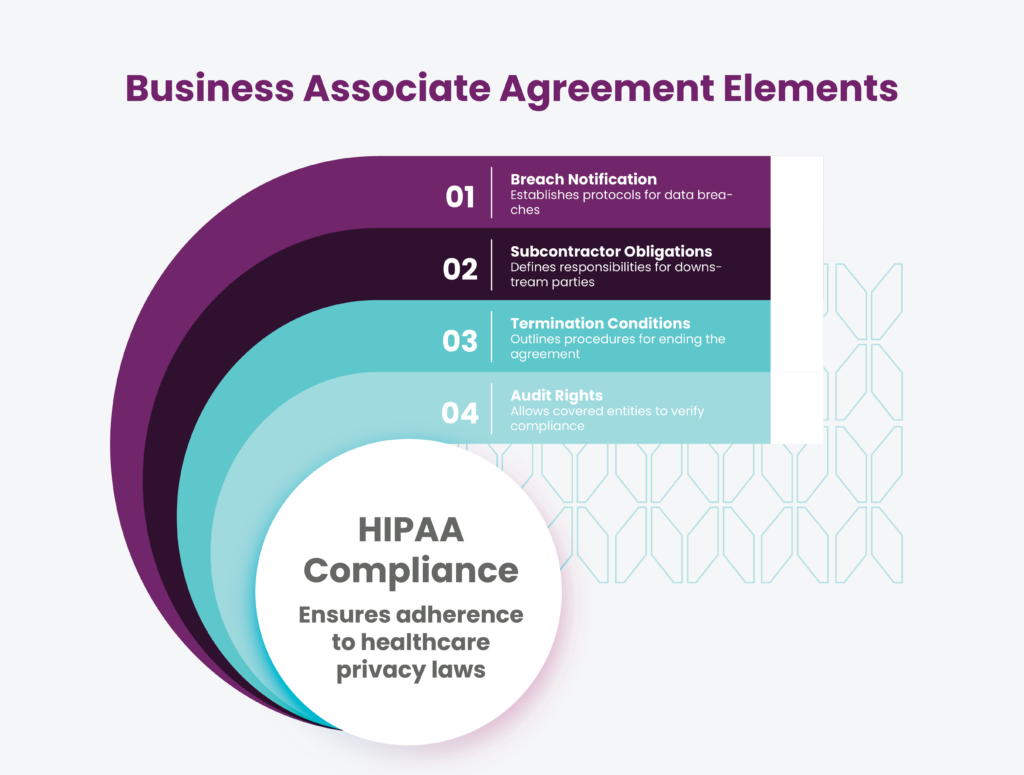
You would think that after decades of HIPAA enforcement, the core elements of a valid BAA would be second nature. Yet incomplete agreements remain one of the most frequently cited violations in OCR investigations. A business associate contract must specify the following core elements to satisfy federal regulations and protect both parties.
| BAA Requirement | Why it Matters |
| Permitted uses and disclosures of PHI | Defines exactly how PHI may be used and shared |
| Administrative, physical, and technical safeguards | Protects the confidentiality, integrity, and availability of PHI |
| Breach notification procedures | Ensures timely reporting and response to security incidents |
| Subcontractor obligations | Extends HIPAA requirements throughout the vendor ecosystem |
| Termination and PHI disposition requirements | Governs the return or destruction of PHI when the relationship ends |
| Audit and compliance rights | Enables verification of ongoing HIPAA compliance |
The Terms of a BAA Will Specify Permitted Uses, Safeguards, and Breach Protocols
The terms of a BAA will specify exactly how the business associate may and may not use PHI. This includes defining permissible uses (such as claims processing, data analysis, or quality assurance) and explicitly prohibiting any use or disclosure beyond what the agreement permits or the law requires.
The agreement must also require the business associate to implement appropriate safeguards. These include administrative measures such as:
- workforce training
- internal policies
- physical protections for facilities and equipment
- technical controls like encryption and access management
Together, these safeguards protect the confidentiality, integrity, and availability of PHI.
The BAA must require the business associate to report any unauthorized use or disclosure of PHI, including breaches of unsecured information. Clear timelines and procedures for notification should be established so the covered entity can respond quickly and meet its own reporting obligations to the Department of Health and Human Services.
Subcontractor Chains, Termination, and Audit Rights
The downstream subcontractor obligation is one of the most overlooked elements of BAA compliance. If a business associate subcontracts any function that involves PHI, a separate BAA must be in place between the business associate and the subcontractor. This requirement creates the accountability chain that makes compliance enforceable across complex, multi vendor relationships.
The agreement should also address termination conditions. Either party should have the right to terminate if the other violates any material term. At termination, the business associate must return or destroy all PHI received from or on behalf of the covered entity.
Audit rights round out the essential provisions. The covered entity should reserve the right to audit the business associate’s compliance with HIPAA, including reviewing risk assessments, policies, and procedures. This audit capability is what separates genuine compliance from agreements that exist only on paper.
What Is BAA Compliant in Practice? Operational Challenges Most Articles Ignore
Here is where things get interesting! Knowing what is BAA compliant on paper is one thing, but achieving it across a sprawling vendor ecosystem presents a very different set of challenges.
One of the most persistent operational issues involves managing “in scope” versus “out of scope” services with cloud providers. Consider a covered entity that signs a BAA with Google for its Workspace services. If the organization fails to prevent employees from sharing PHI through personal Gmail accounts, the entity is in violation of HIPAA despite having a signed agreement in place. The BAA only covers the services explicitly identified within it, and ensuring that workforce behavior stays within those boundaries requires ongoing governance rather than a one time configuration.
The “persistent access” question adds another layer of difficulty: Even when a vendor technically has no view access to PHI, the data may reside on their servers indefinitely. Cloud service providers that store encrypted PHI are considered business associates under HIPAA, even if the covered entity holds the decryption key. This means organizations need BAA agreements with vendors they might never have thought of as having access to patient data.
HIPAA preempts state laws unless the state provides greater privacy protections. States like Texas have stringent medical record privacy laws that apply to any organization processing PHI of a Texas resident, regardless of where that organization is located. A BAA that satisfies federal HIPAA requirements may still fall short of state level obligations, creating an unexpected compliance gap.
Perhaps the most damaging operational failure is the due diligence gap. Research funded by the California Healthcare Foundation found that many covered entities restricted their vendor vetting to high risk IT vendors and never audited whether business associates were actually HIPAA compliant. A signed BAA contract is a necessary starting point, but assuming it equals compliance is a mistake that regulators have penalized repeatedly.
BAA Compliance in the Age of AI and Cloud Vendors
If you have adopted AI tools or cloud platforms in the last few years, your BAA compliance obligations have almost certainly expanded in ways that traditional agreement management processes were never designed to handle.
Cloud service providers like Microsoft Azure, AWS, and Google Cloud Platform offer standardized BAA forms that apply uniformly across their entire customer base. These agreements often include conditional compliance clauses that deserve close attention. AWS, for example, stipulates that its compliance obligations depend on the customer correctly configuring the services covered under the agreement, enabling audit logging, and encrypting all PHI placed into the cloud. The compliance burden effectively shifts back to the covered entity, making it essential to read these agreements carefully rather than treating them as automatic protections.
AI tools present an emerging challenge of their own. When a healthcare organization adopts an AI platform that processes PHI, questions arise about data handling, model training, and whether the vendor’s infrastructure qualifies for business associate status under HIPAA. Organizations need to evaluate whether their data is being used exclusively for their own purposes or contributing to broader model training, and whether the vendor’s security posture meets the standards that HIPAA demands.
The conditional and evolving nature of these vendor relationships means that organizations must treat their HIPAA BAA agreements as living documents. Annual reviews, at minimum, should confirm that service configurations remain compliant, that subcontractor relationships are still covered, and that platform changes have not introduced gaps in protection.
HIPAA Business Associate Agreement Template Pitfalls: What to Watch For in Any BAA Form
A quick internet search will turn up dozens of HIPAA Business Associate Agreement template options, but grabbing one off the shelf without careful review is a risk in itself.
Generic BAA form templates often fail to account for specific vendor relationships, state level requirements, or the unique risks associated with different types of PHI access. A template designed for a billing company relationship will look very different from one covering a cloud infrastructure provider, and treating them interchangeably introduces compliance exposure.
Large software vendors typically offer their own BAA forms, but these are written to protect the vendor’s interests first. Microsoft’s BAA, for example, includes a clause excusing it from responding to patient access and amendment requests because PHI is not stored in designated record sets. These carve outs are easy to miss if you are reviewing the document at surface level rather than examining each provision against your organization’s actual obligations.
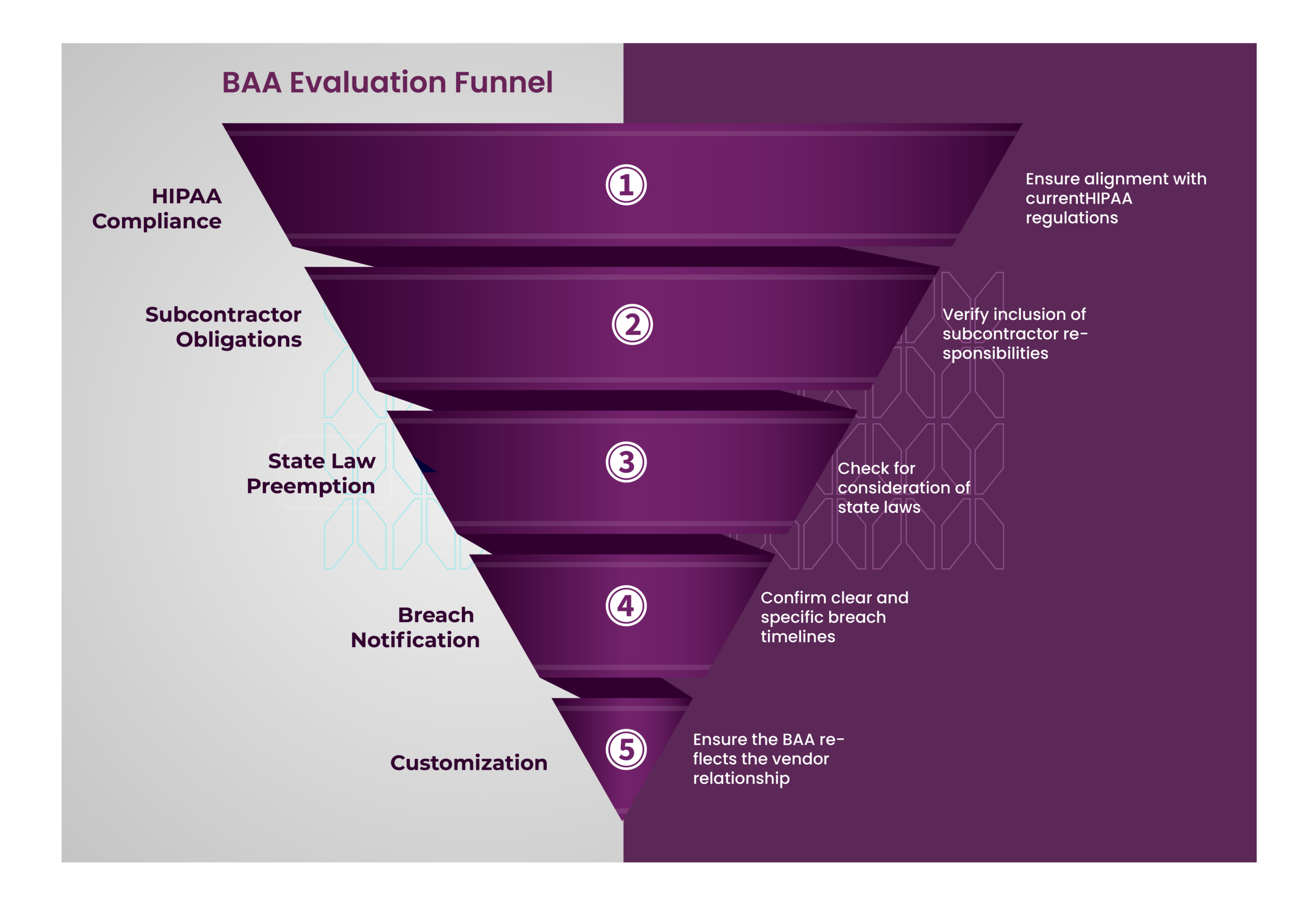
When evaluating any BAA form or HIPAA Business Associate Agreement template, run through these critical checkpoints:
- Does it reflect current HIPAA regulations, including post HITECH Act requirements?
- Does it address subcontractor obligations?
- Does it account for any state laws that may preempt HIPAA in your jurisdiction?
- Does it include meaningful breach notification timelines rather than vague language?
- Has it been customized to reflect the specific nature of the vendor relationship it governs?
Template drift is another concern worth monitoring. Organizations that created their BAA templates years ago and have never revisited them may find that their agreements no longer reflect current regulatory expectations, service configurations, or vendor relationships. A regular review cadence is essential to maintaining genuine BAA compliant status.
How CLM Software Transforms BAA Agreement Management at Scale
If the challenges described throughout this article sound familiar, you are likely managing BAA agreements through some combination of shared drives, email chains, and spreadsheet trackers. That approach may work with a handful of vendors, but it breaks down quickly as organizations scale their third party relationships into the dozens or hundreds. If you want to explore how modern platforms solve these specific industry challenges, read our comprehensive guide on healthcare contract management.
This is where Contract Lifecycle Management (CLM) platforms prove their value. A purpose built CLM solution centralizes every stage of the BAA lifecycle, from drafting and negotiation through execution, compliance monitoring, and renewal.
Malbek offers several capabilities that directly address the operational pain points of BAA management. Its AI powered template system allows legal teams to build standardized BAA templates with built in compliance guardrails, ensuring that every agreement includes the required HIPAA provisions without relying on manual checklists or outdated boilerplate.
The Malbek Playbook feature takes this further with automated review against reference standards, flagging potential compliance gaps before agreements reach the signature stage. For BAA management specifically, this means playbook rules can enforce the inclusion of required subcontractor clauses, breach notification timelines, and termination provisions across every agreement, regardless of which team member drafted it.
The Malbek platform enables teams to automatically classify and track PHI related clauses across their entire agreement portfolio with BusinessIQ. When a regulation changes or a vendor relationship evolves, contract managers can quickly identify every affected BAA and prioritize updates accordingly. Clause assessment capabilities with Bek evaluate terms for balance and favorability, giving teams immediate visibility into whether a vendor’s proposed BAA language meets organizational standards or requires revision before execution.
Malbek’s centralized repository and search capabilities also support the due diligence process that regulators increasingly expect. Rather than digging through departmental file systems to determine whether a specific vendor has a current BAA in place, teams can access a single source of truth that tracks agreement status, expiration dates, and compliance obligations across the entire vendor ecosystem. The platform’s integration methodology connects with existing ERP and supplier management systems, ensuring that contract data flows seamlessly between upstream and downstream processes without requiring custom code.
For organizations managing complex business associate relationships at scale, this level of centralized visibility and automated enforcement is what separates reactive compliance from proactive risk management.
Frequently Asked Questions
Conclusion
If there is one takeaway from this entire discussion, it is this: BAA agreements deserve more strategic attention than they typically receive. As vendor ecosystems grow more complex and regulatory expectations continue to evolve, treating these agreements as static documents is a recipe for compliance gaps that can carry significant financial and reputational consequences.
Organizations that invest in structured review processes, thorough vendor due diligence, and CLM technology capable of managing BAA complexity at scale will be better positioned to protect PHI, reduce risk, and maintain the trust of every stakeholder in the chain. A signed BAA is not the finish line. It is the starting point. As healthcare organizations expand their use of cloud services, AI platforms, and third-party vendors, effective BAA management becomes an ongoing operational discipline rather than a one-time legal exercise. The organizations that succeed are the ones that treat BAAs as living risk-management tools—not static documents buried in a shared drive.
Stop leaving your HIPAA compliance to chance and let Malbek secure your entire vendor ecosystem automatically. Read our guide to preparing for a contract management software demo and book your personalized walkthrough to see these BAA safeguards in action.
Sources:
1: https://censinet.com/perspectives/healthcare-benchmarking-study-breaches-third-party-vendors
2: https://www.kriegdevault.com/insights/hipaa-wrapped-ocrs-2024-hipaa-highlights