



Contracts Are the New Center of Gravity in the Enterprise Buy-Side Stack

Something fundamental has shifted in how enterprises think about procurement, suppliers, and the technology that connects them. If you last looked at the source-to-pay landscape a few years ago, the map you remember no longer matches the territory. The categories have expanded, the buying committee has fragmented, and the center of gravity has moved. It now sits squarely on the contract.
That claim deserves a defense, so let me walk through what we are seeing across the market, why the old playbook is breaking, and what it means for how you should think about your contract strategy going forward.
Source-to-pay is no longer a straight line
For years, the buy-side world was described as a linear pipeline. You analyzed spend, sourced a supplier, signed a contract, bought goods and services, and paid invoices. Done. Rinse and repeat next quarter.
Today, that pipeline has become a continuous cycle, and it has grown new components. Procurement intake now sits at the front door, capturing and channeling requests from across the business. Procurement orchestration sits at the core, coordinating handoffs between systems and teams. Supplier risk and performance management has climbed from an afterthought to one of the top priorities in procurement, driven by tariff volatility, regulatory pressure, and a market that seems to produce a new disruption every quarter.

Here is the part that matters most: every stage of that cycle touches the contract. Spend analysis is only as good as the terms it can see. Sourcing decisions get memorialized in contracts. Supplier risk lives inside indemnification clauses, liability caps, and obligations that someone agreed to years ago. Invoices get disputed or approved based on what the contract actually says. The contract is not one stop on the journey. It is the thread that runs through the entire loop.
Supplier risk is really a contract-data problem
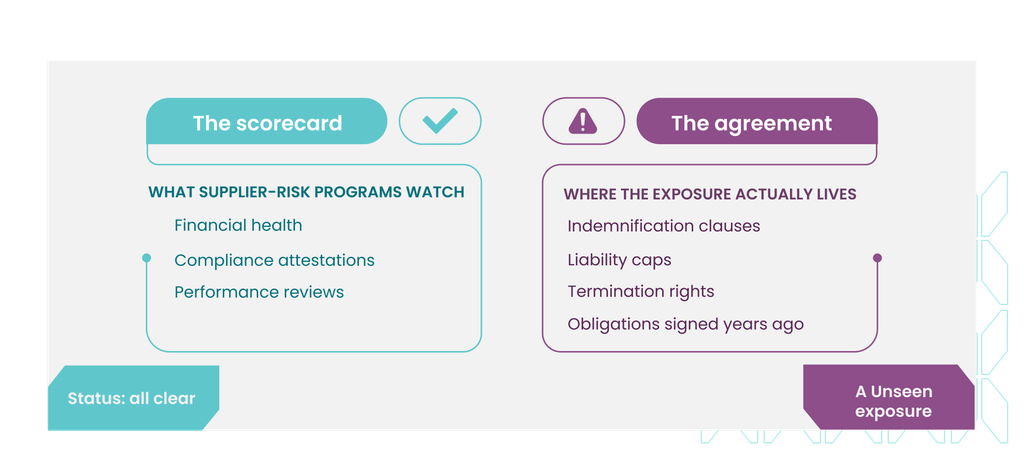
Supplier risk management gets treated as a scorecard exercise: financial health checks, compliance attestations, performance reviews. But the risk that bites lives in the agreement. Indemnification clauses, liability caps, termination rights, and obligations someone signed years ago decide what you are exposed to when a supplier stumbles, and none of it shows up on a scorecard.
Contracts sit at the intersection of three business processes
Zoom out and the picture gets even more interesting. The contract does not just anchor the buy side. It sits at the intersection of three distinct enterprise processes.
The first is source-to-pay: spend analytics, sourcing, supplier management, procurement, and accounts payable. The second is lead-to-cash: lead management, quoting and proposals, revenue management, order management, and receivables. The third is legal operations: matter management, contract work itself, and e-billing.
Those three processes converge at exactly the same point — the contract. Buy-side, sell-side, and legal all converge on the same artifact, and each function reads that artifact through a different lens. Procurement wants supplier obligations and renewal dates. Sales and finance want revenue commitments and payment terms. Legal wants risk allocation and compliance posture.
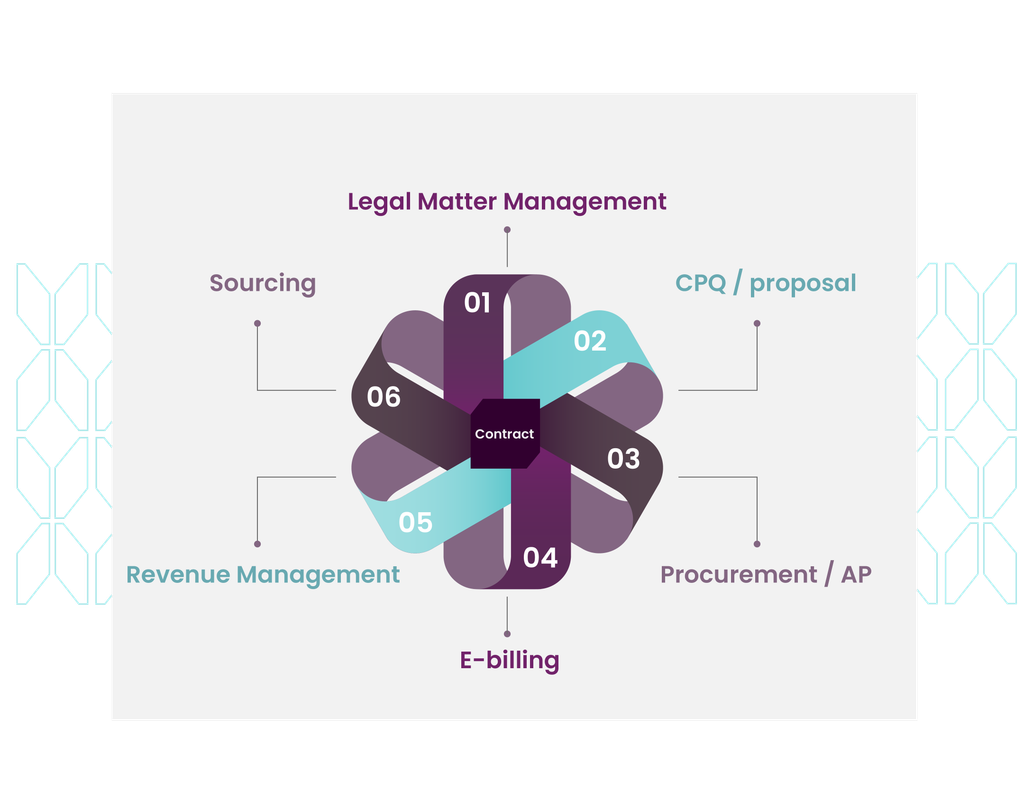
Most organizations still manage that single point of convergence in three disconnected ways, or worse, in shared drives and inboxes. When the most connected asset in your enterprise is also the least visible one, value leaks out of every process it touches. World Commerce & Contracting puts a number on it: organizations lose an average of 9% of contract value to poor contracting and weak post-signature management. On a large enterprise’s contract portfolio, that is not a rounding error — it is a line item.
The buying committee is not who it used to be
There is a second structural shift happening alongside the process shift, and it changes how technology decisions get made.
The Chief Procurement Officer used to be the undisputed decision maker for anything in this space. That era is over. Today, the CPO shares the table with the general counsel, the CIO, the CFO, heads of supply chain, and increasingly the business practitioners who live in these systems every day. Each of those stakeholders has veto power, distinct success criteria, and a different definition of value.
For buyers, this means internal alignment is now the hardest part of any contract technology initiative. For vendors, it means a single-persona pitch no longer wins. Any platform decision in this category has to prove value to legal, procurement, finance, and IT simultaneously, and it has to do so without demanding that any of them abandon the systems they already trust.
That last point brings us to the most important pattern of all.
The winning architecture: a source of truth plus a specialist
Watch how mature enterprises are actually assembling their stacks right now and a clear pattern emerges. This is the best of breed vs. best of suite question, remapped onto the buy-side stack. They are not buying one mega-suite to do everything, and they are not stitching together a dozen point tools either. They are doing something in between.
They standardize on one or two platforms as their source of truth for procurement or finance operations. Then they complement that foundation with specialists in the areas where depth actually matters. Supplier risk gets a specialist. Spend analytics gets a specialist. And more than almost any other domain, contract lifecycle management gets a specialist.
Why? Because the contract modules inside the big suites were built as checkboxes, not as products. Ask anyone who has tried to run sophisticated contracting inside a monolithic procurement or ERP platform, and you will hear the same stories: multi-year implementations, custom code everywhere, and adoption that never materializes. The suite remains a perfectly good system of record for transactions. It was simply never designed to be a system of intelligence for agreements.
The practical takeaway for buyers is that this is not an either-or decision. The right question is not “suite or specialist” but “which specialist complements my suite.” That reframing changes the evaluation criteria. Out-of-the-box integration with your existing procurement and ERP backbone stops being a nice-to-have and becomes the price of admission. Configurability by business users, without an army of consultants or a permanent IT dependency, becomes the difference between a platform that spreads across the enterprise and shelfware with a login page.
Beware the AI point solution trap
No conversation about this market is complete without addressing the elephant in every demo room: AI.
A wave of AI-first point tools has flooded the legal and contracting space over the past two years, and the market confusion is real. These tools are genuinely impressive at what they do. The problem is, what they do is narrow. Automated redlining is rapidly becoming a commodity. Nearly everyone can mark up a draft now. If that capability is the headline of a pitch, you are looking at a feature, not a platform.
The hard problems, and the ones where the money actually lives, come post-signature. Obligation management. Indemnification and liability exposure across thousands of live agreements. Renewal and expiration risk. The question every executive team is asking right now in a turbulent economy: what exactly are we on the hook for, and where?
There is a cautionary tale playing out in adjacent categories. Point solutions that launch with a single clever capability discover that buyers will not adopt them in isolation, because a disconnected tool adds clutter to a stack that everyone is trying to simplify. So the point solution pivots, raises money, and tries to rebuild itself as a full platform, years behind vendors who started with the whole problem in view. Buyers who bet on the point solution get to fund that education.
The lesson is not that AI does not matter. It matters enormously. The lesson is that AI creates durable value when it operates across your entire contract repository and connects to the processes around it, not when it performs one trick on one document at a time.
Post-signature intelligence is where the value compounds
This is the conviction Malbek was built on, and the market has now caught up to it. Signature is not the finish line. It is the starting line.
Everything pre-signature is about efficiency, and efficiency matters. But everything post-signature is about intelligence: understanding commitments, surfacing risk, catching revenue leakage, and connecting contract data to the market signals that change what those commitments are worth. When tariffs shift, when regulations land, when a supplier stumbles, the enterprises that can immediately see which agreements are exposed hold an advantage that compounds every single quarter.
That requires treating the contract repository as a living source of contract intelligence rather than a filing cabinet. It requires AI that reasons across the whole portfolio. And it requires a platform that legal, procurement, finance, and the business can all actually use.
This is the problem Malbek BusinessIQ was designed to solve. It turns your existing contract repository into an Intelligence Core℠, a living, queryable layer that reasons across every agreement you hold. Context Threading℠ reads obligations, indemnities, and liability caps the way they actually appear in contracts, scattered across paragraphs, tables, and exhibits, so when a regulation lands or a supplier stumbles, the question of what you are on the hook for has an answer you can pull up in minutes instead of reconstructing it by hand. That is commercial intelligence legal, procurement, and finance can all act on from one source of truth.
Contracts sit at the center of your enterprise, whether you manage them that way or not. The only question is whether you can see what they are telling you.